
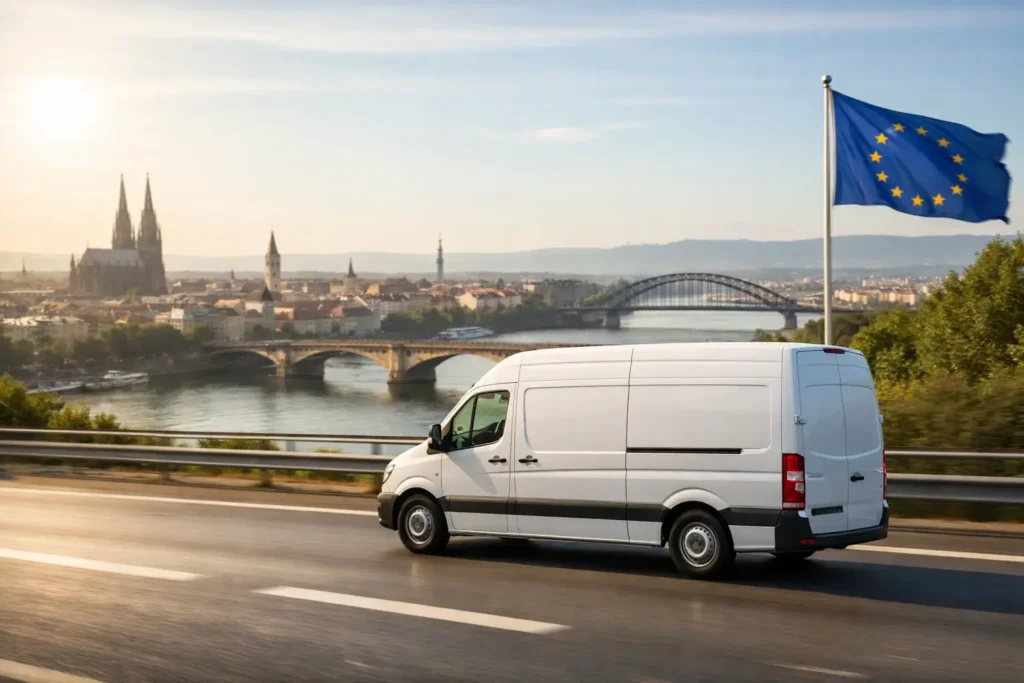
A production line is waiting on one pallet. A customer in Germany expects delivery before close of business. A standard groupage booking may be cheaper on paper, but if the freight misses a transfer hub, the real cost lands elsewhere.
That is where dedicated van delivery Europe services earn their place. For many cross-border shipments, especially urgent, sensitive or high-value goods, assigning one vehicle to one load is not a premium extra. It is the most controlled option available.
What dedicated van delivery Europe actually means
In practical terms, dedicated van delivery Europe means your goods travel on a van assigned specifically to your shipment, from collection to delivery, without being consolidated with other customers’ freight. The load stays on the same vehicle, under the responsibility of one transport plan, across the full route.
For logistics managers and buyers, that changes the risk profile immediately. There are fewer handling points, fewer opportunities for damage, less exposure to misrouting and more certainty over timing. If your consignee needs a direct run from northern France to Belgium, or from Italy into the Netherlands, a dedicated van can often remove delays built into hub-based transport.
This does not mean a dedicated van is always the right answer. If the load is flexible on timing and cost is the only decision driver, classic road freight can make better sense. The value of a dedicated service comes from control, speed and accountability.
When a dedicated van is the right transport choice
The strongest use case is urgency. If a manufacturer is missing a component, or a distributor needs to replenish stock before a sales interruption, waiting for a standard linehaul departure is often not acceptable. A dedicated van can be dispatched quickly and routed directly.
It also suits freight that should not be transferred between depots. Fragile industrial parts, confidential documents, prototypes, trade show materials and specialist components all benefit from reduced handling. The fewer times goods are moved, the fewer chances there are for damage, loss or delay.
Another common reason is delivery discipline. Some destinations, such as factories, ports, restricted urban sites or customer facilities with fixed unloading slots, need a precise arrival window. Dedicated transport makes that easier to manage because the vehicle schedule is built around one shipment rather than around a network of mixed consignments.
For companies trading across multiple European markets, the appeal is even clearer when communication matters as much as transit. Direct transport is easier to monitor, easier to update and easier to adapt if the delivery site changes instructions mid-route.
Why dedicated van delivery in Europe reduces operational risk
Most transport problems begin at a handover point. Freight is loaded, unloaded, re-labelled, regrouped or queued at a platform waiting for the next movement. Every extra touchpoint introduces time loss and uncertainty.
A dedicated van removes much of that exposure. One collection, one route, one delivery. That simplicity matters when you are moving time-critical freight across borders where local traffic conditions, driving regulations and delivery-site rules can already create enough variables.
There is also a security advantage. If your shipment contains valuable parts, commercially sensitive goods or customer-specific equipment, keeping it separate from other loads supports confidentiality and tighter chain-of-custody control. For many B2B shippers, this is not only about theft prevention. It is about reducing information risk and ensuring the right goods arrive with the right paperwork and the right consignee.
This is one reason express operators build their offer around vehicle suitability rather than forcing every shipment into a standard network model. On routes where time and control matter more than consolidation efficiency, the transport design should reflect that reality. MAP Transport applies that principle across its Xpress and UltraExpress service by matching the delivery method to the urgency and handling needs of the load.
Speed matters, but so does suitability
Not every urgent shipment belongs on the smallest available vehicle. Choosing dedicated van delivery Europe should still start with the actual shipment profile: weight, dimensions, loading method, route, delivery deadline and any special handling constraints.
A van is often ideal for pallets, cartons, boxed industrial goods, spare parts and smaller urgent consignments that need a direct run. But if the shipment is oversized, unusually heavy or difficult to load, a different vehicle and service category may be the safer choice. Fast transport is only useful if the freight is loaded correctly, secured properly and moved in line with legal and operational limits.
This is where experienced planning makes a difference. A specialist transport partner will not simply ask how quickly you want the goods moved. They will check whether a van is genuinely suitable, whether border or route restrictions apply, and whether another option would lower risk without compromising delivery.
For non-standard freight, that may mean moving away from vans altogether and into a tailored solution such as exceptional shipments. The right answer is not always the fastest to quote. It is the one that protects service performance.
The cost question: is dedicated transport worth it?
Usually, dedicated transport costs more than groupage or scheduled freight on a per-shipment basis. There is no point pretending otherwise. You are paying for exclusive vehicle use, direct routing and higher operational responsiveness.
The better question is what delay would cost you. If a late delivery stops production, breaches a customer commitment, causes a failed installation visit or triggers penalty exposure, the premium for a dedicated van can be modest by comparison. For many industrial shippers, the transport invoice is only one part of the cost picture.
There are also situations where dedicated van delivery Europe can be commercially sensible even without a crisis. If your freight is awkward to consolidate, highly time-sensitive or moving to a location poorly served by scheduled departures, direct transport can reduce hidden inefficiencies that standard services create.
The key is to assess cost against outcome, not against the cheapest available rate. Reliable execution has value, particularly when your own customer measures your performance by delivery certainty rather than by how little you spent moving the goods.
What to provide when requesting a quote
Fast quoting depends on clear shipment data. The more precise the information, the quicker the transport team can confirm vehicle suitability, routing and timing.
For a dedicated van movement, the essential details are straightforward: collection point, delivery point, ready date and time, number of packages, weight, dimensions and the nature of the goods. If there are loading constraints, site access rules, stacking restrictions or delivery booking requirements, those need to be shared at the start.
If the goods are urgent, say so clearly. A proper express planning process is built around real deadlines, not vague preferences. If your consignee must receive the load by 10 am tomorrow, that requirement should shape the route from the first call.
At MAP Transport, customers typically request a no-obligation quote with exactly these operational details so the team can propose the most suitable transport option rather than a generic price.
Choosing a transport partner for dedicated European deliveries
A dedicated service is only as dependable as the operation behind it. The vehicle itself is not the differentiator. Planning quality, communication discipline and cross-border experience are what determine whether the promise holds up under pressure.
Look for a partner that can coordinate across multiple European countries, respond quickly, and provide clear updates during transit. Multilingual communication is especially useful when collection and delivery points are in different markets and site contacts need direct coordination.
Coverage also matters. A provider with established road freight reach across Europe is better placed to react when routes shift, destinations change or your urgent shipment needs to move outside your usual lanes. MAP Transport supports shipments across 45 countries and beyond Europe into selected adjacent markets, which is often decisive for businesses managing varied import and export flows.
Finally, assess how the company thinks about service. A reliable freight partner should ask what the shipment needs, not push every load into the same model. Sometimes that will be a dedicated van. Sometimes it will be standard road freight. Sometimes it will require specialist handling. The value is in making the right call quickly and taking ownership from collection to delivery.
Dedicated van delivery Europe works best when failure is expensive
If the shipment can wait, use the service that fits that reality. If the load is urgent, sensitive or operationally critical, direct van transport gives you something groupage cannot – control from end to end.
For European businesses shipping across borders, that control often makes the difference between a manageable transport task and a wider supply chain problem. When the goods matter enough that delay is not a minor inconvenience, a dedicated vehicle stops being an upgrade and starts being the sensible plan.
