
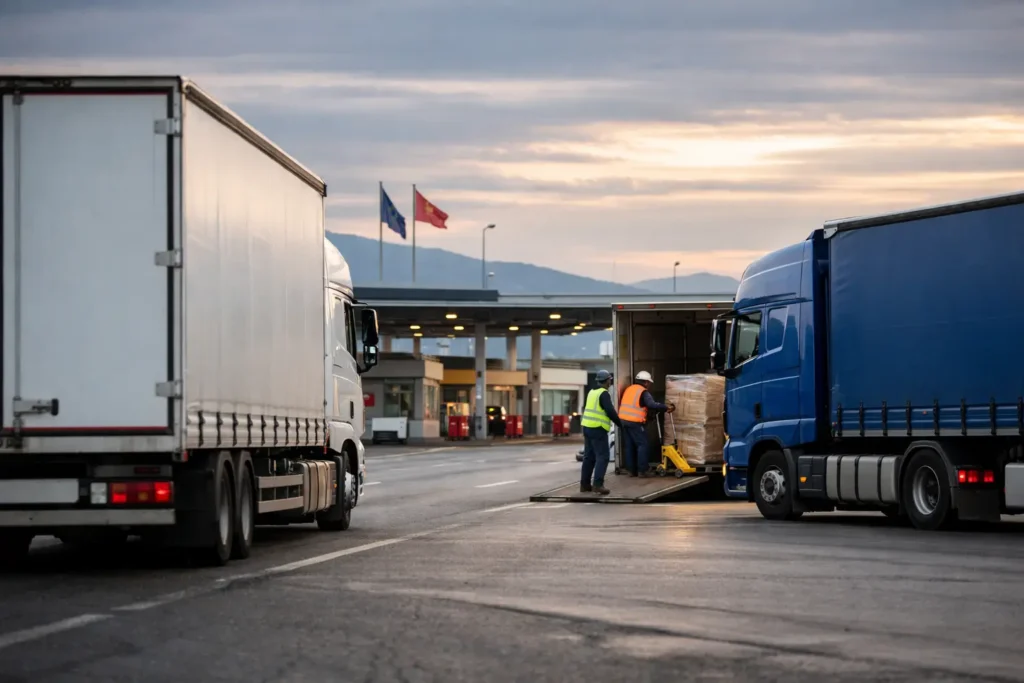
If you are tendering transport today based on pre-2020 assumptions, there is a good chance your plan is already behind the market. Capacity looks available on some corridors, yet lead times remain fragile. Rates may soften in one quarter and harden abruptly on another lane. Add customs pressure on UK, Swiss or Turkey flows, and the question becomes practical, not theoretical: is the road freight market entering a new structural cycle? For supply chain managers, this matters because the old model of stable planning, rate-first buying and easy carrier substitution is becoming less reliable on the routes that carry the most operational risk.
Why this may be more than a normal freight upswing
Road freight has always moved in cycles. Demand rises, capacity tightens, rates increase, then the market cools. What feels different now is that several changes are lasting longer than a usual rate cycle.
One of the clearest signals is cost structure. Driver shortages have not disappeared, compliance obligations keep growing, and border formalities are now a fixed part of many European flows rather than a temporary disruption. According to the IRU driver shortage reporting, the gap in qualified drivers remains a structural issue across Europe. That affects more than recruitment costs. It changes service reliability, route planning and the flexibility available for urgent or last-minute shipments.
At the same time, shippers are asking for two things that do not always sit easily together: lower transport spend and higher delivery certainty. That tension is shaping a market where providers that can only compete on price are under pressure, while operators with strong coordination, customs handling and access to the right vehicle type are becoming more valuable.
This is why a structural cycle matters. It is not just about whether rates go up or down next month. It is about whether the operating rules of the market have shifted enough to change how buyers should secure road freight.
Is the road freight market entering a new structural cycle on European lanes?
On many European lanes, the answer looks increasingly like yes, but not evenly. The market is fragmenting by corridor, urgency and border complexity.
Standard intra-EU moves between major industrial centres may still look relatively liquid. Yet once a route includes the UK, Switzerland or Turkey, the number of variables rises quickly. Customs documentation, transit time uncertainty, inspection risk and local restrictions can all affect the outcome. A low quote on paper does not mean low total cost if a shipment misses a delivery slot, triggers production downtime or sits at the border because one document was prepared incorrectly.
A concrete example: a manufacturer moving components from northern Spain to Birmingham may compare several road offers and select the lowest linehaul rate. But if the haulier has limited customs coordination and weak communication during the Channel crossing, one paperwork issue can create a delay of 24 to 48 hours. For a just-in-time production environment, the transport saving disappears immediately.
The same applies on Switzerland or Turkey lanes, where customs precision is part of service quality, not an admin detail. The European Commission transport pages and national customs authorities continue to update compliance and market rules, which means transport planning needs more active monitoring than it did a few years ago.
Three structural forces changing road freight buying
The first force is permanent volatility in capacity quality. There may be vehicles in the market, but not every available lorry is suitable for the job. Time-critical freight, high-value cargo, oversized goods and customs-sensitive shipments need the right setup from the start. In practice, that means supply chain teams are buying fit, not just space.
The second force is border complexity. Brexit made this visible, but it is not limited to the UK. Switzerland, Turkey and onward flows towards the Caucasus all require a different level of document control and operational follow-up. The real issue is not whether customs exists. It is whether your transport partner can anticipate where the process is likely to fail.
The third force is service segmentation. The market has become less tolerant of one-size-fits-all transport buying. A routine pallet movement and an urgent line-stop delivery should not be handled through the same planning logic. More shippers are separating their flows into standard, express and exceptional categories because the risk profile, vehicle requirement and communication cadence are different.
This is where a tailored service model becomes commercially useful. MAP Transport’s road freight services, for example, are structured around standard, urgent and exceptional movements rather than pushing every shipment through the same process. That reflects how buyers now need to manage transport risk across mixed freight portfolios.
What this means for rates, service and procurement decisions
A new structural cycle does not automatically mean permanently higher rates. It means pricing is becoming more conditional on lane complexity and service expectations.
On straightforward routes with stable volume, buyers can still negotiate effectively. But on difficult corridors, urgent collections or customs-heavy moves, the cheapest option often carries hidden exposure. Procurement teams need to judge transport offers against three questions: how secure is the capacity, how strong is the border process, and how quickly will someone act if the shipment deviates from plan?
That shift also changes supplier evaluation. A quote within 48 hours remains useful, but on urgent freight a rapid decision path matters more than a polished PDF. Likewise, tracking matters less as a dashboard feature than as a communication discipline. Shippers want to be informed at any time of the progress because the operational value lies in early warning and fast escalation.
A practical recommendation is to split tender logic by shipment type:
- routine imports and exports with predictable lead times
- urgent shipments where delivery in a few hours or under 24 hours protects production or customer service
- non-standard or heavy loads requiring specialist handling and route planning
- customs-sensitive flows where documentation accuracy is part of on-time delivery
When these categories are mixed under one buying rule, service quality becomes inconsistent and true cost control gets harder.
The operational insight many shippers miss
The most overlooked issue in this market is not rate movement. It is reaction speed.
In a structurally tighter and more complex road freight environment, delays are often manageable if they are identified early. They become expensive when nobody takes ownership fast enough. This is especially relevant on routes involving ferry crossings, border checks or timed industrial deliveries.
Consider an urgent shipment from Belgium to a plant in western Turkey. The challenge is not only distance. It is the chain of dependencies: collection timing, driver hours, border processing, document readiness and final delivery coordination. A generic transport setup may technically cover the route, but if the operator does not actively monitor each stage, small deviations compound.
That is why experienced shippers increasingly value personalised follow-up over generic visibility tools. A multilingual operations team that can coordinate across countries, update stakeholders and intervene quickly often protects more value than a small rate saving.
For companies running complex import/export flows, this is the practical test of whether the road freight market is entering a new structural cycle. If success now depends more on coordination quality, customs competence and rapid response than it did before, then the market has already changed in a meaningful way.
How to respond if your transport network is exposed
The right response is not to rebuild your entire network overnight. It is to identify where your current model is vulnerable.
Start with the lanes where one delay has a disproportionate business impact. That usually includes UK, Switzerland and Turkey traffic, urgent replenishment, and customer deliveries with strict booking windows. Then check whether your transport setup matches the actual risk. If a high-impact route is still being purchased as commodity freight, you are likely carrying avoidable exposure.
Next, review whether your providers can support different service levels without losing control. A standard full load, an express van movement and an exceptional shipment should each have their own execution logic. If that distinction is missing, service failures tend to appear at the worst possible moment.
It also helps to work with partners that can cover a broad geography while staying operationally close to the shipment. MAP Transport supports freight movements across 45 countries, including difficult corridors where customs and timing matter most. Its express transport service is built for urgent deliveries that cannot wait for standard planning windows, while its contact team provides direct access for tailored discussions around route, dimensions and timing.
A recent Reuters view of European industry and freight demand has shown how uneven the recovery remains across sectors and countries, which is another reason to avoid treating all lanes the same. In this market, selective control beats broad assumptions.
The real question is less whether a new structural cycle has officially begun, and more whether your transport strategy still fits the current operating reality. On complex European road flows, the answer increasingly depends on execution discipline as much as price. That is where specialist support makes a measurable difference. Need support on your transport flows? Contact our team for a tailored solution.
Have a question or need a quote? Contact us at (+34) 943 62 95 77 (ask for Raquel) or by email at lo*******@**********rt.com