
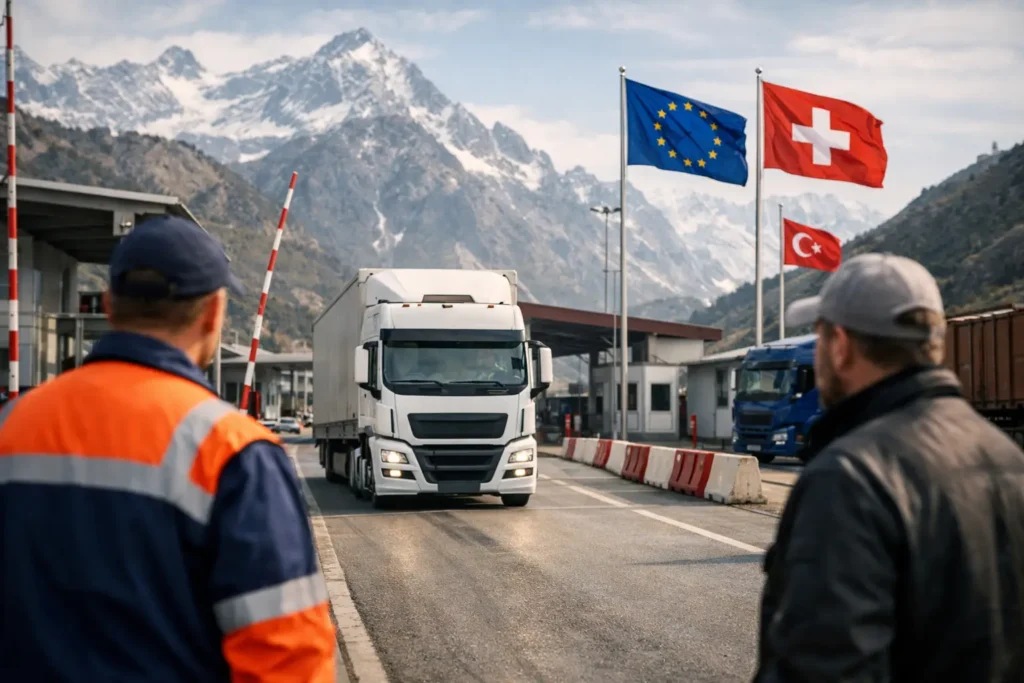
A lane that looked routine three years ago can now decide whether production keeps moving or stops by Thursday. That is why some European corridors are becoming strategic again for supply chain managers: not because the map has changed, but because risk has. Border friction, industrial relocation, energy costs, driver availability and pressure on lead times are concentrating volume on a smaller number of reliable road routes. For importers, manufacturers and distributors, the issue is no longer simply finding capacity. It is choosing corridors that can absorb disruption without turning every shipment into an exception.
Why some European corridors are becoming strategic again in practice
In freight, a corridor becomes strategic when it does more than connect origin and destination. It offers repeatability, workable transit times, customs predictability where relevant, and enough capacity to recover when something goes wrong. That matters more now because European supply chains have become less tolerant of delay.
Several shifts are reinforcing this. Nearshoring and supplier diversification are moving more production into Central and Eastern Europe, Turkey and nearby markets. At the same time, some traditional maritime and rail alternatives have become less predictable for certain cargo profiles, pushing time-sensitive flows back towards road. According to the International Road Transport Union{:target= »_blank »}, road freight still carries the majority of inland freight in Europe, which means corridor performance has a direct effect on service levels and stock risk.
The result is a clearer hierarchy of routes. The Benelux-Germany-Poland axis, Iberia-France-Germany connections, and flows linking Europe with Turkey are not just busy. They are increasingly decisive for industrial continuity. If your components, metals, temperature-sensitive products or urgent replacement parts depend on those routes, corridor choice becomes a board-level issue very quickly.
The pressure points making certain routes more valuable
Not every delay is equal. A two-hour hold-up on a domestic leg is inconvenient. The same delay on a cross-border route with a booked unloading slot, customs clearance, or onward production dependency can trigger missed shifts, detention and expensive replanning.
That is one reason why some corridors are becoming strategic again: they combine density with operational resilience. Dense routes tend to offer more recovery options, including relays, alternative border crossings, and better access to express vehicles. Sparse or fragmented routes may look acceptable on paper, but they give planners fewer options when there is congestion, weather disruption or a last-minute document issue.
Take the Europe-Turkey corridor as an example. Demand is strong because Turkey remains a major industrial base and sourcing market for European buyers, but the route also comes with border procedures, permit considerations and variable waiting times. On paper, transit may be competitive. In practice, performance depends heavily on document quality, timing, and whether the carrier can react quickly if a unit is delayed. The European Commission’s mobility and transport data{:target= »_blank »} continues to show how closely freight performance is tied to network bottlenecks and cross-border efficiency.
A similar pattern appears on UK-related flows. Since Brexit, the route is still commercially essential, but no longer operationally simple. A corridor that includes customs clearance, pre-lodgement requirements and strict booking windows at ports or terminals needs more than a rate. It needs discipline.
The corridors drawing renewed attention from shippers
For many manufacturers and distributors, the most strategically relevant corridors now share one feature: they connect production clusters to consumption hubs with enough frequency to support both planned and urgent transport.
The Iberian Peninsula to France, Benelux and Germany is a clear example. It remains critical for automotive, consumer goods, industrial inputs and food-related flows. But it is becoming more strategic because many firms are trying to reduce inventory while maintaining service. That increases the value of reliable daily departures and fast recovery when a loading window shifts.
Central Europe to the Balkans and Turkey is another. As sourcing patterns change, these routes are carrying more components, machinery and semi-finished goods. They also involve more operational variables than an intra-EU move. Customs errors, driver-hour constraints and border congestion can turn a normal movement into a delayed one unless the transport plan is built around those risks.
Northern corridors also matter more than they did when demand patterns were flatter. Scandinavia is operationally demanding because of distance, weather exposure, ferry dependencies on some flows, and relatively high costs for failure. A missed connection there can be harder to absorb than on shorter continental routes. That is why shippers moving urgent freight into Sweden, Norway or Finland often prioritise a transport partner with true time-critical capability rather than standard planning alone.
A concrete example: when corridor choice changes the outcome
Consider a Spanish industrial supplier shipping machine components to southern Germany, with a follow-on consignment continuing to Turkey for final assembly. The first leg looks straightforward. The second introduces customs and tighter sequencing.
If the shipment is planned as a generic long-haul road move, any loading delay in Spain can cascade. The German cross-dock misses its slot, the Turkey-bound vehicle departs later, border timing worsens, and the consignee loses a production window. If the same flow is planned corridor-first, the decision changes. You may assign a dedicated express van for the first urgent leg, hold the onward unit with pre-checked documents, and use a specialist team to monitor the border phase.
That is not theoretical. On complex routes, the cheapest transport setup can easily become the most expensive once one timing assumption fails. A well-chosen corridor plan often costs slightly more upfront but reduces the real cost of disruption.
Why some European corridors are becoming strategic again for urgent freight
Urgent transport makes corridor quality visible very quickly. If a critical spare part must reach a plant in under 24 hours, there is no margin for vague routing, weak communication or improvised paperwork. The route has to support the promise.
This is where corridor strategy and service design meet. A standard full-load approach does not solve every problem. Sometimes the right answer is a dedicated van, direct driving and live milestone updates. Sometimes it is splitting loads, routing through a more reliable border point, or avoiding a saturated hub even if the direct mileage is longer.
For supply chain managers, the operational insight is simple: urgent freight should not be treated as an exception layered onto a weak corridor. It should be planned around a corridor with recovery options built in. That is one reason specialist providers with classic, express and exceptional transport capabilities can add value beyond capacity alone. They can match the mode to the lane’s risk profile rather than forcing every shipment into the same template.
What supply chain managers should review now
If a corridor carries high-value goods, feeds production, or regularly crosses customs borders, it deserves a fresh review. Start with your actual failure points rather than your contracted map. Where do delays recur? Which lanes depend too heavily on one border crossing, one ferry, or one unloading slot? Which suppliers are now shipping from new locations that your routing guide has not properly absorbed?
A useful benchmark is to compare planned transit against achieved transit over the last six months, not just for average performance but for variance. A lane averaging 48 hours with frequent swings to 72 is less reliable than one averaging 55 with consistent delivery. Reliability is often the stronger commercial advantage when customer penalties or plant downtime are in play.
It also helps to separate corridor types. Intra-EU routine flows, UK flows, Switzerland movements, Turkey lanes and oversized consignments should not be managed with the same assumptions. Each has different exposure to customs, permits, local restrictions and response times. The UK Government customs guidance{:target= »_blank »} and the EU customs portal{:target= »_blank »} make the formal requirements clear, but execution still depends on how well the transport plan fits the route.
For companies shipping across Europe, this is where a specialist road freight partner can make a measurable difference. MAP Transport supports flows across 45 countries with tailored options for standard transport, urgent deliveries and exceptional shipments, including demanding lanes involving the UK, Switzerland, Turkey and Scandinavia. If you need a fast quote, a dedicated express transport service, support for complex international road freight, or want to contact the team, the value is in building the right route around the shipment, not squeezing the shipment into the wrong route.
Some corridors are becoming strategic again because resilience has become scarce, not because geography has become fashionable. The companies that respond fastest are usually the ones that stop buying lanes as commodities and start managing them as operational assets.
Need support on your transport flows? Contact our team for a tailored solution.
Have a question or need a quote? Contact us at (+34) 943 62 95 77 (ask for Raquel) or by email at lo*******@**********rt.com