
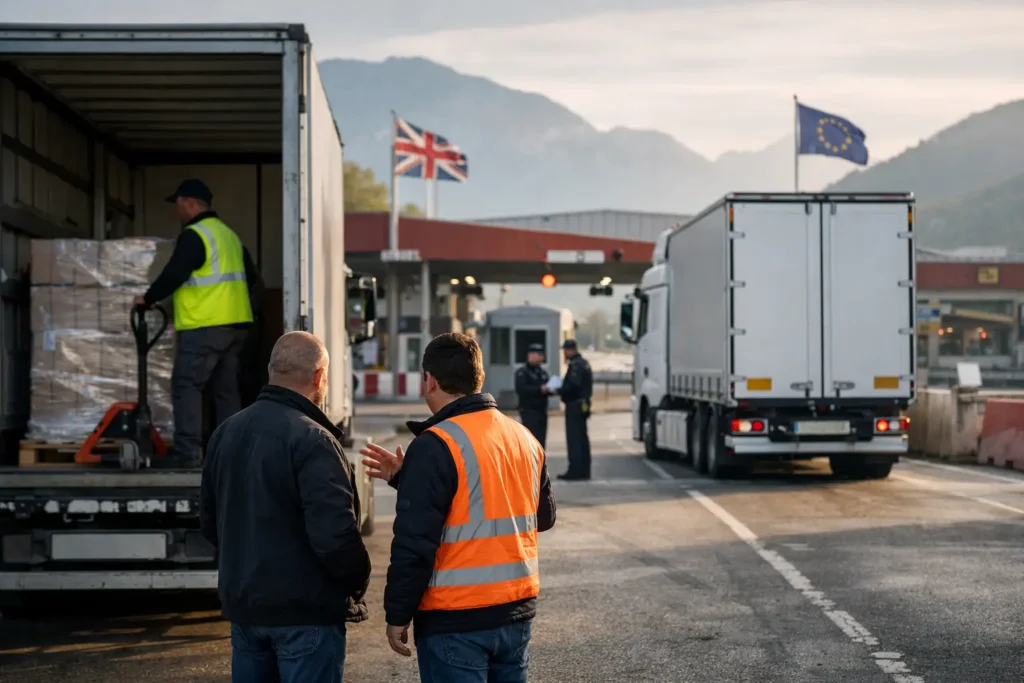
A rate spike is easy to spot on a transport invoice. What usually goes unnoticed is everything that happens around it – the production planner reshuffling jobs, the buyer approving last-minute premium freight, the customer service team managing missed delivery promises, and the stock sitting in the wrong place at the wrong time. That is the invisible cost of logistics volatility, and for supply chain managers it is often more damaging than the headline freight increase itself. On complex European road flows, especially where customs, urgent deadlines or specialist equipment are involved, volatility quietly erodes margin long before finance captures it.
Why the invisible cost of logistics volatility is rarely on the invoice
Most transport reviews focus on visible spend: lane rates, fuel surcharges, tolls and accessorials. Those matter, but they only tell part of the story. The real financial damage often appears elsewhere in the business, spread across departments and cost centres.
When a planned road shipment from northern Spain to Switzerland is delayed by border documentation issues, the carrier rate may remain unchanged. Yet the consignee may need to rebook labour, production may wait for a critical component, and procurement may pay more for a replacement movement. None of that sits neatly under “transport cost”, but it is still caused by transport volatility.
This is one reason logistics leaders underestimate risk. According to the European Commission, road freight carries the majority of inland freight in the EU, which means even small disruptions can create wide operational consequences across industrial supply chains. On high-frequency lanes, repeated minor disruptions can be more expensive than one major incident because they normalise inefficiency.
Where volatility hits hardest in European road freight
Volatility does not affect every flow in the same way. Standard intra-EU groupage may absorb some disruption more easily than a dedicated urgent movement to a production site. The cost profile changes depending on route complexity, cargo criticality and time sensitivity.
Customs-sensitive routes multiply hidden costs
Movements involving the UK, Switzerland or Turkey carry a higher administrative burden. A missing commodity code, an incorrect invoice value or a mismatch between documents can turn a predictable transit into a costly delay. The direct charge may be modest. The indirect cost is usually much larger.
Take a parts shipment moving from Belgium to the UK for a scheduled maintenance window. If customs clearance is held up, the problem is no longer just a delayed lorry. It can trigger idle engineers, rescheduled site access, contractual penalties and emergency re-delivery. The transport event becomes a business interruption.
For teams shipping on these corridors, documentation discipline is not a back-office detail. It is a cost-control tool. Guidance from HMRC and the European Commission customs portal makes the compliance framework clear, but execution still depends on operational follow-up.
Urgent transport exposes weak planning fast
Volatility becomes expensive when a standard shipment suddenly needs to move in hours rather than days. Premium freight is sometimes unavoidable, but it is often the final symptom of earlier instability: late supplier release, poor communication, or lack of contingency capacity.
IRU has repeatedly highlighted how driver shortages and border friction affect road transport capacity across Europe. When capacity tightens, urgent shipments do not just cost more. They also compete for scarce resources, which can push risk into other planned flows.
That is why the same missed pickup can have very different consequences. For non-critical stock replenishment, the impact may be manageable. For an automotive or industrial line-down scenario, every hour has a measurable cost.
The four hidden cost areas supply chain teams should track
If you want to reduce the invisible cost of logistics volatility, start by measuring it properly. In practice, four areas tend to absorb most of the hidden damage.
The first is labour disruption. Transport delays create unplanned work for procurement, customer service, production and finance. People spend time chasing ETAs, correcting paperwork, rebooking unloading slots and informing customers. That effort is rarely costed, but it is real.
The second is inventory distortion. Companies react to unreliable transport by increasing safety stock or placing orders earlier than needed. That may protect service levels, but it ties up working capital and can create imbalance across sites. A business that does not trust its inbound timings often pays for that mistrust in stock.
The third is premium correction cost. This includes express vans, dedicated vehicles, out-of-hours unloading and partial shipments used to recover service failures. In many businesses, these emergency moves are approved quickly because the alternative is worse. Over time, though, they become a hidden tax on unstable flows.
The fourth is customer impact. A delayed delivery can affect OTIF performance, trigger complaints and weaken confidence in lead time promises. For industrial suppliers, this has long-term commercial consequences. Service failure is not always visible in one month’s transport budget, but it can shape future purchasing decisions.
A practical example of the invisible cost of logistics volatility
Imagine a manufacturer shipping a 1,200 kg urgent component load from Germany to Turkey. The original plan is a standard road movement timed to meet a customer installation date. Then the collection slips by half a day because the goods are not ready, and customs paperwork is completed late.
At that point, the visible response may be a more expensive vehicle and a faster routing option. But the invisible costs build around it. The consignee reschedules unloading. The project team updates the end customer. Internal staff spend hours on calls and document checks. If the cargo misses the installation slot, technical teams may need to return later, adding travel and labour cost.
This is why transport volatility should be evaluated at shipment level and at process level. The vehicle change is the obvious cost. The process failure behind it is the recurring one.
How to reduce volatility before it becomes margin loss
The strongest logistics operations do not eliminate volatility completely. That is unrealistic. They reduce exposure through better planning discipline, clearer escalation and transport partners who can adapt vehicle type and service level to the job.
Build route-specific control points
A shipment to France is not managed in the same way as a shipment to Switzerland or Turkey. Customs-sensitive lanes need earlier document validation, tighter cut-off control and named responsibility for clearance checks. Time-critical lanes need clear escalation points before a shipment turns into an emergency.
A useful operational rule is simple: identify the last point at which a standard shipment can still be recovered without premium freight. If teams do not know that threshold, they usually act too late.
Match service level to business risk
Not every load needs the fastest option. But every load does need the right option. Standard freight, express transport and exceptional shipments should be chosen based on delivery consequence, cargo characteristics and route complexity, not habit.
This is where tailored planning matters. A one-size-fits-all approach often creates hidden cost because it either overpays for low-risk shipments or underprotects critical ones. On urgent or specialist flows, a dedicated solution can be cheaper overall than recovering a failed standard movement.
For businesses handling regular European imports and exports, this is also where a partner with flexible service design makes a difference. MAP Transport’s road freight services are built around the shipment requirement rather than forcing every movement into the same model.
Improve visibility, but focus on useful visibility
More tracking data does not automatically reduce volatility. What matters is actionable visibility: knowing whether the shipment is on time, what risk has appeared, and who is responsible for the next decision.
For supply chain managers, the most useful updates are often the least glamorous ones – collection confirmed, document issue identified, border delay explained, revised ETA agreed. Good visibility reduces hidden cost because it shortens decision time.
That is particularly relevant on cross-border lanes where small delays can escalate quickly. MAP’s contact team works in a multilingual environment because transport issues across Europe are rarely solved by systems alone.
What better transport buying looks like under volatile conditions
The cheapest quoted rate is not always the lowest landed cost. Under volatile conditions, good transport buying means asking different questions: how quickly can the partner react, how do they handle urgent requests, what happens on customs-heavy routes, and how clearly do they communicate exceptions?
For a supply chain manager, the right provider is not just moving freight. They are reducing decision pressure inside your business. That matters on routes into the UK, Switzerland, Turkey and the Caucasus, where delays can stem from paperwork, timing, border processes or equipment constraints rather than distance alone.
A useful benchmark is to review how often your team pays for avoidable correction. If express moves, rebooked deliveries and customs amendments are becoming routine, volatility is already costing more than the lane rate suggests. This article on urgent transport planning is a good starting point if time-critical movements are becoming too frequent in your operation.
The invisible cost of logistics volatility is not really invisible. It is simply fragmented across stock, labour, service and risk. Once you start treating transport stability as a margin issue rather than a freight issue, better decisions become easier to justify. For companies moving goods across complex European corridors, that usually means tighter preparation, faster escalation and a transport partner that can adapt when conditions change.
Need support on your transport flows? Contact our team for a tailored solution.
Have a question or need a quote? Contact us at (+34) 943 62 95 77 (ask for Raquel) or by email at lo*******@**********rt.com
