
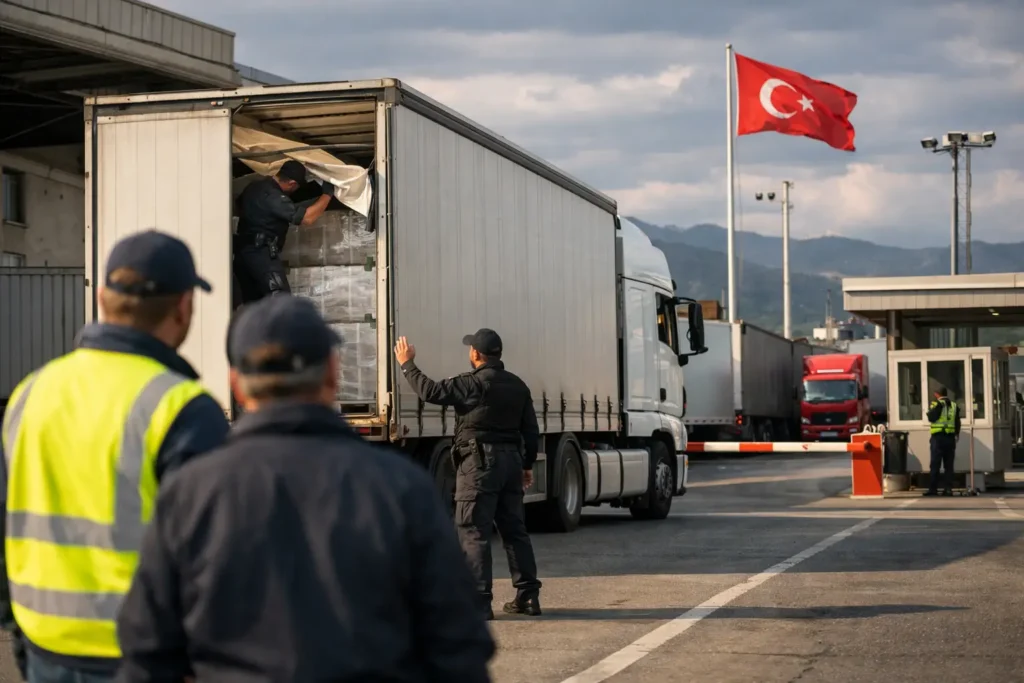
A lorry can leave on time from northern Spain, hit no major traffic, and still miss delivery by a full day. The usual reason is not distance. It is a border issue, a customs discrepancy, a poor vehicle choice, or a handover gap between parties who are not working from the same operational picture. That is why cross-border transport Europe is rarely just about booking capacity. For supply chain managers moving industrial goods across the UK, Switzerland, Turkey or Scandinavia, the real challenge is controlling risk before the vehicle starts rolling.
Why cross-border transport Europe gets delayed
Most delays in international road freight do not come from one dramatic failure. They come from small operational misses that build into lost hours. A collection slot is too tight for the site. The commodity description on the paperwork is too vague. A shipment heading to a non-EU destination is booked like a routine intra-EU load. By the time someone spots the mismatch, the vehicle is already at the frontier.
This is especially visible on routes where customs still shape lead times. The UK, Switzerland and Turkey are the obvious examples. In these lanes, border formalities are part of the transport plan, not an administrative afterthought. According to the European Commission customs framework, traders must ensure declarations and supporting documentation are accurate before goods move through external borders. In practice, one missing reference can hold a vehicle far longer than road conditions ever would.
There is also a vehicle planning issue that buyers sometimes underestimate. A standard full-load movement and an urgent van shipment may cover the same route, but they do not behave the same way operationally. If the service model does not match the real delivery requirement, the transport is already under pressure before departure.
The routes where planning matters most
Not every European lane carries the same exposure. Moving palletised goods from France to Belgium is one thing. Moving machinery components from Germany to the UK, regulated materials into Switzerland, or urgent industrial parts from Italy to Turkey is another.
In cross-border transport Europe, the highest-risk routes tend to combine one or more of these factors: customs formalities, long transit distances, time-critical delivery windows, or specialist loading requirements. Scandinavia adds weather and ferry coordination. Turkey adds a deeper customs and transit layer. The UK adds post-Brexit formalities that still catch shippers out when data is incomplete or responsibility between exporter, importer and forwarder is blurred.
A practical example: a manufacturer shipping replacement metal parts from Barcelona to Birmingham may assume the urgent part is finding a vehicle fast. In reality, the critical step is making sure commodity data, commercial invoice details, collection readiness and border references are aligned before departure. If the goods leave quickly but the paperwork is corrected later, the « express » move can end up slower than a properly planned standard shipment.
That is why experienced operators build route-specific planning into the quote stage. The right question is not only « How fast can this move? » but also « What will stop it moving as planned? »
Customs is not a side task
For many shippers, customs remains the biggest dividing line between routine freight and disrupted freight. On external-border routes, the transport plan is only as strong as the documents behind it.
The most common problems are familiar. Commodity descriptions are too generic. Values do not match across documents. EORI or tax details are missing. Loading dates shift, but supporting documents are not updated. These are avoidable issues, but only if they are checked before dispatch. The UK Government guidance and Swiss customs authority both make it clear that documentary accuracy sits at the centre of compliant border movements.
An operational insight that matters here: the haulier should not be the first party to discover a customs gap at the border. If your transport partner asks the right questions early – origin, destination, Incoterms, value, nature of goods, urgency, weight and dimensions – it becomes much easier to spot problems while there is still time to fix them.
This is where tailored coordination pays for itself. A one-size-fits-all booking process works poorly on customs-sensitive lanes because the risk profile changes from shipment to shipment. The same customer may need a routine grouped movement one day and a highly controlled urgent load the next.
Urgent freight needs a different operating model
There is a persistent mistake in time-critical road freight: treating urgency as a premium add-on to a normal process. It is not. Urgent transport works when the operating model changes from the start.
If a production line is waiting for one missing component, the shipment does not need the cheapest possible option. It needs the fastest workable route, immediate dispatch, direct communication and active monitoring. In those cases, vans and dedicated lorries often make more sense than standard planning. The service level must reflect the business impact of delay.
The IRU has repeatedly highlighted how border friction and administrative bottlenecks affect road freight performance across international corridors. For supply chain teams, that translates into a simple rule: urgent freight should involve fewer handovers, clearer ownership and faster exception management.
A good example is an automotive supplier facing a line-stop risk in eastern France after a missed inbound from northern Italy. Booking a standard service may look acceptable on paper, but if the customer needs delivery within hours, the only sensible approach is a dedicated express vehicle with immediate loading, direct routing and live follow-up. Cost matters, of course. But the cost of choosing the wrong mode is usually higher.
How to reduce risk in cross-border transport Europe
The strongest improvements usually come from process discipline rather than dramatic change. Shippers who perform well on difficult lanes tend to do four things consistently.
First, they give complete shipment data at quotation stage. Weight, dimensions, loading constraints, commodity type, delivery deadline and border specifics should be shared at the start. That allows the transport team to choose the right vehicle and route rather than patching problems later.
Second, they separate standard freight from business-critical freight. Not every shipment needs an express solution, but genuinely urgent loads should not be forced into a normal planning model just to save on rate. The service choice has to match the operational consequence of delay.
Third, they treat communication as part of transport performance. A supply chain manager does not just need a vehicle. They need to know if the load is on schedule, if a document issue has surfaced, and what recovery action is underway. Silence creates escalation inside the customer business long before the freight arrives.
Fourth, they work with partners who understand complex routes rather than only easy ones. A provider that regularly handles the UK, Switzerland, Turkey or Nordic lanes is more likely to identify risk early and offer practical alternatives when conditions change.
For companies reviewing their current setup, these questions are worth asking:
- Are border-document checks happening before dispatch or only when something goes wrong?
- Are urgent shipments routed through a dedicated process?
- Does the transport provider adapt the vehicle to the load, or force every movement into the same model?
- Can your team get a realistic update quickly when timing starts slipping?
What good cross-border transport looks like in practice
Reliable international road freight is not flashy. It looks like a quote that reflects the actual shipment. It looks like a collection arranged around site reality. It looks like the right vehicle, the right paperwork, and someone tracking the movement closely enough to intervene before a delay becomes a failure.
That matters even more when goods are oversized, high-value or operationally sensitive. Exceptional shipments, for instance, need route checks, permit awareness and tighter coordination across loading and delivery points. Standard methods do not work well for non-standard freight.
This is also where experience shows. A transport partner with long-standing coverage across Europe and beyond the EU frontier can spot the difference between a routine lane and a lane that only looks routine until it reaches a customs post. That judgement is hard to replace with software alone.
For shippers dealing with regular imports and exports, the goal is not simply moving freight from A to B. It is reducing uncertainty on every move. If your team wants practical support on standard road freight, urgent deliveries or specialist loads, MAP Transport explains its approach across its road freight services, shares updates on international transport issues, and makes it easy to request a tailored quote.
The strongest transport setups are usually the ones that prevent problems quietly, long before anyone starts asking where the lorry is. Need support on your transport flows? Contact our team for a tailored solution.
Have a question or need a quote? Contact us at (+34) 943 62 95 77 (ask for Raquel) or by email at lo*******@**********rt.com
