
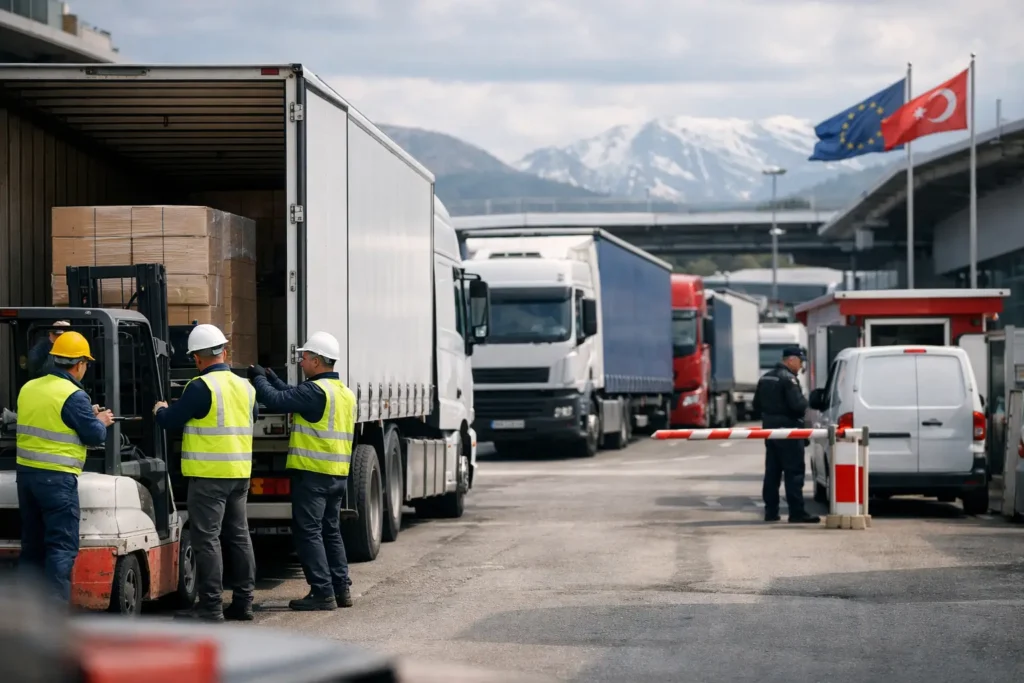
A production line rarely stops because of one dramatic failure. More often, it is a late collection in Germany, a missing customs reference for the UK, a driver held at a border, or a load planned on the wrong vehicle type. If you are responsible for outbound or inbound road freight, you already know that small disruptions quickly become missed delivery windows, penalty costs and unhappy customers. That is why understanding how to reduce freight delays is not just a transport question. It is an operational discipline that affects service levels, working capital and supplier performance.
Start by finding where delays actually begin
Freight delays are often blamed on the journey itself, but many of them start before the vehicle moves. A vague collection slot, incomplete loading details, wrong pallet count or unclear delivery restrictions can add hours before transit has even started. In cross-border road transport, those hours matter.
A useful first step is to review your last 20 delayed shipments and group the causes. In many cases, you will find the pattern is operational rather than exceptional. The issue may be poor shipment data, late document release, consignee access limits, or a route that was planned as standard freight when it should have been treated as urgent.
According to the IRU, border waiting times and administrative friction remain a major source of inefficiency in international road transport. That means delay reduction starts with preparation, not only with faster vehicles.
An operational insight here is simple: if your transport team only sees the load request when the goods are ready, you are planning too late. The earlier your carrier receives weight, dimensions, commodity, collection readiness and delivery constraints, the more realistic the routing becomes.
How to reduce freight delays with better shipment planning
The companies that reduce delays most consistently are not always the ones paying for the fastest service. They are the ones matching the transport plan to the shipment profile.
That means asking a few practical questions before booking. Is the load standard or time-critical? Does it require a direct van rather than a groupage movement? Are there site restrictions, crane requirements or unloading appointments? Is there any customs exposure on the route, such as UK, Switzerland or Turkey?
For example, a manufacturer shipping replacement industrial parts from northern Spain to Birmingham may initially book a standard road movement to control cost. But if the consignee needs delivery before the next production shift, standard routing may create avoidable risk – especially if documentation is released late or the delivery point has narrow time windows. In that case, an express service with direct transit and active follow-up is often cheaper than the cost of downtime.
This is where tailored service matters. A one-size-fits-all model tends to create delays because the shipment is forced into the wrong network logic. On more urgent routes, a dedicated van or team-driver option can remove consolidation stops and reduce handling points. On more complex loads, the right equipment and route permit planning are equally decisive. You can see how this works in practice across international road freight services.
Customs and border control are still major delay drivers
If your flows involve the UK, Switzerland or Turkey, the answer to how to reduce freight delays almost always includes stronger document control. Border crossings are not only about transit time. They are about accuracy.
A lorry arriving at the border with inconsistent invoice values, missing commodity codes, incomplete origin data or incorrect reference numbers can lose hours very quickly. In some cases, the vehicle is ready and the route is clear, but the paperwork is not.
The European Commission’s customs guidance makes clear that document compliance and pre-arrival processes are central to smoother cross-border movements. The problem for many shippers is not a lack of rules. It is that customs work is treated as an admin step rather than a transport risk.
A practical recommendation is to build a shipment release checklist for all non-EU or customs-sensitive lanes. Keep it short and operational. Check commercial invoice data, EORI details, commodity descriptions, gross and net weight, packaging count, Incoterms and any route-specific references before collection is confirmed. This sounds basic, but it prevents some of the most expensive avoidable delays.
There is also a trade-off. More control at booking stage can add a little time upfront. But that controlled delay is usually far cheaper than a vehicle waiting at a border or a delivery failing because customs clearance is incomplete.
Carrier responsiveness matters more than most KPIs show
Many freight buyers track on-time delivery, but fewer track speed of response when something changes. Yet that is often where delay prevention is won or lost.
A delayed collection can sometimes be recovered if the carrier reacts within minutes, reallocates equipment and updates the consignee early. The same issue becomes a serious service failure when nobody spots it until the planned delivery time has already been missed.
This is especially true on longer European routes and difficult corridors. Bad weather in Scandinavia, ferry disruption, driving restrictions, border congestion or late factory readiness all require active traffic management. A multilingual operations team that can coordinate with shipper, driver and consignee in real time reduces friction that static systems do not solve on their own.
One reason many shippers outsource strategic lanes is not just buying transport capacity. It is buying follow-up. If your provider can give a tailored transport quote quickly and then actively monitor the shipment from collection to delivery, your internal team spends less time chasing updates and more time managing risk.
A useful benchmark is communication tolerance. If a shipment becomes high-risk, how long can your operation wait before it needs an answer – 30 minutes, one hour, half a day? For urgent industrial flows, the answer is usually measured in minutes.
Build contingency into urgent and complex routes
Not every shipment needs premium service, but some lanes should never be planned with zero margin. This applies particularly to plant-critical parts, export loads with fixed delivery appointments, and shipments moving on routes with customs or permit complexity.
The UK Government’s [border operating model](https://www.gov.uk/government/collections/the-border-operating-model « UK border operating model » target= »_blank » rel= »noopener noreferrer ») continues to evolve, and that alone is a reminder that transport planning cannot be static. A route that worked six months ago may now need a different lead time, document process or delivery promise.
This is where contingency planning becomes practical rather than theoretical. You may decide to hold a later cut-off for standard loads but book urgent consignments on direct service. You may split a critical order into two vehicles to reduce total exposure. You may route oversized freight with more conservative transit timing because permit and escort variables are less predictable.
Here are the main situations where extra planning usually pays off:
- UK, Swiss and Turkish routes with customs dependencies
- Time-critical spare parts and shutdown-related shipments
- Oversized or non-standard loads needing permits or specialist handling
- Deliveries into remote areas or sites with strict access windows
The point is not to overpay for every movement. It is to identify where the cost of a delay is higher than the cost of prevention.
Use data, but keep it operational
Statistics help, but only if they lead to better decisions. One figure often cited across supply chain research is that transport visibility improves exception management, yet visibility alone does not reduce delays if nobody acts on the signal.
A better approach is to monitor a small set of useful indicators by lane and by customer requirement. Look at collection punctuality, document accuracy, border hold frequency, failed first delivery, and response time to incidents. These measures tell you much more than a broad monthly on-time figure.
For instance, if a lane from Belgium to Turkey shows acceptable total transit averages but repeated delays at document release stage, the answer is not to pressure the haulier for faster driving. The answer is to fix pre-departure process discipline. If a route into Switzerland repeatedly misses morning delivery slots, review whether loading completion times are realistic or whether the service type is wrong.
A good transport partner should help translate these patterns into action. That could mean adjusting cut-off times, using express services on selected flows, changing the collection sequence, or planning exceptional loads earlier. Articles on urgent road transport often focus on speed, but speed only works when the planning logic behind it is sound.
Freight delays are reduced by fit, not force
The most reliable way to reduce delays is to align service level, route complexity, customs readiness and communication speed before the goods leave the site. Some shipments need standard planning and cost control. Others need direct vehicles, specialist handling or much tighter operational follow-up. Knowing the difference is what protects delivery performance.
For supply chain managers, that means looking beyond the rate sheet and asking a harder question: is this movement being managed according to its real risk profile? Companies that answer that well usually see fewer surprises, fewer escalations and stronger customer service.
With 40 years of experience and transport coverage across 45 countries, MAP Transport supports businesses that need dependable road freight, urgent shipments and specialist coordination on complex European routes. Need support on your transport flows? Contact our team for a tailored solution.
Have a question or need a quote? Contact us at (+34) 943 62 95 77 (ask for Raquel) or by email at lo*******@**********rt.com
