
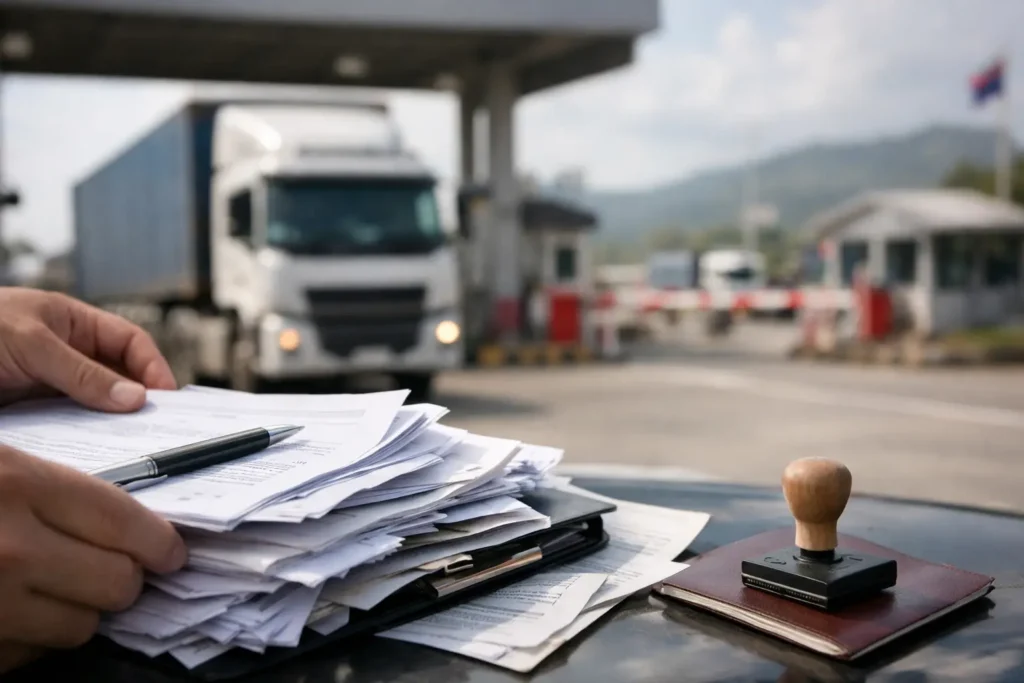
A lorry can be loaded on time, routed correctly and booked on the right ferry or tunnel slot, then still lose hours at the border because one code, one reference or one missing declaration does not match the goods on board.
That is why cross border road freight customs paperwork is not an admin afterthought. For manufacturers, distributors and import-export teams, it is part of delivery performance. If the paperwork is wrong, the vehicle waits. If the vehicle waits, production plans, customer commitments and transport costs start moving in the wrong direction.
Why cross border road freight customs paperwork affects delivery performance
In cross-border road transport, paperwork does two jobs at once. It proves what the goods are, who owns them, where they are going and what duties or controls apply. At the same time, it gives customs authorities enough confidence to release the load without inspection or further queries.
The practical problem is that each shipment sits at the intersection of commercial data, transport data and regulatory data. The invoice may say one thing, the packing list another, and the customs declaration something slightly different again. Even small differences in weight, product description or commodity code can trigger questions.
For regular lanes inside the EU, the process is usually lighter. Once a road movement crosses into non-EU territory, or moves under a transit procedure, the documentation burden changes quickly. Routes involving the UK, Turkey, Azerbaijan or Kazakhstan need especially careful planning because the border process is not just about customs clearance. It may also involve transit guarantees, security filings, permits, origin evidence or checks linked to the product itself.
That is where an experienced freight partner makes a measurable difference. The value is not just moving the load. It is controlling the information around the load so the border does not become the weak point in the chain.
The core documents used in cross border road freight customs paperwork
The exact file depends on the origin, destination, Incoterms, type of goods and whether the movement is import, export or transit. Still, most cross-border road shipments rely on the same foundation.
The commercial invoice is usually the starting point. Customs uses it to assess value, seller and buyer details, currency, terms of sale and product information. If that invoice is vague, for example describing goods as « parts » or « materials » without precision, clearance can slow down immediately.
The packing list supports the physical reality of the load. It should match the number of pallets, packages, net and gross weight, and the way the goods are presented for inspection. If the declaration says 10 pallets and the lorry presents 12, expect questions.
The CMR consignment note remains central in international road freight. It records the carriage arrangement and the parties involved in the movement. It is not a customs declaration, but it must still align with the declared goods and routing.
Then there is the customs declaration itself, using the correct commodity code, customs procedure and supporting references. In many cases, this is where delays begin. The goods may be loaded correctly, but if the tariff code is inaccurate or the declared procedure does not match the shipment purpose, customs may hold the load.
Where transit applies, a transit document and movement reference are also critical. These movements need close control because the goods are travelling under customs supervision between points. If the office of departure, route or discharge process is mishandled, the issue does not end at the border. It can become a guarantee claim or a compliance problem afterwards.
Depending on the goods, you may also need certificates of origin, preference documents, licences, sanitary or phytosanitary certificates, export control paperwork or proofs linked to regulated residues and specialist materials. There is no useful one-size-fits-all checklist here. A standard palletised industrial load and an exceptional shipment requiring specialist handling will not carry the same documentary risk.
Where customs paperwork usually goes wrong
Most problems are not dramatic. They are ordinary data failures that build into costly delays.
The first is poor product description. Customs authorities need a real description of the goods, not internal shorthand. If your ERP says « assy unit 4B » that may make sense internally, but it is not suitable for border processing.
The second is mismatch across documents. The invoice, packing list, CMR and declaration must tell the same story. Different weights, incomplete addresses, inconsistent Incoterms or old company registration details are common causes of query.
The third is timing. A declaration prepared too late can miss a departure slot. For urgent road freight, that matters. When a shipment is meant to arrive within hours or in under 24 hours, a border delay can wipe out the value of paying for express capacity.
The fourth is assuming yesterday’s process still applies today. Border rules change. System requirements change. Product controls change. A lane that moved smoothly six months ago may now need additional references or pre-arrival filings.
The fifth is failing to account for the route itself. A direct movement and a movement crossing several jurisdictions do not carry the same customs exposure. The paperwork has to reflect the actual operational path of the vehicle, not just the final buyer and seller.
How to reduce border risk before the lorry departs
The most effective fix is preparation before vehicle allocation, not after loading. That means confirming the customs status of the goods, checking whether the shipper or consignee is responsible for clearance, and validating the data used for the declaration before the lorry is booked.
For procurement and logistics teams, this often comes down to a disciplined handover. Provide accurate shipment details early: commodity, value, weight, dimensions, origin, destination, delivery terms and any product-specific controls. If the goods are urgent, say so at the start. If the load is oversized or non-standard, say so even earlier, because exceptional movements often require a different documentary path as well as a different vehicle plan.
It also helps to work with a partner that can match service level to shipment reality. Standard loads do not need the same operational model as time-critical consignments. On the MAP Transport road transport services pages, that distinction is built into how shipments are handled, whether the priority is classic planning, urgent delivery or specialist execution for non-standard freight.
Communication matters just as much as documents. A multilingual operational team can check inconsistencies quickly with consignor, consignee, broker and driver before the border becomes involved. That shortens the time between spotting an issue and correcting it.
It depends on the lane, the goods and the service level
Not every shipment needs the same customs strategy. A repeat industrial movement on a familiar lane may be straightforward if master data is clean and both sides know their responsibilities. A first-time export to a less familiar market is different. So is a shipment moving under urgent conditions where there is little tolerance for document rework.
This is why transport buyers should be cautious about comparing rates in isolation. A lower line-haul price can disappear quickly if the operator does not control the paperwork chain, lacks route familiarity or cannot respond fast when customs queries arise.
For businesses shipping beyond core EU lanes, this becomes even more relevant. Movements into markets such as Turkey, Azerbaijan and Kazakhstan require planning discipline because the transport execution and the border process are closely linked. The international transport model has to account for both.
If the load is urgent, the customs side has to be handled with the same urgency as the vehicle dispatch. A fast van or dedicated lorry does not solve a missing reference. That is why time-critical operations work best when the documentation workflow is integrated with the transport plan, as in express transport, rather than treated as a separate step.
What experienced shippers should ask before confirming a load
Before release, ask a few operational questions. Who is making the declaration? Who is responsible under the agreed Incoterms? Do all documents match on quantity, value and description? Is transit required on the chosen route? Are there product controls, licences or certificates that apply?
Then ask the harder question: what happens if customs queries the file outside normal office hours? For many businesses, that is where service quality becomes obvious. The right partner does not just book a vehicle. They stay accountable for the movement and keep you informed of progress.
For companies that want fewer border surprises, the goal is simple. Build the shipment file early, check it against the operational plan, and make sure the transport partner is equipped to respond quickly when the route or the regulation demands more than standard handling. Businesses that need that level of control can request a quote with the shipment details up front and deal with the customs risk before it turns into a delivery problem.
Good paperwork rarely gets noticed when everything runs to plan. That is precisely the point – the best border process is the one that keeps your load moving and your customer asking about the goods, not the delay.