
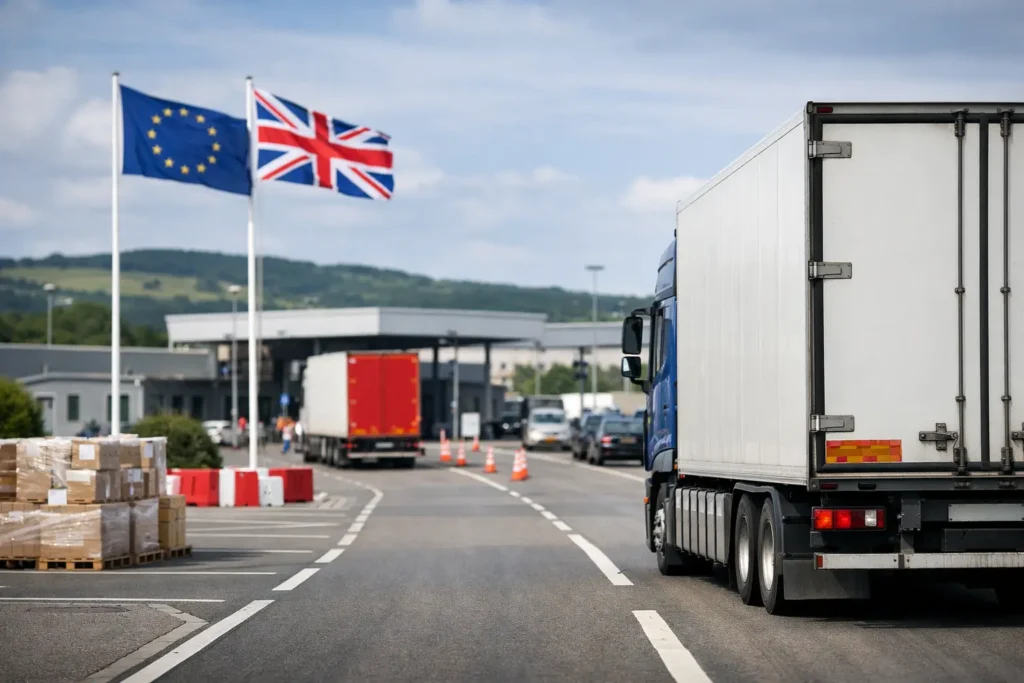
A lorry can leave Lyon on time, arrive at the Channel as planned, and still lose half a day because one reference number is missing. That is the practical reality of UK-EU transport now. For logistics teams, post-Brexit road freight requirements are no longer a side issue handled at the border. They sit at the centre of planning, cost control and delivery performance.
If you move goods between the UK and the EU, the question is not whether there are more formalities. There are. The real question is how to build them into your transport process so they do not undermine lead times, customer commitments or vehicle utilisation.
What changed under post-Brexit road freight requirements
Before Brexit, road freight between the UK and EU member states moved within the single market. Customs declarations were not required for most routine movements, and border formalities were far lighter. Now, every shipment needs to be treated as an international movement with customs and, in some cases, sanitary or security controls.
That has changed the job of the shipper as much as the carrier. A haulier can move the goods, but the shipment will only move efficiently if the commercial invoice, commodity codes, customs entries and movement references are correct before departure. Border systems are less forgiving than they were when intra-EU trade was effectively frictionless.
For manufacturers, distributors and procurement teams, this means transport buying is more closely tied to compliance discipline. The cheapest rate can become the most expensive option if it leads to a missed ferry, storage charges, or a failed delivery window.
Core documents for UK-EU road freight
The exact paperwork depends on the goods, direction of travel and customs procedure, but a standard shipment usually requires a commercial invoice, packing information, the relevant customs declaration and transport document details. In many cases, you will also need proof of origin if you want to claim preferential tariff treatment under the UK-EU Trade and Cooperation Agreement.
The distinction between origin and where the goods were dispatched from still causes confusion. A product shipped from France is not automatically of EU origin. If origin is declared incorrectly, duty relief may be refused and the shipment can be delayed while the issue is clarified.
For many operators, the practical minimum is this: product description must be accurate, commodity codes must be correct, values must be defensible, and Incoterms must clearly define responsibility. If any of these points are vague, everyone downstream pays for it in time.
Businesses moving regular loads often reduce risk by standardising their shipment data before booking. That means using the same approved product descriptions, tariff classifications and document checks each time rather than rebuilding the file from scratch for every consignment.
GVMS, border references and pre-lodgement
One of the most important post-Brexit road freight requirements for accompanied movements is making sure the right customs references are linked to the vehicle before it reaches the port. Depending on the route, this may involve the Goods Vehicle Movement Service, commonly known as GVMS.
GVMS allows customs declarations to be pre-lodged and connected to the vehicle movement through a Goods Movement Reference. Without the correct reference, the vehicle may not be permitted to board, or it may be stopped for further intervention. This is where operational discipline matters. A booking confirmed too early, before customs entries are final, can create as many problems as a late booking.
For shippers working with urgent freight, this becomes even more sensitive. Time-critical loads do not have spare hours built into the plan. If the customs data is still being corrected when the van is ready to depart, express transport loses its advantage.
That is one reason many companies prefer a freight partner that manages the movement with close follow-up rather than simply assigning a vehicle. When timings are tight, communication between shipper, customs agent, driver and consignee has to be continuous. You can see how this fits within a service model built around dedicated planning and status visibility at MAP Transport.
When SPS and product controls apply
Not every consignment faces the same level of control. Food products, plants, animal products and certain agricultural goods can fall under sanitary and phytosanitary rules, often shortened to SPS. These shipments may require export health certificates, pre-notifications and, depending on the goods and route, physical inspection.
This is where many general overviews of post-Brexit road freight requirements become too simple. The requirements are not uniform. A pallet of machine parts and a mixed load of chilled food do not carry the same documentary and border risk.
The trade-off is clear. Groupage and mixed-load planning can reduce unit transport cost, but regulated goods can introduce extra handling points and extra control risk. In some cases, a dedicated vehicle is the more dependable option, especially where shelf life, strict delivery appointments or customer penalties are involved.
If your business handles specialist or non-standard cargo, the transport plan also needs to account for how customs and border procedures interact with the load itself. That is particularly relevant for project cargo, oversized goods or movements that already require route planning and permits, as seen in exceptional shipments.
Responsibilities under Incoterms matter more than before
Brexit has made weak Incoterm discipline more expensive. If buyer and seller are not aligned on who handles export clearance, import clearance, duty, VAT and supporting documents, the problem usually appears when the vehicle is already moving.
That is why transport teams should not treat Incoterms as a sales detail. They directly affect whether the shipment can cross the border without interruption. DAP, DDP, EXW and FCA each place responsibility differently, and the wrong assumption can leave customs entries incomplete or VAT treatment wrong.
For example, some sellers agree to commercial terms that imply more import-side control than they actually have. Others use EXW where the practical export process is not suited to it. The result is avoidable rework, often at the worst possible moment.
A good discipline is to review Incoterms at quote stage, not after booking. If the movement is urgent, this is even more critical. Services built for short lead times, such as express road transport, depend on having the compliance side settled before wheels start turning.
Delays are usually administrative before they are physical
When businesses think about border disruption, they often picture queues at ports. In practice, many delays start earlier. The invoice may not match the declaration. The commodity code may be incomplete. A driver may be waiting for a movement reference that was expected but never issued. The vehicle is available, but the file is not ready.
That changes how transport performance should be measured. Transit time on the road is only one part of delivery reliability. Pre-departure readiness is just as important. A carrier with strong operational follow-up can help identify missing elements early, but the shipper still needs internal ownership of product and commercial data.
This is especially true for repeat lanes. If you ship regularly between the UK and mainland Europe, every recurring problem should be treated as a process fault to eliminate, not a one-off irritation to absorb.
How to keep UK-EU freight moving reliably
The most effective approach is not to memorise every rule in isolation. It is to build a repeatable shipment workflow. Start with a clear data set for each product, define customs responsibility by Incoterm, confirm whether GVMS or route-specific pre-lodgement applies, and check whether the goods fall under SPS or any other controlled regime.
Then align the transport mode to the real risk profile of the shipment. Standard freight may suit routine cargo with stable lead times. Urgent consignments may justify dedicated vans or direct vehicles. High-value, heavy or unusual loads need planning that combines customs, routing and handling rather than treating them separately. A practical overview of these options is set out across the company’s road transport services.
This is where experience still matters. Border systems can be digital, but road freight remains operational. Timing, document accuracy, vehicle choice and communication all interact. If one part fails, the shipment feels the effect immediately.
For companies shipping between the UK and EU, the job is not to remove every post-Brexit friction point. That is unrealistic. The job is to control the ones you can control early enough that the lorry keeps moving when it matters.