
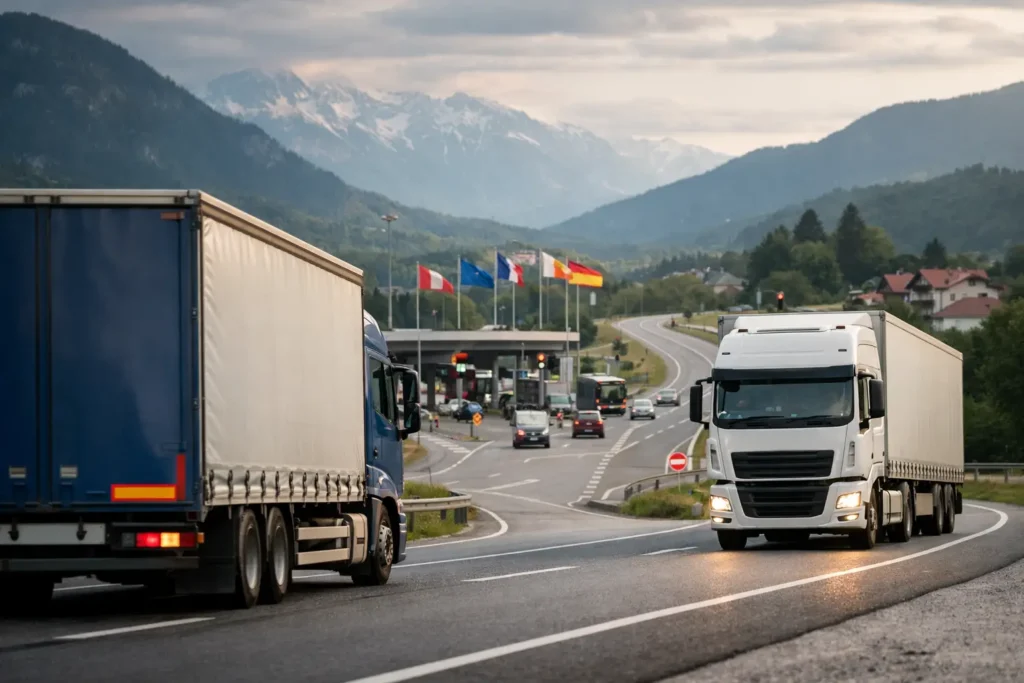
A delivery slot that looked realistic on Monday can be under pressure by Wednesday. A border crossing that moved smoothly last month can suddenly slow to a crawl. If you are asking why is road freight becoming less predictable in Europe, the short answer is that more variables now affect each movement, and they change faster than many supply chains can absorb.
For logistics managers and procurement teams, the issue is not just delay. It is wider planning risk. Production schedules, customer commitments, unloading bookings and stock levels all depend on road transport arriving when expected. When predictability drops, the cost does not stay in transport. It spreads across the business.
why is road freight becoming less predictable in Europe?
European road freight has always involved complexity, but the balance has shifted. There are now more pressure points across infrastructure, regulation, labour, weather and security. On their own, each factor is manageable. Combined, they create a network where small disruptions can have outsized effects.
That matters because road freight is still the mode many businesses rely on for cross-border flexibility. It supports routine replenishment, urgent shipments, industrial components, oversized loads and last-minute production requirements. Yet the same flexibility that makes road transport valuable also leaves it exposed to real-world disruption on every leg of the route.
More cross-border friction, even within established lanes
Many shippers assume that mature European routes should now be highly stable. In practice, even familiar corridors can become less reliable when border procedures, customs checks, local enforcement or transport documentation requirements tighten.
This is especially visible on movements that touch non-EU markets or pass through multiple jurisdictions. A shipment may be physically ready to move, but if one document needs amendment or one checkpoint changes its inspection pattern, transit time can stretch quickly. The effect is not always dramatic. Sometimes it is a series of small hold-ups that erodes delivery certainty by several hours, then by a full day.
For manufacturers and distributors, this is where planning starts to fail. Lead times may still look acceptable on paper, but they become harder to trust in operational reality.
Driver shortages are reducing buffer in the system
One of the biggest reasons road freight is becoming less predictable in Europe is the shortage of qualified drivers. This is not simply a recruitment issue. It changes how much spare capacity exists in the market.
When capacity is tight, there is less room to recover from disruption. A missed loading slot is harder to replace. A vehicle delayed by congestion may affect the next assignment. A time-critical load may still move, but only by paying more for priority capacity or changing the vehicle plan.
This is where experienced freight coordination matters. The transport market can still deliver under pressure, but only if the shipment is matched to the right service level and vehicle type from the outset. Treating all loads as standard freight is often where avoidable delay begins.
Congestion is no longer limited to the usual bottlenecks
Europe has always had known pressure points – ring roads around major cities, Alpine crossings, port approaches, industrial regions and major motorway interchanges. What has changed is the frequency and spread of congestion.
Urban restrictions, roadworks, event traffic, local strikes and seasonal peaks now affect secondary corridors as well as main routes. In some cases, hauliers divert to avoid one problem and run straight into another. A route that looked efficient at dispatch can become suboptimal by the time the vehicle reaches the next country.
For standard freight, this may mean a later arrival. For express freight, it can be decisive. If your business depends on delivery in a few hours or within 24 hours, route monitoring and response speed are not optional. They are part of the service.
Weather disruption is hitting harder and more often
Weather has always influenced road transport, but recent years have made conditions less stable. Heatwaves can affect tyre performance, road safety and driver working conditions. Flooding can close local access roads that are essential for final delivery. Snow and ice still disrupt mountain and northern routes, while heavy storms can create regional standstills with little warning.
The point is not that every weather event stops freight. It is that weather volatility reduces confidence in standard transit assumptions. If a lane has only one practical route, or if unloading depends on a narrow booking window, even moderate disruption matters.
This is one reason some shippers now review route resilience in more detail, not just headline transit time. The fastest route is not always the most dependable one.
Security risks are changing transport decisions
Cargo theft, unauthorised access, fraud and shipment tampering have become bigger concerns on certain lanes and for certain goods. Higher-value products, sensitive industrial materials and urgent shipments are particularly exposed because delay and security often interact.
A driver may need to avoid an insecure parking area. A route may need to be adjusted. Additional checks may be introduced before release or handover. All of this is sensible risk management, but it can reduce schedule flexibility.
For B2B shippers, the implication is clear. Predictability is no longer only about kilometres and traffic. It is also about how securely a movement can be planned and controlled from collection to delivery. That is why transport partners with strong operational follow-up, clear communication and confidentiality standards tend to perform better when conditions change.
Regulatory pressure is increasing operational complexity
Road freight is shaped by driving time rules, emissions policies, national restrictions, toll changes, vehicle access rules and compliance requirements for specific cargo types. None of this is new. What is changing is the pace and unevenness of implementation.
A route can remain commercially attractive yet become operationally more difficult because of local restrictions on vehicle class, delivery hours or documentation. Oversized or exceptional loads are even more exposed, as permits, escorts and route approvals can create narrow operating windows.
This is where transport predictability becomes lane-specific. Two shipments with similar distances may carry very different risk profiles depending on cargo type, destination conditions and border or permit requirements.
why road freight is becoming less predictable in Europe for shippers
For buyers of transport, the biggest mistake is to treat unpredictability as a carrier problem alone. Some causes sit outside any operator’s direct control. What matters is how well the shipment is prepared, monitored and adapted when conditions move.
Better outcomes usually come from better transport design. That includes giving complete shipment data early, choosing a realistic service level, allowing for route-specific risk and working with a partner that can communicate in real time across borders. If your transport provider only reacts once a delay is already visible to the customer, control has already been lost.
At MAP Transport, that principle shapes how shipments are managed across Europe. Standard loads, urgent consignments and specialist movements each need different planning logic, which is why services are separated into Classic Service, Xpress and UltraExpress, and Exceptional Shipments. That is not a marketing distinction. It is an operational one.
What practical steps reduce the risk?
Start with precision. Incomplete information about weight, dimensions, loading constraints or delivery conditions creates avoidable delay before the vehicle even moves. A fast quote is useful only if it is built on accurate shipment data.
Next, match urgency to the right mode of execution. Not every shipment needs dedicated express capacity, but genuinely time-critical freight should not be planned like routine groupage or standard full-load transport. Paying for the wrong service level can be as costly as paying too much.
It also helps to work with a partner that covers the full route with active coordination, not just booking. On volatile lanes, multilingual communication, border awareness and live follow-up make a measurable difference. If the route changes, someone needs to own the adjustment.
Finally, review reliability by corridor, not by headline average. One supplier may perform very well between Benelux and Germany, for example, but face recurring issues on south-east European routes. Predictability is contextual. Procurement decisions should be too.
If you are planning regular or urgent road movements, it is worth reviewing how your current transport setup handles exceptions, not just normal days. A shipment can be quoted quickly through the request a quote process, but the real value comes from what happens after booking – vehicle choice, follow-up, communication and response when conditions shift.
Road freight in Europe is unlikely to become simple again soon. Networks are under pressure, compliance is tightening and customer tolerance for delay is getting lower, not higher. The businesses that protect service best are usually not the ones chasing the cheapest rate. They are the ones building more control into each movement from the start, with the right partner behind them. For a market that now changes by the hour, that is what dependable transport looks like.