
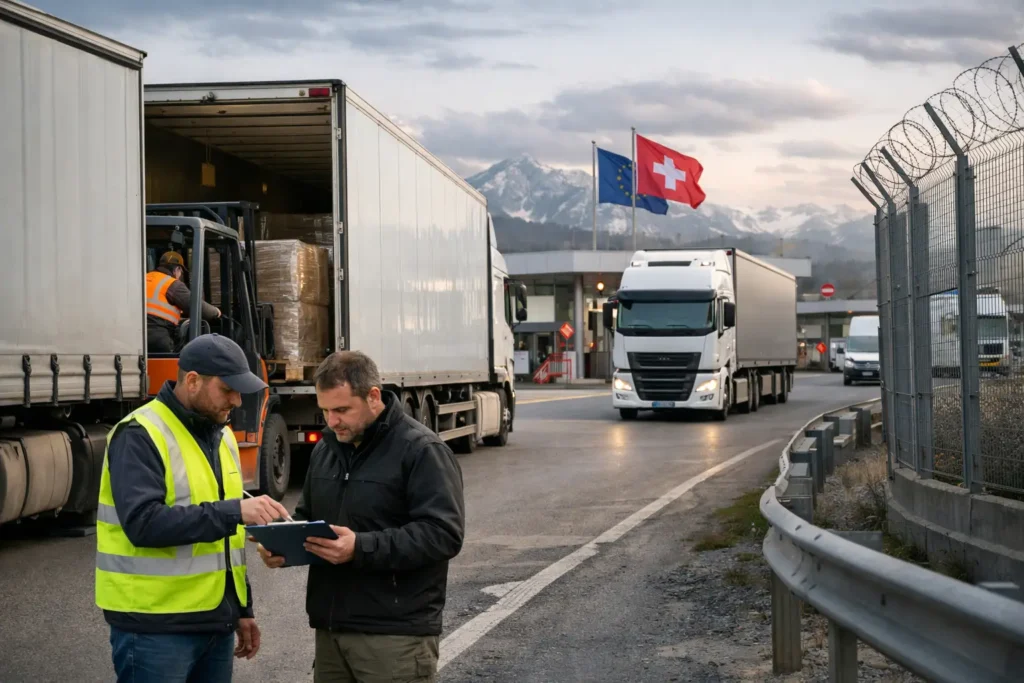
A delayed lorry at a border, an unsuitable vehicle for a high-value consignment, or an unanswered status request can quickly become a production issue rather than a transport issue. For supply chain managers, secure road transport solutions are not simply about preventing loss or damage. They are about protecting delivery commitments, confidential commercial information and the continuity of cross-border flows. This becomes especially relevant on routes involving the UK, Switzerland, Turkey or the Caucasus, where customs processes, transit times and local requirements introduce additional points of failure. Security must therefore be planned into the transport operation from quotation to final delivery.
Security starts before the vehicle is assigned
The most effective transport risk control happens before collection. A freight movement cannot be secured properly if the planner does not have the full operational picture: the precise collection and delivery addresses, commodity type, weight, dimensions, loading requirements, delivery deadline and any customs status.
A request described simply as “three pallets to Turkey” leaves too much room for error. Is the cargo stackable? Does it require a curtain-sided lorry, a dedicated vehicle or an express van? Is the consignee able to receive the goods immediately after customs clearance? Are commercial invoices and packing lists aligned with the physical shipment? Each answer affects both risk and cost.
For sensitive, time-critical or high-value consignments, vehicle selection should follow the shipment requirement rather than a standard template. A dedicated van may be more appropriate than groupage when a manufacturer needs a replacement component delivered from northern Spain to southern Germany before a production line stops. For a larger shipment, a direct full-load lorry can reduce handling points and therefore reduce the opportunity for damage, misrouting or delay.
This approach also protects confidentiality. Clear instructions should be shared only with the operational parties who need them, while collection and delivery contacts must be confirmed before dispatch. A secure movement begins with accurate data and accountable planning, not with tracking alone.
Secure road transport solutions need control at every handover
Every additional handover creates a potential gap in visibility. Consolidated transport can be cost-effective for flexible freight, but it may not be the right choice where delivery certainty, limited handling or confidentiality is the priority. The decision depends on the cargo value, urgency, route complexity and consequences of a missed delivery slot.
For routine European flows, a planned groupage or part-load service can offer a sensible balance between price and performance. However, an urgent shipment to a factory in the UK may justify a dedicated express vehicle. The higher transport cost can be substantially lower than the cost of an idle production line, missed vessel connection or contractual penalty.
Operational control should cover the full chain: confirmed collection, vehicle allocation, loading verification, route monitoring, customs preparation where required, delivery appointment management and proof of delivery. The objective is not to send generic updates. It is to identify a deviation early enough to act on it.
A useful operational rule is this: the transport provider should be able to explain who owns the next action at any point in the journey. If a vehicle is waiting at a border, someone must be checking the document status. If a delivery site changes its opening hours, someone must inform the driver and assess the impact. If cargo cannot be unloaded, someone must decide whether the vehicle waits, redirects or returns.
Customs control is part of freight security
On EU-only movements, the main risks may be collection readiness, traffic restrictions or delivery access. On non-EU routes, customs adds another layer of exposure. The UK, Switzerland, Turkey, Azerbaijan and Kazakhstan all require disciplined document management and close coordination with the importer, exporter and customs representatives.
According to the European Commission, customs formalities are central to the movement of goods entering or leaving the EU customs territory. In practical terms, incomplete or inconsistent paperwork can stop a vehicle even when the cargo and route plan are otherwise correct.
A common example is a UK-bound machinery spare part sent under extreme time pressure. The consignor may have the goods ready, but an incorrect commodity description, missing value information or unclear Incoterms can delay clearance. The lorry then waits, the delivery window is lost and the urgency that justified express transport is undermined.
To reduce this risk, document checks should happen before collection, not when the vehicle reaches the port or border. The key files usually include the commercial invoice, packing list, transport instruction and any route-specific customs references. For specialised or regulated goods, additional information may be necessary. The exact requirement depends on the commodity and destination, which is why a tailored review is more reliable than assuming a previous shipment can simply be repeated.
Visibility matters only when it leads to action
Many shippers have access to location updates. Fewer receive useful operational follow-up when a movement changes course. A location pin does not resolve a missed ferry, a border inspection or a driver arriving before a site opens. Secure road transport solutions require monitoring backed by people who can make decisions and communicate in the right language with the right party.
This is particularly valuable on long-distance routes where several stakeholders are involved. A manufacturer in France, a carrier collecting in Germany, a broker handling formalities and a consignee in Turkey may all need a different update. Multilingual coordination avoids delays caused by unclear instructions or messages sitting unanswered outside local working hours.
The most useful status reporting is specific. It confirms whether the vehicle has loaded, whether the shipment is progressing to plan, whether customs formalities are complete and whether the final delivery time remains achievable. If there is a problem, the update should state the impact, the corrective action and the next expected milestone.
For urgent transport, this level of follow-up is essential. A delivery promised in a few hours cannot be managed through occasional check-ins. It needs active supervision from collection through to proof of delivery.
Match the service level to the consequence of failure
Not every consignment needs the same security model. Overspending on a dedicated vehicle for low-priority stock can damage transport budgets. Equally, choosing the cheapest option for a critical component can create far greater costs downstream. The practical question is not “What is the lowest freight rate?” but “What is the financial and operational impact if this shipment is late, damaged or unavailable?”
Three service choices often cover most requirements:
- Standard road freight for planned flows where transit time is important but flexible enough for consolidation or scheduled departures.
- Express or UltraExpress transport for urgent goods that need a dedicated vehicle and delivery in hours or under 24 hours across Europe, depending on distance and route conditions.
- Exceptional shipment management for oversized, heavy or non-standard cargo requiring specialist vehicle planning, loading coordination and route assessment.
A metal supplier moving a standard palletised export to Belgium may prioritise an economical scheduled service. The same supplier sending a replacement die to a customer in Scandinavia after an equipment failure will need a different decision: direct collection, suitable vehicle capacity, regular progress updates and delivery arranged around the receiving site’s availability.
Security is therefore not one feature added to a transport booking. It is the result of selecting the appropriate service, vehicle, route plan and communication level for the business consequence of failure.
Build security into your transport brief
Supply chain teams can improve transport performance by treating the transport brief as a risk-control document. Include the exact goods description, dimensions, weight, loading method, cargo value where relevant, deadline, collection and delivery contacts, site restrictions, customs status and any handling constraints. If the shipment is urgent, state why. A genuine production-critical movement should be planned differently from an order that is merely preferred sooner.
It also helps to agree escalation expectations in advance. Who should be contacted if collection is missed? Who can approve a delivery change? What evidence is required at handover? These details prevent delays when a problem occurs outside normal office hours.
MAP Transport has coordinated international road freight since 1985, supporting more than 200 customers each year with standard, express and exceptional movements. For complex routes, the value lies in having one team responsible for matching the service to the shipment and keeping the customer informed throughout transit.
The strongest transport plan is the one that gives your team fewer surprises, even when the route is demanding and the delivery window is tight.
Have a question or need a quote? Contact us at (+34) 943 62 95 77 (ask for Raquel) or by email at lo*******@**********rt.com
Need support on your transport flows? Contact our team for a tailored solution.