
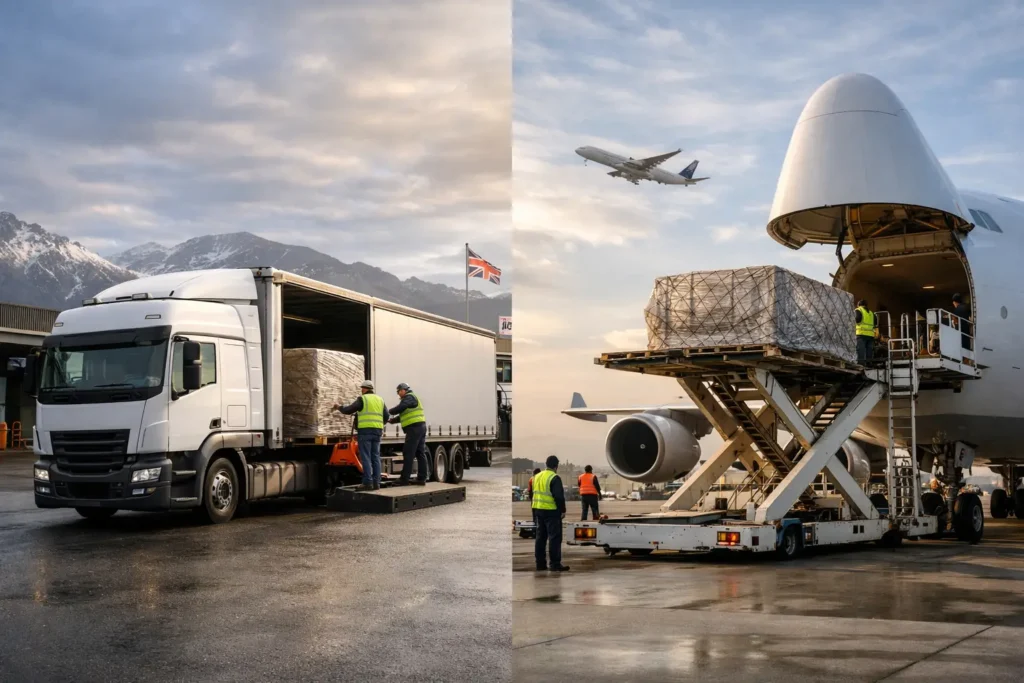
A production line in Birmingham is waiting for a replacement component from northern Italy. The part is small, the delay is expensive, and the procurement team has two options: book air freight or send a dedicated road vehicle. Road freight vs air freight is rarely a simple cost-versus-speed decision. Collection cut-off times, customs exposure, final-mile delivery, shipment dimensions and the cost of downtime all change the answer. For European manufacturers and importers, the best mode is the one that protects the delivery commitment without paying for speed that the shipment does not actually need.
Road freight vs air freight: start with the real deadline
Air freight is the obvious choice when transit time is measured in hours, particularly for high-value parts, medical products or production-critical components. But airport-to-airport transit is not the same as door-to-door delivery. Freight must be collected, delivered to a handling agent, screened, loaded, unloaded, cleared and moved from the destination airport to the consignee.
For shipments within Europe, this process can narrow air freight’s practical advantage. A dedicated van collected in Belgium at 08:00 can often deliver in Germany, northern France or the Netherlands the same day. On longer lanes, a two-driver express service can move urgent freight across Europe in under 24 hours, while avoiding airport handling queues and transfer points.
The operational question is not, « Which mode is fastest? » It is: « What is the latest safe delivery time, and which transport plan gives us the highest certainty of meeting it? »
A useful rule is to work backwards from the required delivery slot. Account for loading readiness, collection time, customs formalities where relevant, border crossings, airport cut-offs and the consignee’s receiving hours. If air freight saves only a few hours but introduces an extra handover and a difficult final-mile delivery, dedicated road transport may be the lower-risk option.
Compare total landed transport cost, not the headline rate
Road freight is usually more cost-effective for medium and larger shipments travelling within Europe. It can carry pallets, industrial equipment, lengthy goods and awkward dimensions directly from supplier to consignee. There is no requirement to build the shipment around airline unit-load devices, airport acceptance rules or strict volumetric charging thresholds.
Air freight charges are heavily influenced by volumetric weight. A light but bulky crate can be priced as though it weighs far more than its physical weight. Road pricing is also affected by space and vehicle selection, but a tailored vehicle can be a better fit for freight that is oversized, non-stackable or difficult to handle at an airport.
Consider a manufacturer moving four pallets of urgently needed packaging machinery parts from Spain to the UK. Air freight may appear attractive because the flight itself is short. However, once collection, cargo terminal handling, security screening, export formalities, UK import clearance, airport delivery and final transport are added, the cost and delivery risk rise quickly. A direct road movement can collect from the supplier, cross by ferry or tunnel, complete the required customs process and deliver to the plant under one coordinated plan.
That does not mean road is always cheaper. A small, dense consignment needed in Istanbul the following morning may justify air freight if the alternative is a dedicated vehicle travelling several days. The decision depends on the value of the goods, the financial impact of delay and whether a direct road route can meet the committed date.
Direct delivery is road freight’s practical advantage
The main strength of road freight is control over the full journey. A lorry or dedicated van can load at the shipper’s site and deliver directly to the consignee, with fewer handovers than an airport-based movement. Fewer handling points generally mean lower exposure to misrouting, damage and information gaps.
This matters for industrial consignments that cannot sit in a general cargo terminal. Metal components, machinery parts, sensitive prototypes and regulated materials may require specific securing, documentation or delivery arrangements. A planned road movement allows the vehicle type to match the cargo rather than forcing the cargo into a standard airfreight process.
Road remains the dominant mode for inland freight across the EU, accounting for roughly 77% of tonne-kilometres. That reflects a practical reality for supply chain teams: most European origin-to-destination flows are connected by road, and factories, distributors and construction sites receive goods at loading bays rather than airports.
For routine imports and exports, road transport also supports a range of service levels. Groupage can reduce cost when timings are flexible. A dedicated vehicle gives greater control for sensitive or high-priority loads. Express vans and two-driver services are designed for deliveries where every hour matters. The correct choice is therefore not simply road or air, but standard, dedicated or urgent road transport based on the service failure your business needs to avoid.
Customs can outweigh the transport mode
Customs is where many apparently fast transport plans lose time. This is particularly relevant on routes involving the UK, Switzerland, Turkey and the Caucasus, where border documentation and clearance readiness must be considered before the vehicle or aircraft is booked.
Air freight does not remove customs requirements. It may place them under greater time pressure because cargo has to meet flight cut-offs and airport acceptance deadlines. Missing a document, commodity code, invoice detail or import instruction can mean the freight misses its planned departure or waits after arrival.
Road freight gives planners more flexibility to coordinate documentation alongside the physical movement. On a UK-bound shipment, for example, the haulier, exporter, customs agent and importer can align export declarations, transit arrangements, safety and security information and clearance instructions before the vehicle reaches the port or Channel crossing. The road journey still has customs risk, but it is managed as part of one door-to-door operation.
For Turkey or Kazakhstan, transit planning becomes equally important. The fastest theoretical route is of little value if the paperwork, border sequence or vehicle suitability has not been checked in advance. An experienced freight partner should confirm the commercial invoice, packing list, commodity information, cargo dimensions, loading conditions and delivery contact before dispatch. This prevents urgent freight becoming urgent only because basic data was missing at booking.
When air freight is the right decision
Air freight earns its premium when the commercial cost of delay is higher than the additional transport cost. It is usually the stronger option for very small, high-value consignments travelling long distances, emergency stock replenishment, critical samples and components needed before a road movement could physically arrive.
It can also be appropriate where a customer has a firm next-day requirement far beyond practical driving distance. If a supplier in Europe must send a compact replacement part to a destination where direct road transit would take several days, air may be the only credible route to protect production.
Before approving air freight, supply chain managers should test four points:
- Is the goods-ready time early enough to meet the airport cut-off?
- Can the shipment clear security and customs without special restrictions or missing data?
- Is delivery required airport-to-airport or door-to-door?
- What is the cost of a one-day delay compared with a dedicated express road vehicle?
The final point is often missed. A dedicated road solution can be more predictable than consolidating an urgent consignment into an airfreight chain, especially when the consignee is far from the arrival airport or needs a timed delivery outside standard hours.
Build mode choice into your transport planning
The most effective businesses do not make the road freight vs air freight decision from scratch on every shipment. They define escalation rules for regular lanes. For example, standard road freight may be the default for planned movements between France and Germany, dedicated road transport for production-critical loads, and air freight only when the required delivery date falls outside road capability.
This approach controls premium spend while giving operations teams a clear response when a supplier is late. It also improves communication with purchasing and production teams, who can see the cost and risk consequences of requesting a faster mode.
The key operational insight is that urgency should be measured from goods readiness to delivery, not from departure to arrival. A shipment that is ready late in the day may not benefit from air freight if it misses the cut-off. A dedicated express vehicle, collected immediately and monitored throughout transit, may create the more dependable recovery plan.
MAP Transport has coordinated international road freight since 1985, matching standard, express and specialist vehicle solutions to the shipment rather than applying a one-size-fits-all service. For European flows, including complex customs routes, the right plan starts with precise information: origin, destination, collection time, weight, dimensions, cargo type and the real consequence of late delivery.
The better transport choice is the one that reaches the consignee when promised, with customs and handling risks already accounted for – not simply the one that looks quickest on a transit-time chart.
Need support on your transport flows? Contact our team for a tailored solution.
Have a question or need a quote? Contact us at (+34) 943 62 95 77 (ask for Raquel) or by email at lo*******@**********rt.com