
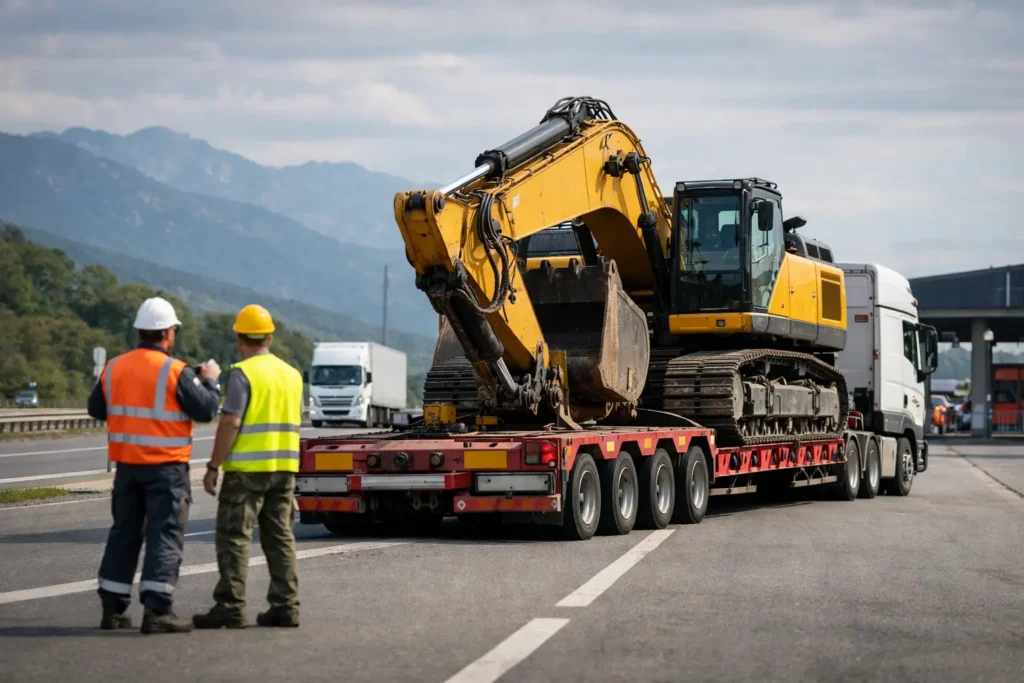
A production line is ready, an installation crew is booked, and the machinery cannot leave because its true transport dimensions were confirmed too late. This is a familiar and costly situation for industrial supply chain teams. The best way to ship oversized machinery by road is not simply to find a low-loader and book a collection. It is to establish the load profile early, design a legally workable route, secure the right permissions and manage every handover to site. For cross-border moves, particularly into the UK, Switzerland or Turkey, customs timing must sit within the transport plan rather than be treated as paperwork at the end.
Start with the machinery, not the vehicle
Oversized machinery should be assessed in its transport condition, not its catalogue condition. A machine may be within normal limits once a removable guard, hopper or control cabinet is packed separately. Equally, a load that appears manageable can become exceptional when its base frame, lifting points or centre of gravity are considered.
Before requesting a quote, provide the final packed length, width, height and gross weight. Include photographs from all sides, the machine’s centre of gravity where known, lifting instructions, loading and unloading addresses, and the site contact responsible for access. The transport planner also needs to know whether the unit can be driven, rolled, lifted by crane or loaded with a forklift.
This information determines whether the shipment requires an open trailer, a low-loader, an extendable trailer or another specialist arrangement. Choosing the vehicle first can create avoidable problems: insufficient deck length, an excessive overall height, an unsuitable loading angle or a load distribution issue that prevents legal movement.
A practical example is a 28-tonne CNC machining centre travelling from northern Spain to a customer site near Birmingham. The machine itself may fit a suitable low-loader, but the journey can still depend on whether the collection factory has crane capacity, whether the UK delivery site has booked an unloading slot and whether the importer can clear the goods promptly at the border. The road movement is only one part of the operation.
The best way to ship oversized machinery by road is route-led
For standard freight, a direct motorway route is often the sensible starting point. Exceptional loads need a different approach. Height restrictions, bridge weights, roundabout geometry, roadworks, city restrictions and local escort requirements can change the route, the transit time and the cost.
A route survey should confirm that the loaded vehicle can pass safely from gate to gate. This includes the last kilometres at each end, where industrial estates, narrow entrances, overhead cables and parked vehicles often create more risk than the motorway network. A delivery that reaches a site but cannot turn through the gate is not a successful delivery.
The operational insight is simple: overall height is usually the dimension most likely to change the route. A few extra centimetres can rule out underpasses or force a longer diversion. Reducing transport height by removing a non-essential component may therefore save more time and cost than it adds in packing or reassembly work.
Permit rules vary by country and, in some cases, by region or local authority. Lead times also vary. The best plan builds in contingency for authority approvals and does not promise a collection date before the route and permissions have been validated. This matters especially on multi-country journeys, where one restriction can affect the entire schedule.
MAP Transport coordinates movements across 45 countries and can align the transport method with the actual dimensions, route and delivery constraints rather than applying a one-size-fits-all service.
Build permits, escorts and site handling into one plan
An exceptional shipment may require transport permits, warning markings, escort vehicles, restricted movement windows or police coordination, depending on the dimensions and countries involved. These are not optional administrative details. They influence when the lorry may travel, where it can stop and whether the planned delivery appointment remains realistic.
Site handling deserves the same attention. Confirm crane capacity, reach, lifting accessories, ground bearing capacity and space for the lorry to position. If unloading is due at a construction site or a live manufacturing facility, establish who controls the gate, where the vehicle waits and what happens if the unloading team is delayed.
For machinery that must arrive before a shutdown weekend, the plan should include a clear escalation route. If the original unloading slot becomes unavailable, the operator needs an agreed decision-maker who can authorise a revised arrival time, secure overnight parking or arrange temporary holding. Leaving these decisions until the driver reaches site creates cost and safety exposure.
Where possible, schedule a joint pre-transport call between the shipper, consignee, lifting contractor and transport coordinator. It takes little time, but it exposes practical gaps early: an unconfirmed crane booking, missing rigging, restricted gate hours or a machine that has not been made ready for loading.
Treat UK, Switzerland and Turkey customs as a transport milestone
Cross-border oversized machinery moves are particularly sensitive to border delays because the vehicle may be travelling under permit conditions or to a tightly controlled delivery slot. The customs file must be complete and available before departure, not assembled while the lorry waits at a frontier.
For UK movements, confirm the importer of record, commodity classification, customs declarations, commercial invoice, packing details and any supporting origin evidence. Switzerland requires equivalent discipline, despite its central position within European road flows. Turkey and routes onward towards the Caucasus can involve longer border processes, document controls and timing constraints that must be factored into the schedule.
The key question is not just, “Are the documents prepared?” It is, “Can the consignee clear the goods at the point and time the vehicle arrives?” If the answer is uncertain, the transport plan needs a controlled alternative rather than an assumption.
For temporary exports, demonstrations, repairs or returns, establish the customs procedure before loading. A machine travelling out for service and coming back into the EU should not be handled like an ordinary sale. Incorrect documentation can lead to avoidable duty exposure, delays and disputes over the machine’s status.
Urgent transport is possible, but speed cannot replace compliance. Where an installation deadline is fixed, early document checks and real-time communication are more valuable than trying to recover several lost days with a faster vehicle.
Control risk through packing, securing and communication
Machinery damage claims often begin with a small planning failure: loose accessories, unprotected control panels, insufficient weather protection or a centre of gravity that was never communicated. The load must be prepared for road forces, not merely for storage on the factory floor.
Protect sensitive surfaces and electronics, secure movable components, drain fluids where required, and separate fragile accessories into properly identified transport units. The securing method should match the machine’s approved lashing points and weight distribution. Never assume that a standard arrangement is suitable for a specialist load.
Communication should be equally structured. Agree collection readiness, border status, estimated arrival, permit restrictions and delivery completion points before the vehicle departs. For time-critical or high-value machinery, a single operational contact on each side reduces conflicting instructions and gives the driver a clear route for escalation.
Cost control comes from certainty, not from selecting the cheapest initial rate. A quote should reflect the actual dimensions, route restrictions, permit requirements, customs process, loading method and delivery conditions. If these items are unclear, the lowest headline figure can become the most expensive option once waiting time, failed delivery or re-planning is added.
Plan early enough to protect the installation date
The best way to ship oversized machinery by road is to treat the movement as a coordinated project with a transport deadline, not a last-minute booking. Confirm the machine’s final dimensions, route viability, permissions, customs responsibility and site readiness before committing the installation team. That approach protects the delivery date, the equipment and the budget.
For urgent, heavy or non-standard loads, experienced coordination makes the difference between a vehicle arriving at the right place and a delivery being genuinely ready to complete. MAP Transport has managed specialist road freight since 1985, combining tailored vehicle planning with personalised follow-up throughout transit.
Need support on your transport flows? Contact our team for a tailored solution.
Have a question or need a quote? Contact us at (+34) 943 62 95 77 (ask for Raquel) or by email at lo*******@**********rt.com