
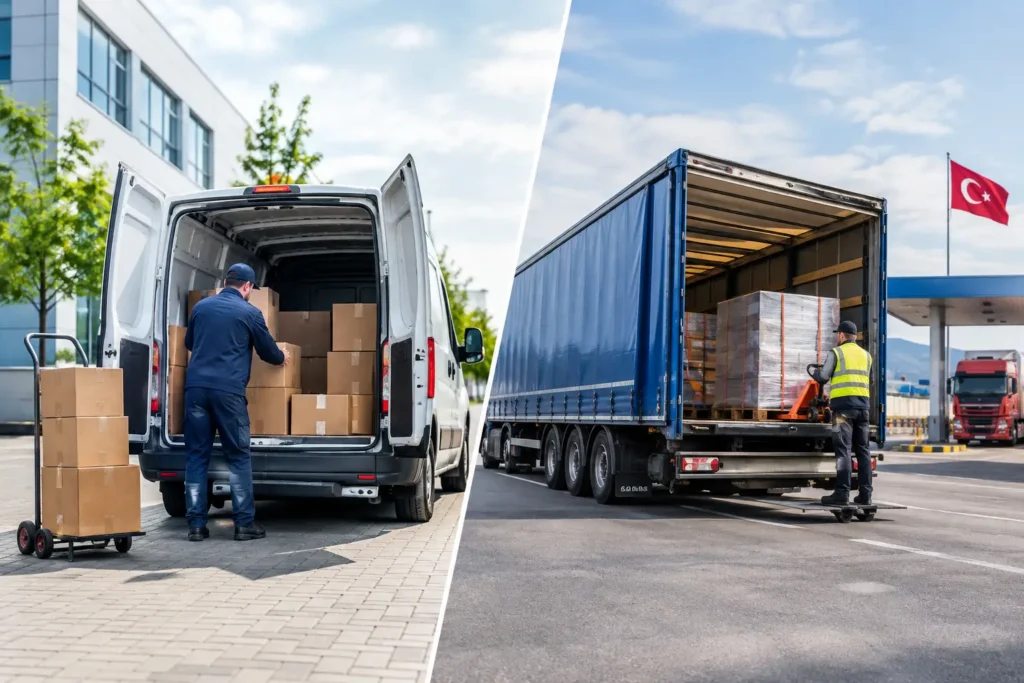
A late production release in Birmingham, a machine part needed in Lyon before the next shift, or a customs-sensitive consignment heading to Switzerland: the wrong vehicle choice can turn a manageable movement into a costly exception. The van delivery vs lorry delivery decision is not simply about physical space. It determines how quickly a collection can be arranged, whether a shipment travels directly or through a network, how customs documents are managed, and what a delay will cost the receiving site. For cross-border road freight, vehicle selection should begin with the operational consequence of arriving late, not with the cheapest headline rate.
Van delivery vs lorry delivery: start with the shipment profile
A van is usually the stronger option when time, control and direct movement matter more than unit cost. It suits urgent pallets, cartons, prototype parts, replacement components and documents that need dedicated collection and delivery. With a vehicle assigned to one consignment, the route can be planned around the collection window and delivery deadline rather than a multi-stop schedule.
A lorry is normally the more commercially effective choice for standard freight, larger volumes and repeat flows. Whether the load moves as a full vehicle, part load or consolidated shipment, the available capacity spreads transport cost across more goods. It is also the sensible option where loading requires a loading bay, where several pallets are ready together, or where the consignee accepts a planned delivery slot.
The first decision should be based on four practical questions:
- What is the actual ready time, including packing and export documentation?
- What is the latest acceptable delivery time at the consignee?
- How much space, weight and loading equipment does the shipment require?
- What is the cost of production stoppage, missed installation or customer downtime?
A compact urgent load may physically fit in either vehicle. That does not mean both services deliver the same result. The relevant comparison is the total risk to the transport flow.
When van delivery protects delivery time
Dedicated van transport is built for consignments that cannot wait for consolidation, terminal handling or a fixed departure cycle. Once collected, the shipment can travel directly to its destination with fewer handovers and fewer points where timing can slip. For a critical spare part, that reduction in handling is often worth more than the difference in freight price.
Consider a manufacturer in northern England whose customer in Belgium has a failed production-line component. If the part is ready at 14:00 and the line needs it the following morning, waiting for a standard groupage departure may not be viable. A dedicated van can collect at short notice, move through the Channel crossing on the most suitable schedule and deliver directly to the site. The transport plan is based on the customer’s production deadline, not a network timetable.
This is also where communication matters. Urgent transport does not eliminate disruption from traffic, ferry capacity, weather or border checks. It gives the transport team more control over the response. A dedicated vehicle can be rerouted, its crossing adjusted or the consignee informed quickly if the collection time changes.
Vans are particularly useful when the shipment is high-value relative to its size, sensitive to delay or requires confidentiality. However, they are not automatically the best answer for every urgent request. If the cargo is too large, needs specialist securing, requires tail-lift access or has handling restrictions, a larger or specialist vehicle may be necessary. Speed still depends on selecting equipment that can be loaded safely and legally.
When lorry delivery makes better commercial sense
For regular European freight flows, a lorry service offers the capacity and planning discipline that keeps transport spend under control. It is the natural choice for multi-pallet orders, industrial materials, packaged goods and shipments where the delivery window is planned in advance. A full load also reduces handling compared with moving the same volume through several separate urgent vehicles.
The economic advantage becomes clearer when shipments can be consolidated. A distributor sending regular palletised goods from Spain to Germany may gain more from fixed collection days and planned departures than from booking individual direct vehicles. Predictable loading volumes allow the transport provider to match the correct vehicle, plan the route efficiently and give the receiver realistic delivery information.
A lorry service is not synonymous with slow service. Good planning can provide dependable transit times across Europe, particularly when collection readiness, loading hours and delivery appointments are confirmed early. The operational risk appears when a standard service is asked to absorb an unplanned deadline without allowing for the time needed to collect, consolidate and transit.
For larger consignments, the right question is often whether to use a dedicated full load or a part load service. A full load offers greater control over timing and handling. A part load can reduce cost when the delivery date has flexibility. The choice should reflect the receiving operation, not just the number of pallets.
Border crossings can change the vehicle decision
Customs-sensitive routes require a different level of scrutiny. The UK, Switzerland and Turkey are not simple intra-EU movements, so vehicle availability alone does not guarantee a successful collection. Commercial invoices, packing lists, commodity information, customs declarations and the parties responsible for clearance must be aligned before departure.
A van may be the right operational answer for an urgent shipment from France to the UK, but only if the export and import data are complete before it reaches the border. A fast vehicle waiting for a missing reference, incorrect consignee details or an unclear goods description is not express transport. It is an expensive delay.
The same principle applies to lorry freight. For routine flows into Switzerland or Turkey, a well-prepared standard service can be more reliable than an urgent booking made after documents have been rushed. Customs planning should therefore be part of vehicle selection from the first quote request. State the commodity, value, Incoterms, origin, destination and any specific controls at the outset.
This is especially relevant for industrial goods, regulated materials and non-standard consignments. If a load requires specialist handling or has unusual dimensions, the documentation, route permissions and vehicle choice must be coordinated together. Separating those decisions creates avoidable risk.
Compare total transport cost, not just the rate
A van often carries a higher cost per pallet or per kilogram because the customer pays for dedicated capacity and speed. A lorry movement can offer a lower unit cost, particularly for standard freight that can be consolidated. But neither price is meaningful without the cost of failure.
For example, a lower-cost lorry service may be the correct choice for a 10-pallet replenishment order with a five-day delivery window. It is unlikely to be the correct choice for one pallet containing a component that prevents a customer from restarting production. In the second case, the extra cost of a dedicated van may be small compared with a day of lost output, engineer downtime and contractual penalties.
When comparing quotes, procurement teams should look beyond the line-haul figure. Check whether the price reflects direct or consolidated transport, likely collection time, delivery commitment, border support, loading requirements and status updates. A clear scope prevents a low initial rate becoming a higher final cost through waiting time, failed collection or a service change after booking.
An operational insight worth applying: classify shipments by consequence of delay before asking for a quote. A simple internal label such as standard, priority, critical or exceptional helps teams avoid treating every request as urgent while ensuring truly time-sensitive freight receives the right response.
Build the vehicle decision into the booking process
The quality of the booking information determines the quality of the transport plan. Provide weight, dimensions, number of pallets, stackability, collection and delivery hours, goods description, ready time and required arrival time. For non-EU routes, include the customs status and the contact responsible for clearance.
MAP Transport has coordinated road freight since 1985 and covers 45 countries, including complex routes involving the UK, Switzerland, Turkey and the Caucasus. The value of an experienced freight partner is not simply access to vans and lorries. It is the ability to challenge an unsuitable request early, match the service to the commercial risk and keep the shipper informed throughout the movement.
The most useful closing thought is simple: use a van when a delay would materially damage the operation, and use a lorry when planned capacity delivers the better outcome. The strongest transport decision is the one that protects both the delivery commitment and the wider supply chain.
Need support on your transport flows? Contact our team for a tailored solution.
Have a question or need a quote? Contact us at (+34) 943 62 95 77 (ask for Raquel) or by email at lo*******@**********rt.com