
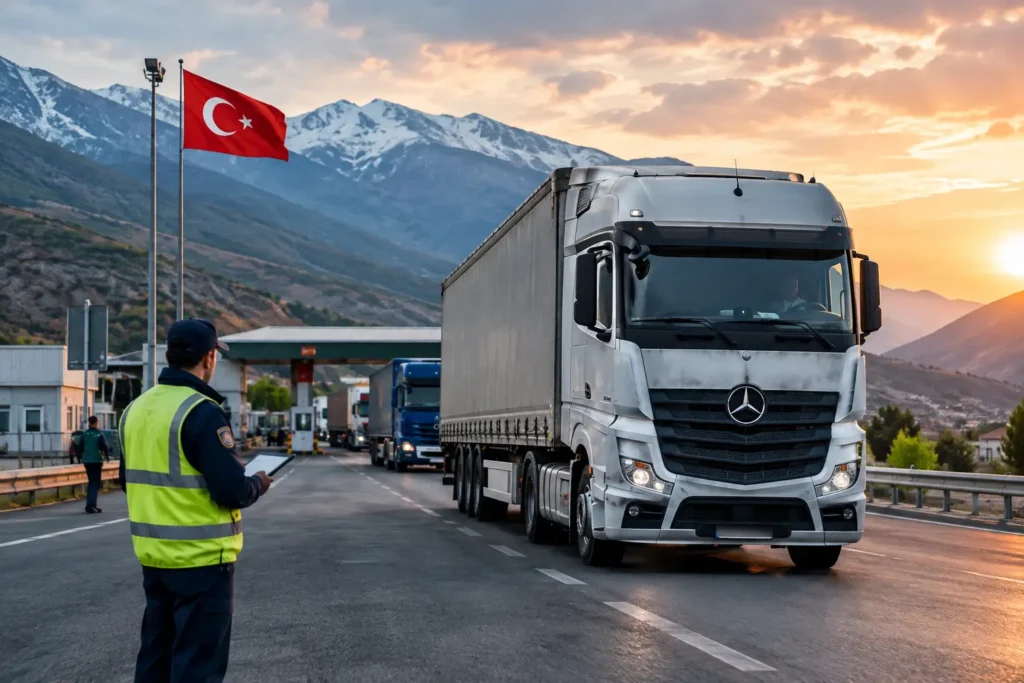
A production line in Central Europe waiting for components from Türkiye does not care that the vehicle left on time. It cares whether the lorry clears the border, whether the customs file is accepted first time, and whether the driver can still meet the delivery slot after a long queue. These are the top risks Turkish corridors create for importers, exporters and supply chain teams moving freight between Europe, Türkiye and the Caucasus. The route is commercially vital, but it is not a standard intra-European road movement. Delivery certainty depends on planning the route, documents, vehicle and contingency response as one operation.
Border queues can erase a planned transit margin
The Bulgaria-Türkiye border is one of the most important road gateways between the EU and Türkiye. Kapitan Andreevo-Kapıkule handles very high freight volumes, which makes it efficient when flows are stable but exposed when inspections, system outages, holiday peaks or traffic restrictions occur. A queue that moves slowly for several hours can turn a realistic delivery plan into a missed slot.
The main risk is not simply waiting time. It is the lack of certainty around it. A shipment scheduled with a narrow unloading appointment in Germany, France or Benelux may have no meaningful recovery time once the vehicle is delayed at the frontier. The same applies to traffic moving through Greece via Kipi-İpsala, particularly when capacity shifts from one crossing to another.
Operationally, the right question is not, “What is the normal transit time?” It is, “What happens if border clearance takes a day longer than normal?” For time-critical freight, that answer may require a dedicated van, a team-driver solution on the European leg, or a pre-agreed recovery option after clearance.
A useful constraint is driver-hours compliance. Under EU drivers’ hours rules, a driver is normally limited to 56 hours of driving in one week and 90 hours across two consecutive weeks. Border waiting may not always consume driving time, but it affects rest planning, parking options and the practical ability to recover a late schedule. Transit plans built around the theoretical maximum driving day are fragile from the outset.
Customs errors are among the top risks on Turkish corridors
Türkiye has a customs union relationship with the EU for many industrial goods, but this does not remove the need for controlled border formalities. The customs treatment depends on the commodity, origin, route and commercial terms. Export declarations, import entries, invoices, packing lists, transport documents, proof of origin where needed and transit paperwork must align before the vehicle reaches the frontier.
Small inconsistencies can create large delays. A commodity description that is too vague, an incorrect gross weight, missing supporting paperwork or a mismatch between invoice and customs declaration may result in queries, physical checks or a vehicle being held while the issue is corrected. For a standard replenishment load, this is costly. For an urgent production part, it can be critical.
Consider a manufacturer sending replacement machine components from northern Italy to Bursa. The goods may fit easily in a curtain-sided lorry, yet the movement can still fail operationally if the declared tariff classification does not match the description and supporting documents. The lorry is ready, the driver is available and the consignee expects delivery, but the load is not moving.
Build the document check into the transport schedule
A practical pre-departure control should verify the consignee’s customs instructions, invoice values and currency, package count, weights, commodity descriptions, Incoterms and any transit reference required for the route. This should happen before loading, not when the lorry is already approaching the border.
For sensitive goods or first-time flows, appointing a clear customs contact at both origin and destination reduces decision time when a query arises. There should also be agreement on who can authorise a correction outside normal office hours.
Permit availability and routing rules can limit capacity
Not every vehicle that is physically available can legally perform a Türkiye movement. Bilateral permits, multilateral permits, vehicle eligibility, driver documentation and country-specific restrictions can all affect capacity. This becomes more acute during seasonal peaks, when permit availability may be tighter and suitable vehicles are already committed.
The commercial consequence is often underestimated. A shipper may receive a competitive price based on an assumed loading date, only to discover that the proposed equipment or permit position does not support the planned route. The resulting change can increase cost, add days or require a different border crossing.
This is particularly relevant for freight continuing towards Azerbaijan or Kazakhstan through the Caucasus. The route is not just a longer version of a European delivery. It involves additional border interfaces, local operating constraints and route choices that should be evaluated against the cargo’s urgency, value and tolerance for delay.
For oversized or heavy cargo, the permit question becomes even more specific. Dimensions, axle loads, escort requirements and permitted travel windows may shape the route and departure date. Exceptional shipments need route validation before a collection commitment is made, rather than after the load has been prepared.
Security risk rises when vehicles are forced to wait
Long waits at borders increase exposure to cargo crime, tampering and informal approaches to drivers. Higher-value goods, electronics, automotive components and industrial equipment require particular attention, but lower-value loads can also become vulnerable when seals are broken or documents go missing.
Security should be designed around the actual journey. That means selecting secure parking where possible, using suitable sealing and checking procedures, providing clear escalation contacts for the driver and maintaining active shipment monitoring. For confidential or high-value freight, the information shared about cargo, route and delivery timing should be limited to those who need it.
The trade-off is cost versus exposure. A lower-cost plan that leaves a loaded vehicle waiting overnight in an unsuitable location can be more expensive than a monitored direct solution once the risk of loss, claim handling and customer disruption is considered. The right service level depends on the cargo and delivery consequence, not simply the pallet count.
Urgent freight needs a recovery plan, not a faster promise
When a Turkish corridor shipment is genuinely urgent, express transport is useful only if the operation has been designed for border reality. A dedicated vehicle can eliminate consolidation delays and provide direct communication, but it cannot bypass a customs hold caused by incomplete paperwork.
The strongest urgent plans separate what can be controlled from what cannot. Vehicle positioning, collection timing, driver handovers, customs preparation and destination availability can be organised. Queue duration and inspection selection cannot. This is why an urgent shipment needs a defined decision point: if the border delay exceeds an agreed threshold, who decides whether to keep the vehicle in place, change the delivery appointment or activate an alternative recovery measure?
Before confirming a time-critical movement, establish four points:
- the latest acceptable delivery time and the cost of failure;
- the exact documents and customs contacts required at each end;
- the preferred crossing and a viable secondary option;
- the communication cadence, including named contacts outside office hours.
This level of preparation is not bureaucracy. It allows the transport partner to act quickly when the plan changes, rather than waiting for approval while the delay grows.
How to reduce Turkish corridor risk before collection
The best risk reduction happens before the vehicle arrives. Build realistic border contingency into the lead time, particularly around public holidays, peak export periods and known congestion. Avoid booking a critical unloading slot immediately after the earliest possible arrival unless the receiver can accommodate a revised time.
Match the service to the shipment. A routine full load may be suitable for a standard planned service with careful document control. A line-stopping component may justify a dedicated Xpress movement, where collection, routing and progress updates are managed around a single consignment. A wide industrial unit needs specialist planning for permits, handling and route constraints.
It also helps to measure corridor performance by more than collection-to-delivery time. Track border dwell time, document-query frequency, missed slots, security incidents and the cost of expedited recovery. These figures show whether the issue lies in the carrier plan, customs data, consignee readiness or the route itself.
MAP Transport has managed complex European and Turkish road freight flows since 1985, coordinating vehicle selection, customs-sensitive planning and informed follow-up from collection to delivery. For supply chain teams, the objective is not to promise that every border crossing will be predictable. It is to ensure that an unpredictable event does not become an unmanaged business interruption.
A dependable Turkish corridor is built on realistic lead times, accurate paperwork and fast decisions when conditions change.
Have a question or need a quote? Contact us at (+34) 943 62 95 77 (ask for Raquel) or by email at lo*******@**********rt.com
Need support on your transport flows? Contact our team for a tailored solution.