
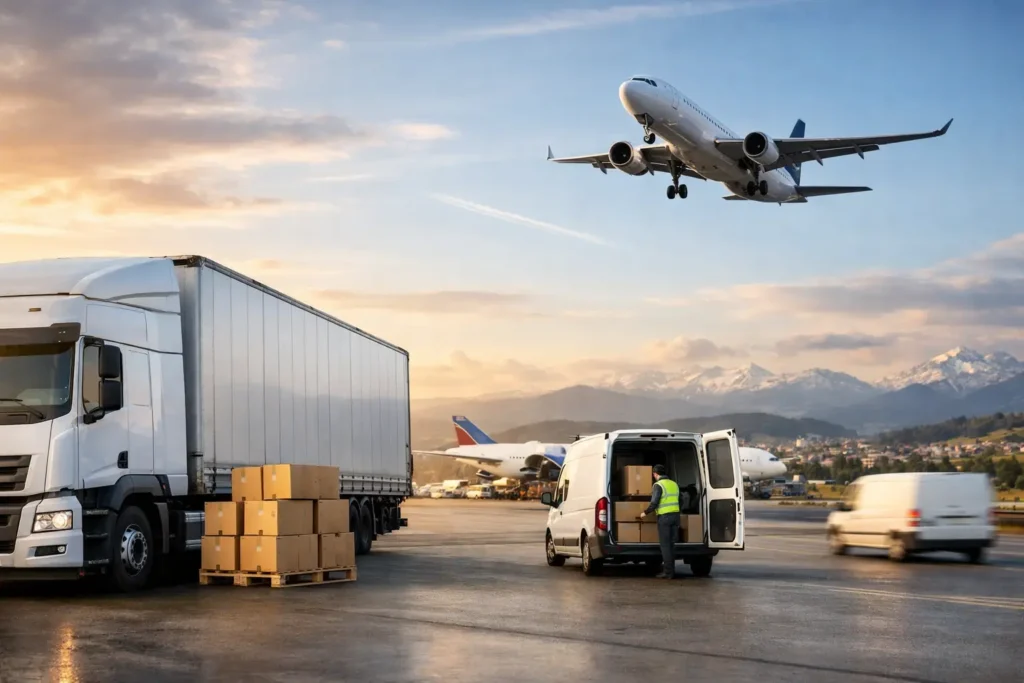
A production line stops at 10:15. A missing component in Lille needs to reach Stuttgart before the late shift. At that point, same day freight delivery Europe is not a marketing phrase. It is a cost-control decision, a customer-service decision, and sometimes a contract-saving decision.
For logistics managers and procurement teams, the real question is not whether urgent transport exists. It is whether a provider can assess the job quickly, choose the right vehicle, manage the route across borders, and keep control from collection to delivery. Same-day road freight can work extremely well across Europe, but only when the shipment, lane and timing make operational sense.
When same day freight delivery Europe is realistic
The first point to be clear about is distance. Not every European lane can be completed door to door on the same calendar day by road. If freight is moving between nearby industrial regions, or from one major cross-border corridor to another, delivery within hours may be entirely realistic. If the collection is in western Germany and the delivery is in Belgium, northern France, the Netherlands or Luxembourg, same-day service may be achievable with the right collection time and direct routing.
If the load needs to travel from Portugal to Poland, or from southern Spain to eastern Romania, the job may still be urgent, but the correct solution is more likely dedicated express road freight with the shortest possible transit rather than a same-day promise that creates unnecessary risk. Serious freight partners will tell you that early, not after the vehicle is loaded.
This is why urgent transport should always begin with operational validation. Collection postcode, delivery postcode, freight dimensions, loading constraints, border requirements and available time windows all affect whether same day is possible. The strongest providers do not force every shipment into one service model. They match the vehicle and the route to the actual requirement.
What makes urgent road freight succeed
Speed matters, but control matters more. A same-day shipment is usually won or lost before the vehicle departs. If quote response is slow, if vehicle allocation is vague, or if loading details are incomplete, the clock starts working against you.
The practical difference comes down to a few operational points. First, the shipment must be assessed immediately. Weight, pallet count, dimensions and whether the goods are stackable decide whether a van, tautliner, box vehicle or specialist equipment is required. Second, the route must be planned for direct movement rather than network handling. Same-day freight is generally not a groupage exercise. It is a dedicated transport decision.
Third, communication needs to stay active throughout transit. On urgent movements, buyers do not just want a booking confirmation. They want to know the vehicle is on site, loaded, moving, delayed or arriving. That level of follow-up is especially valuable when multiple sites, production teams or customers are waiting on the load.
This is where an experienced road freight partner adds value beyond pure price. A lower rate means very little if the shipment is allocated to the wrong vehicle, if a cross-border issue is missed, or if updates disappear once the lorry leaves the collection point.
same day freight delivery Europe for manufacturers and distributors
Manufacturers, industrial suppliers and distributors are usually not buying urgent freight because they enjoy paying for speed. They buy it because the cost of delay is higher than the cost of transport.
A plant shutdown, a missed installation slot, a failed customer delivery, or a stock-out at a distribution site can all justify same-day service. In those situations, the transport plan needs to support business continuity. That means direct collection, no unnecessary transhipment, and clear ownership of the movement from booking to proof of delivery.
For regular shippers, there is also a strategic point worth noting. The best urgent transport arrangements are often built before the emergency happens. When a freight partner already understands your lanes, packaging, site constraints and documentation needs, response times improve. Vehicle choice becomes faster, and fewer details need to be clarified under pressure.
Companies shipping across multiple European markets often benefit from having access to both standard and express services under one operational structure. Routine shipments can move under planned road freight schedules, while urgent consignments can be escalated to a dedicated express solution when required. That avoids the inefficiency of managing separate providers for every exception.
What affects transit time on a same-day shipment
Collection time is one of the biggest variables. A load ready at 07:00 has a very different set of options from a load confirmed at 15:30. Even on short lanes, late booking reduces routing flexibility and increases the chance of traffic-related delay.
Vehicle type also matters. A small urgent consignment may move fastest in a dedicated van because it can be collected quickly and routed directly. A larger or heavier load may need a lorry with a specific body type, tail-lift, ADR capability or loading arrangement. That extra requirement does not make urgent delivery impossible, but it does affect dispatch speed.
Then there are border and compliance considerations. Within much of Europe, road freight moves efficiently, but there are still country-specific restrictions, weekend driving rules, customs procedures on certain lanes, and paperwork requirements for some goods. Time-critical transport depends on getting those details right at the start.
Finally, there is the issue of realism. If a provider promises same-day delivery on every lane without asking enough questions, that is usually a warning sign. Reliable operators define what is possible, what is possible with conditions, and what should move as under-24-hour express instead.
Choosing a provider for same day freight delivery Europe
If you are comparing urgent freight partners, look beyond the headline promise. Ask how quickly they can quote, what information they need to validate the shipment, and whether the consignment will travel direct or enter a network. Confirm what updates you will receive and who is accountable if plans need to change mid-transit.
Coverage also matters. A provider with broad European reach can usually react more effectively across cross-border lanes than a carrier with limited regional depth. Experience with industrial freight, export flows and unusual load requirements is equally important, especially if your urgent shipments are not simple cartons on standard pallets.
It is also worth checking whether the business can support more than one urgency level. Not every shipment needs the same response. Some goods need delivery in a few hours. Others need next-morning arrival at the lowest possible risk. A transport partner that offers standard road freight, express options and specialist handling can usually guide the decision more accurately than one built around a single service type.
At MAP Transport, that approach sits at the centre of how urgent road movements are managed across 45 countries. Rather than treating every request as identical, the team aligns the service to the shipment, whether that means classic road freight, a faster xpress delivery solution or support for exceptional shipments. For buyers under pressure, that kind of flexibility reduces decision time and helps protect delivery performance.
How to prepare an urgent shipment properly
The fastest way to lose time is to send an urgent enquiry with incomplete information. If you need a rapid quotation and dispatch decision, provide the loading address, delivery address, goods description, total weight, dimensions, number of pallets or packages, and whether the freight is stackable or hazardous. Include the earliest collection time and latest acceptable delivery time, not just the date.
It also helps to confirm site conditions. Can a standard articulated lorry access the premises, or is a rigid vehicle or van required? Is there a forklift on site? Are there booking-in rules at delivery? If the goods are sensitive, high-value or confidential, say so from the start so the transport plan can reflect that.
For businesses moving urgent freight regularly, a standing process is even better. A simple internal checklist for emergency shipments can cut avoidable back-and-forth and speed up deployment. If your team already knows the information needed for a quote, urgent bookings become more manageable when time is tight.
Speed is useful. Certainty is better.
Same-day freight is at its best when it is treated as a controlled operational service, not a vague promise. The goal is not merely to move faster. It is to move quickly with the right vehicle, the right routing and the right level of follow-up so your business can make decisions with confidence.
If your operation depends on urgent cross-border road transport, the most useful partner is the one that will tell you what is achievable, act quickly once validated, and keep you informed at every stage. When that happens, speed stops being a gamble and starts becoming part of a dependable freight strategy. To plan your next urgent movement or request a no-obligation price, you can contact the team directly.
