
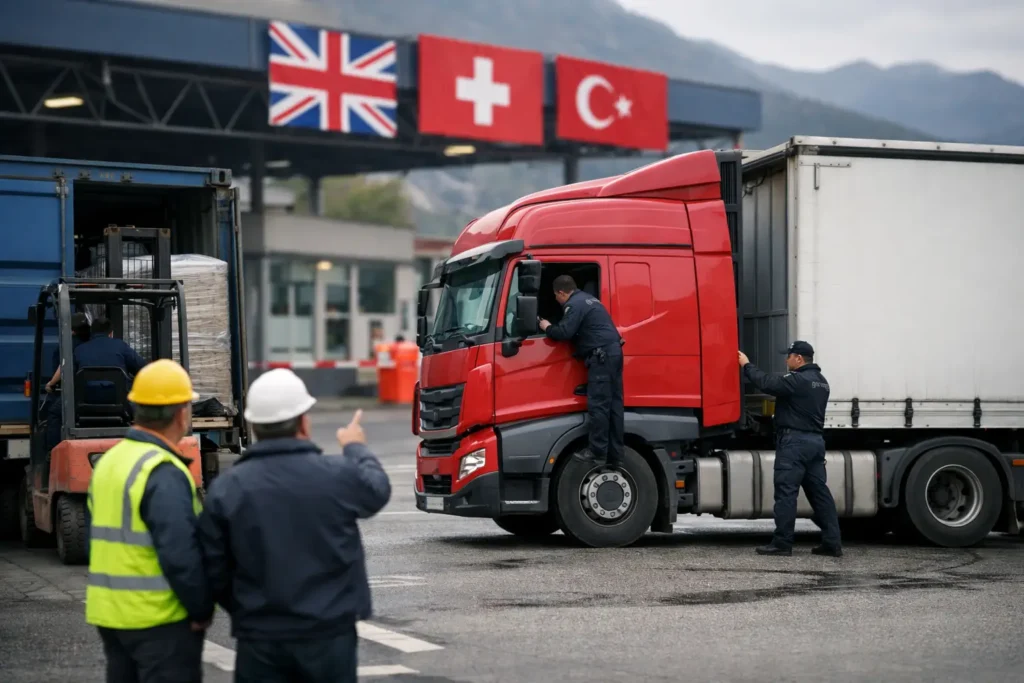
A missed collection in northern Italy, a customs document rejected at the Swiss border, an urgent replacement part stuck because nobody confirmed the correct vehicle type – these are not unusual failures. They are expensive, avoidable selection mistakes. The 5 biggest mistakes exporters make when choosing a transport provider usually happen long before the first pallet is loaded: at quotation stage, during carrier assessment, or when service expectations are left vague. For supply chain managers moving goods across Europe, the real issue is not finding a haulier. It is choosing a transport partner that can protect lead times, margins and customer commitments when the route gets complicated.
1. Choosing on price alone
The first mistake is also the most common. A low rate looks attractive in procurement terms, but road freight costs rarely sit neatly on the quotation. They show up later in waiting time, missed delivery windows, poor updates, rebooking fees and emergency recoveries.
This matters even more on complex cross-border routes. A shipment from Spain to Germany may be relatively straightforward. The same cargo moving into the UK, Switzerland or Turkey brings extra layers – customs formalities, border timing, document checks and tighter tolerance for errors. If the provider has priced aggressively without planning for those realities, the cost comes back to you.
According to the European Commission transport statistics{:target= »_blank »}, road freight remains the dominant mode for inland goods movement across Europe. That scale creates options, but it also creates noise. The cheapest option is not always the most controllable one.
A better test is total transport risk. Ask what is included in the rate, how deviations are handled, and who is responsible if delivery slots are missed. A provider that costs slightly more but keeps your customer informed, secures the right vehicle and resolves issues early is often the lower-cost choice over a quarter.
2. Ignoring route-specific expertise
Not every European route behaves the same way. Exporters often assume that if a provider covers « Europe », they can manage any lane with equal confidence. That is rarely true.
A regular movement to Benelux is one thing. A delivery into Norway in winter, a just-in-time load to the UK, or a shipment transiting towards Turkey is another. Border procedures, transit documents, ferry planning, driving restrictions and local delivery constraints all affect reliability. If your provider treats every route as standard groupage logic, performance suffers.
This is one of the 5 biggest mistakes exporters make when choosing a transport provider because route knowledge is hard to spot in a sales conversation. The right questions are operational. Who manages customs pre-checks? What happens if a vehicle reaches a border without complete paperwork? Is there multilingual follow-up if the consignee changes the slot at short notice?
A concrete example: an industrial supplier shipping urgent machine parts from the Basque Country to Birmingham may focus on transit time only. But if the provider cannot validate commodity data, customs references and final delivery booking before departure, the lorry can lose a full day at the border. The problem is not speed on the road. It is lack of route discipline before the journey starts.
For companies moving freight on difficult lanes, working with a specialist in international road freight transport{:target= »_blank »} reduces that exposure because planning starts with the route reality, not with a generic tariff.
3. Failing to match the service to the shipment
Another costly error is choosing a provider without checking whether their service model fits the actual movement. Exporters often buy « transport » as if every shipment had the same urgency, loading profile and handling needs. It does not.
A standard pallet movement and a production-stopping spare part should not be managed in the same way. Nor should a wide industrial component requiring permits be treated like a routine full load. Yet many transport decisions are made with limited discussion around dimensions, criticality, loading restrictions or customer delivery conditions.
That is where delays begin. If the wrong vehicle arrives, loading is missed. If an urgent consignment is put into a standard planning cycle, the consignee waits. If an abnormal load is given to a provider without specialist coordination, compliance becomes the issue.
The operational insight here is simple: service design matters as much as linehaul capacity. A capable partner should be able to distinguish between standard flows, time-critical shipments and exceptional cargo from the outset. If they do not ask for exact weight, dimensions, loading method, Incoterms and delivery deadline, they are probably not planning with enough precision.
For exporters with mixed freight profiles, this is where tailored options such as express transport services{:target= »_blank »} or specialist handling for non-standard loads make a measurable difference. The goal is not to overbuy urgency. It is to avoid under-planning it.
4. Overlooking communication and escalation procedures
When a shipment is moving normally, almost any provider can appear competent. The real test comes when something changes at 16:40 on a Friday – a consignee is unavailable, a customs reference is missing, a loading bay is blocked, or the required delivery time moves forward by six hours.
Many exporters underestimate how much transport performance depends on communication quality. They focus on fleet access and rate cards, but not on response times, language capability or who actually manages exceptions.
In cross-border road freight, poor communication is not a soft issue. It is a delay multiplier. If one message sits unanswered between shipper, carrier, customs broker and consignee, the load can miss a border cut-off or delivery slot. On urgent shipments, that is often the difference between continuity and production loss.
The IRU{:target= »_blank »} regularly highlights how border friction and documentation gaps affect road transport efficiency. In practice, exporters need a provider with clear escalation paths, proactive status updates and the ability to coordinate across languages and time zones.
Ask direct questions. Who updates us during transit? How quickly do you respond to an exception? Can we speak to operations, not just sales? If the answers are vague, expect the same once the load is live.
A dependable provider should keep you informed at any time of the progress, especially on urgent or customs-sensitive routes. That level of follow-up is often what protects customer relationships when the unexpected happens.
5. Treating customs and compliance as an afterthought
This is the mistake that causes the most disproportionate damage. Exporters often assume customs is only relevant to the broker or that compliance checks can be completed once the vehicle is already scheduled. On UK, Swiss, Turkish and some extended corridor movements, that approach creates immediate risk.
Documentation quality directly affects transit reliability. Commodity descriptions, invoice consistency, origin data, export references and consignee details all need to align. If they do not, the transport provider ends up trying to solve a documentation issue during execution. That is late, expensive and unnecessary.
The UK Government customs guidance{:target= »_blank »} and Swiss customs administration{:target= »_blank »} both make clear that border processes depend on correct, timely data. For exporters, the transport decision should therefore include a compliance decision. Can the provider spot document gaps before collection? Do they understand route-specific border requirements? Can they coordinate if an inspection or document correction is needed en route?
This is especially important for industrial goods, regulated materials and unusual consignments. Even when the cargo itself is straightforward, the paperwork may not be. A provider with customs awareness will raise issues early and reduce the chance of detention, storage charges or failed delivery commitments.
How to choose better without slowing procurement
Avoiding these mistakes does not mean turning every transport tender into a three-month project. It means qualifying providers against real operating conditions.
Start with the lanes that carry the highest business risk – urgent flows, customs-sensitive destinations, difficult delivery points and high-value goods. Then test whether the provider can explain, in practical terms, how they would manage them. A useful shortlist should cover five points: route familiarity, service fit, customs awareness, communication discipline and accountability when the plan changes.
If a provider can only discuss price and transit time, you do not yet know enough. If they ask detailed questions about weight, dimensions, urgency, route constraints and paperwork before providing a quotation, that is usually a better sign. Good transport planning starts with specificity.
For exporters looking to reduce delays and gain more control over cross-border movements, the value lies in a partner that combines quick response with operational follow-through. Since 1985, MAP Transport has focused on exactly that kind of road freight coordination across Europe and beyond on selected corridors. If you want to review a current lane, request a tailored transport quotation{:target= »_blank »} and assess the response against the risks that actually matter.
Choosing well is less about finding a carrier and more about preventing the next avoidable failure before it enters your supply chain.
Need support on your transport flows? Contact our team for a tailored solution.
Have a question or need a quote? Contact us at (+34) 943 62 95 77 (ask for Raquel) or by email at lo*******@**********rt.com