
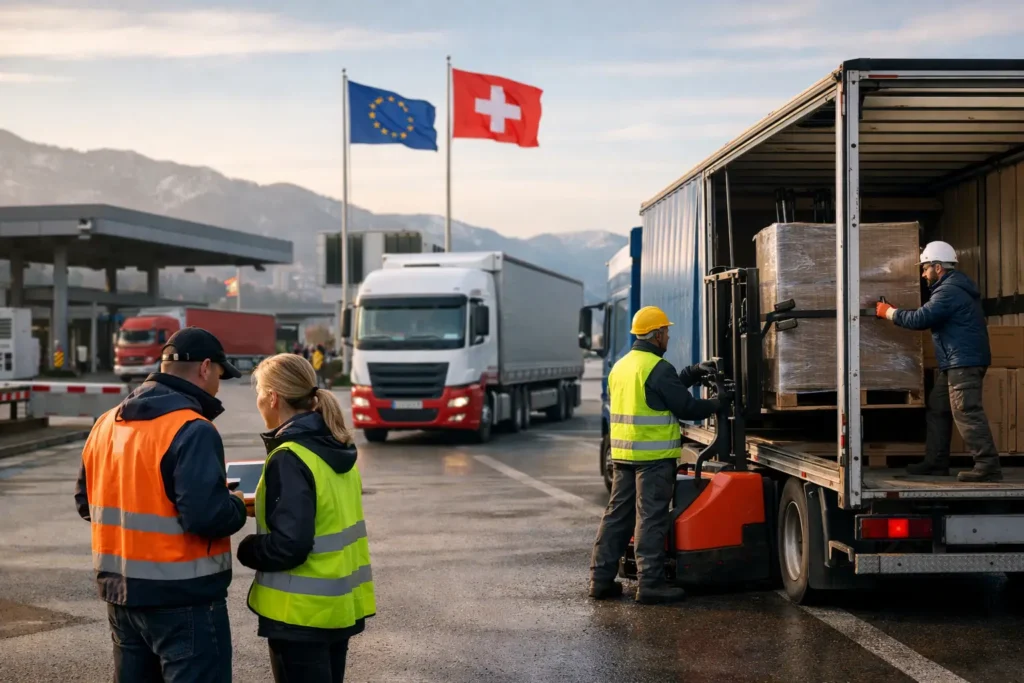
A shipment to Switzerland is held because a document field does not match the goods description. An urgent pallet for a production line in Germany needs collecting within two hours. A part-load to Turkey looks straightforward until the customs sequence changes and the consignee asks for a revised delivery slot. This is where the question becomes practical, not theoretical: the future of European freight: digital platforms or human expertise? For supply chain managers, the real issue is not which side wins. It is which combination reduces delay, controls cost and keeps customers informed when transport conditions change mid-route.
Why the platform-versus-people debate matters now
Road freight across Europe is becoming more data-driven, but not necessarily simpler. Shippers expect live visibility, faster quote turnaround and tighter delivery windows. At the same time, cross-border movements remain exposed to customs checks, documentation errors, driving restrictions, weather disruption and customer-side changes.
Digital freight platforms have grown because they answer a real need. They speed up booking, centralise shipment data and improve transparency. According to the European Commission, road transport remains central to European trade, which means even small efficiency gains in planning and execution matter at scale. For routine lanes with standard freight, digital tools can remove friction.
But freight is rarely routine for long. A late loading slot in northern Italy can affect a connection into France. Border procedures for the UK, Switzerland or Turkey can add steps that a standard workflow does not catch early enough. A platform can show an exception. It does not always solve it.
Where digital platforms genuinely improve European freight
The strongest case for digital platforms is speed and structure. For recurring flows, they help procurement and logistics teams compare options quickly, store shipment requirements and keep a digital record of milestones. They also support cleaner communication between shipper, carrier and consignee.
That matters in everyday operations. If your team is managing multiple imports and exports each week, standardisation saves time. Booking history, automated alerts, digital proof of delivery and rate visibility all reduce administrative load. On stable lanes, that can improve planning accuracy and free your team for more valuable work.
There is also a cost argument. When platform data is accurate, capacity can be matched faster and empty kilometres reduced. The IRU has repeatedly highlighted the pressure on road freight efficiency and driver availability across Europe. In that context, digital tools are not optional extras. They are useful infrastructure.
The limit appears when freight stops behaving like a standard transaction. A platform is excellent at repetition. It is less reliable when a movement needs judgement calls, route adaptation or negotiation across several parties in different languages.
The future of European freight: digital platforms or human expertise in complex lanes?
This is where human expertise keeps its value. Complex freight does not fail because software is bad. It fails because transport is full of edge cases.
Take a time-critical automotive shipment moving from northern Spain to southern Germany. The collection is late, the delivery booking changes twice, and the plant will stop production if the goods miss the line-feed window. A digital system can update timestamps and flag deviation. An experienced operator can decide whether to switch from standard service to a dedicated van, reroute around restrictions and keep the customer informed in real time. That is the difference between visibility and control.
The same applies to customs-sensitive routes. UK, Swiss and Turkish flows still require careful handling of paperwork, Incoterms alignment and border timing. If one reference is wrong, the issue is not just administrative. It can become storage cost, missed slots or a dissatisfied customer. The UK government’s customs guidance makes clear how process-heavy these movements remain. In practice, experienced freight teams spot risks before departure rather than after the vehicle reaches the border.
There is also the matter of exceptional shipments. Oversized or non-standard loads need permit planning, route checks and coordination that cannot be reduced to a simple marketplace logic. A standard digital workflow may register the job. It will not replace the person who knows which sequence avoids a preventable hold-up.
The best operating model is not either-or
For most industrial shippers, the right answer is a blended model. Use digital tools for speed, tracking, document flow and reporting. Rely on human expertise for route design, exception handling, customs management and urgent decisions.
This is usually the most resilient setup because it reflects how transport actually works. Data should support decisions, not pretend to replace them. If your freight profile includes any of the following, human coordination becomes more valuable: frequent exports outside the EU customs area, urgent same-day movements, specialised freight, or consignee networks with strict delivery booking rules.
A practical test is simple. Ask what happens when the original plan breaks. If the answer depends on waiting for the system to refresh, the model is too thin. If the answer includes an operator who can intervene, rebook, escalate and communicate clearly, your transport setup is closer to real operational needs.
At MAP Transport, this approach is reflected in how services are structured: standard flows through a tailored road freight transport service, urgent moves through dedicated express solutions, and non-standard cargo through specialist planning rather than forced standardisation.
What supply chain managers should look for now
The procurement question is no longer whether a transport partner uses digital tools. That should be assumed. The better question is whether those tools are backed by accountable people who understand the lane, the cargo and the commercial risk.
Look for a partner that can provide quick quotation, but also explain the operational assumptions behind the rate. Look for tracking, but also proactive updates when something changes. Look for process, but also the flexibility to switch vehicle type or service level when timing becomes critical.
One useful indicator is how a provider handles urgent transport. If a shipment needs delivery in a few hours or within 24 hours across Europe, the value comes from immediate decision-making, not just system access. Another is customs handling on routes where border friction still matters. If the team can anticipate document issues before loading, your delay risk drops sharply.
It also helps to check whether the provider can support more than one transport profile without pushing every job into the same template. A business shipping both routine pallet freight and occasional oversized machinery does not need two disconnected suppliers. It needs one coordinated transport partner with enough operational range to adapt.
For readers reviewing their own setup, our contact page is the right place to discuss specific flows, while our service information gives a clearer view of how standard, urgent and exceptional transport should be handled differently.
A realistic view of the next five years
The future of freight in Europe will be more digital, but not less human. Platforms will continue to improve visibility, pricing discipline and administrative speed. AI will help with forecasting, document checks and exception alerts. That is all useful.
But European road freight is still a business of timing, judgement and accountability. When a ferry schedule changes, a border queue lengthens, or a consignee rejects a slot, someone needs to decide what happens next. That is not old-fashioned. It is operational reality.
For supply chain managers, the goal is not to choose between software and expertise. It is to build transport flows where technology handles the predictable work and experienced people take ownership of the unpredictable parts. That is how you protect service levels without losing efficiency.
If your business moves freight across difficult lanes, deals with customs pressure or cannot afford uncertainty on urgent shipments, that balance matters more than any platform feature list. It is also where a specialist road freight partner with 40 years of experience can add measurable value, especially when service design, responsiveness and follow-up are part of the job rather than optional extras.
Need support on your transport flows? Contact our team for a tailored solution.
Have a question or need a quote? Contact us at (+34) 943 62 95 77 (ask for Raquel) or by email at lo*******@**********rt.com