
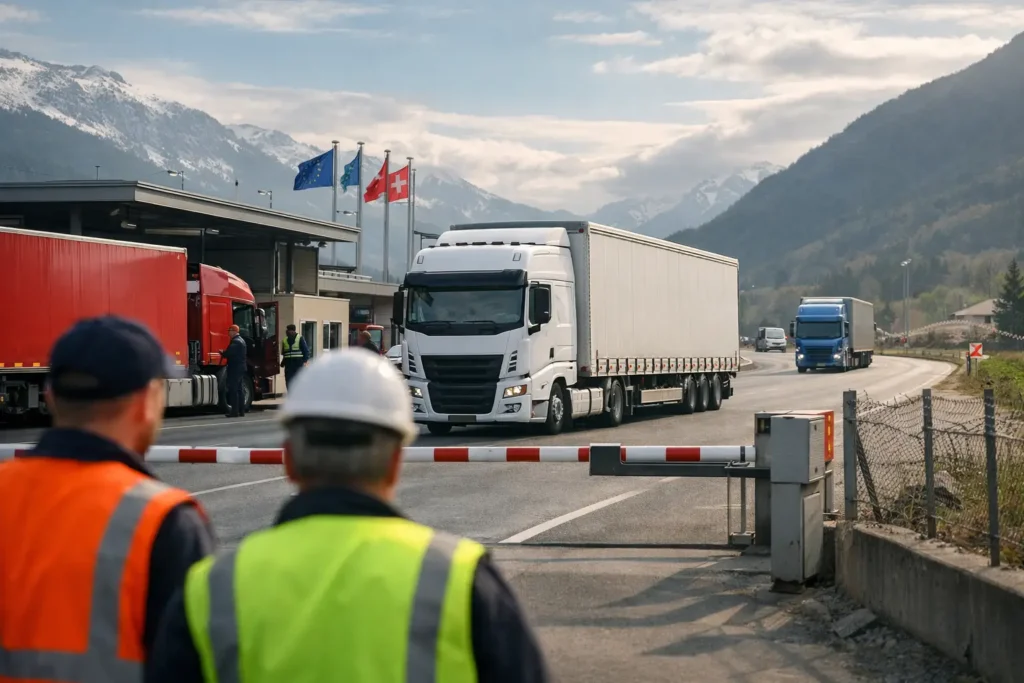
A lane that looked routine five years ago can now decide whether a production line keeps moving or stops for 24 hours. That is the real context behind why some European transport corridors are becoming strategic again. For supply chain managers, this is not a policy debate. It is about lead times, customs exposure, driver availability, infrastructure bottlenecks and the growing need to keep options open when one route suddenly loses reliability.
In road freight, corridors matter most when the market is under pressure. Border friction, industrial reshoring, energy price shifts and war-related detours have all changed the value of certain European lanes. The result is simple: routes once treated as interchangeable are now central to risk control and service continuity.
Why some European transport corridors are becoming strategic again for shippers
A transport corridor becomes strategic when it does more than move freight from A to B. It starts to protect continuity, reduce uncertainty or give access to markets that are harder to serve by alternative routes.
That is happening across several parts of Europe. The North Sea-Baltic axis has regained importance because manufacturers need dependable links between northern ports, Central Europe and the Baltic region. Routes into Turkey are under more scrutiny because they connect European production and distribution networks with a major industrial and commercial hub beyond the EU customs area. Cross-border flows through Switzerland remain highly valuable for time-sensitive cargo moving between key industrial regions, even if customs handling and transit formalities add complexity.
The wider backdrop also matters. According to the European Commission, road freight still carries the majority of inland freight in the EU, accounting for roughly three quarters of total inland freight transport by tonne-kilometres. When so much volume depends on road, even moderate disruption on a few corridors can affect pricing, equipment positioning and delivery windows across multiple countries. EU transport data supports what many logistics teams already see in daily operations.
The pressure points making corridors strategically valuable
The first is resilience. Shippers no longer assume that the shortest route will be the best route every week of the year. Strikes, weather events, tunnel restrictions, border checks and seasonal congestion can turn a standard lane into a problem lane very quickly.
The second is customs friction. This is particularly relevant on UK, Swiss and Turkish flows, where border procedures, transit documents and timing at customs offices can change transport performance more than pure mileage. A corridor with predictable clearance processes often becomes more valuable than a theoretically cheaper route with volatile border dwell times. For official guidance, many operators now monitor updates from EU Taxation and Customs Union and national authorities far more closely than before.
The third is network redesign. More manufacturers are spreading production, nearshoring selected activities or adding buffer suppliers inside Europe and in nearby markets such as Turkey. That increases the importance of corridors linking Western Europe with Central Europe, the Balkans and the Turkish border region. In practice, transport planning is becoming less about one fixed lane and more about maintaining reliable corridor access.
A fourth factor is urgency. Time-critical freight has become less exceptional in sectors such as automotive supply, industrial equipment, chemicals and metal products. If a plant needs a replacement part in hours rather than days, the route must support fast dispatch, realistic transit and active communication if conditions change. That is why urgent transport capability is now tied closely to corridor strategy, not just vehicle availability.
Where this affects daily road freight operations most
Some of the biggest impacts are visible on routes that combine distance, border formalities and tight delivery expectations.
Take a shipment from northern Spain to a manufacturing site near Stuttgart, then onward to Switzerland for final processing. On paper, this is a conventional Western European movement. In reality, corridor choice affects driving time risk, transit through high-traffic zones, customs readiness for Switzerland and the available recovery options if unloading times shift. A poorly planned route can create a cascade: missed delivery slot, storage charges, production delay and a second customs intervention.
Or consider urgent machinery components moving from Belgium to Bursa in Turkey. The issue is not only kilometres. It is whether the operator can coordinate the right vehicle, maintain document accuracy, anticipate border waiting times and keep the consignee informed. On these flows, a strategic corridor is one where transport planning, customs preparation and communication work together.
This is also where tailored service design matters. A standard full-load movement, an express van delivery and an exceptional load do not face the same corridor risks. Treating them as if they do usually creates avoidable cost or delay. That is why many shippers now prefer a partner able to match the transport solution to the lane, the cargo and the urgency rather than defaulting to one fixed set-up. MAP Transport explains this approach across its European road freight services.
Strategic again does not mean simple again
There is a temptation to hear “strategic corridor” and assume priority infrastructure means easier transport. Usually, it means the opposite. Strategic lanes attract volume, scrutiny and volatility at the same time.
For example, the Brenner and Alpine crossings remain essential for north-south European freight, but they are also vulnerable to traffic restrictions, environmental rules and seasonal peaks. The same pattern appears on UK-related routes after Brexit. They remain commercially critical, yet customs documentation, security procedures and port timing can quickly undermine service levels if the flow is not prepared properly.
The International Road Transport Union has repeatedly highlighted that border waiting times and driver shortages continue to affect freight reliability across regions. IRU industry reporting is useful here because it reflects the operational reality behind broad policy announcements.
So yes, some corridors are becoming strategic again, but that does not mean they are automatically efficient. It means they deserve tighter planning, better contingency routes and more precise carrier coordination.
How supply chain managers should respond
The practical question is not whether corridor strategy matters. It is how to use it to reduce transport risk.
Start by looking at lanes where a one-day delay has a real business cost. These are usually your strategic corridors, even if annual volume is not the highest. If customs, production continuity or customer penalties sit behind the shipment, the route deserves closer management than a simple rate comparison can provide.
Then review where you rely on a single border crossing or a single weekly pattern. Corridor dependence often hides in stable-looking transport flows. Everything works until a strike, weather event or customs hold-up removes the only workable option.
A useful operational insight is to classify corridor risk by three factors: border complexity, recovery options and urgency tolerance. A lane to Switzerland with complete customs documentation but no timing flexibility can be riskier than a longer intra-EU route with wider delivery windows. Similarly, a Turkey movement with experienced document handling may outperform a theoretically simpler route managed without enough border expertise.
In many cases, the best response is not a permanent route change. It is a more flexible transport model. That might mean pre-agreed express cover for urgent shipments, earlier customs document preparation, different loading cut-off times or a specialist set-up for non-standard cargo. If you need to review vulnerable lanes or time-critical cross-border flows, the best next step is usually a direct operational conversation through the freight contact team rather than another generic benchmarking exercise.
Corridor strategy is now part of service reliability
For European shippers, corridor strategy used to sit in the background. Today it is part of service reliability itself. The route is no longer just geography. It is a mix of compliance, infrastructure, market access and contingency planning.
That is exactly why some European transport corridors are becoming strategic again. They help companies manage uncertainty across Europe, the UK, Switzerland and Turkey without losing control of cost or delivery performance. The businesses that adapt fastest are usually the ones that treat transport corridors as active operating decisions, not fixed lines on a map.
With 40 years of experience in European road freight and tailored support for standard, urgent and complex shipments, MAP Transport works with customers who need that level of route control. Need support on your transport flows? Contact our team for a tailored solution.
Have a question or need a quote? Contact us at (+34) 943 62 95 77 (ask for Raquel) or by email at lo*******@**********rt.com
