
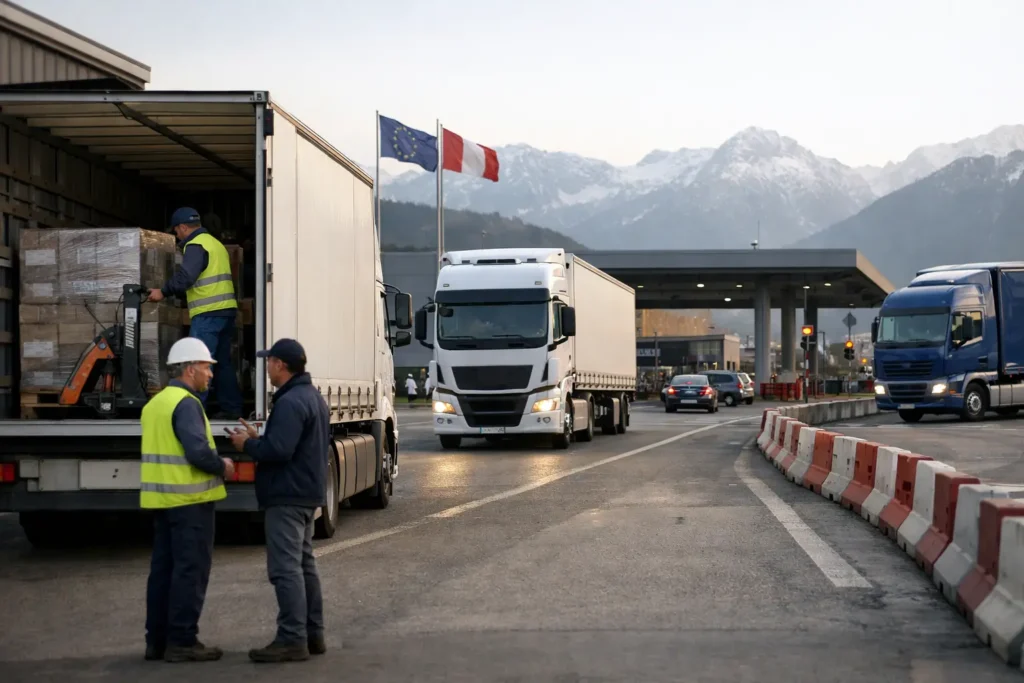
A rate that looked workable on Monday can be wrong by Wednesday. A border check adds six hours, a tunnel restriction changes the route, an urgent collection requires a dedicated van, or a customs file for Switzerland is held back over one missing detail. For supply chain managers, that is the real impact on European transport pricing – not a theoretical cost curve, but daily pressure on margins, service levels and customer commitments. The issue is sharper on cross-border road freight, where pricing is shaped by operational reality as much as by distance.
What really drives the impact on European transport pricing
In European road freight, price is rarely just a matter of kilometres. The final transport cost is built from several variables that move independently, and some of the biggest ones sit outside the carrier’s direct control.
Fuel remains one of the most visible factors, but it is only part of the picture. Road tolls, ferry charges, driver availability, border formalities, restricted delivery windows and equipment positioning all influence the rate. On a standard lane from northern Spain to Belgium, those factors may be predictable enough for stable pricing. On a route involving the UK, Switzerland or Turkey, the pricing model changes because customs handling, transit time risk and documentary accuracy become cost drivers in their own right.
This is why two shipments with the same weight and the same destination country can have very different prices. If one can move as grouped freight on a flexible schedule and the other needs direct delivery by a dedicated vehicle within 24 hours, the cost logic is completely different. The transport buyer who only compares the headline rate usually misses where the real exposure sits.
According to the European Commission, road freight remains a dominant mode for inland freight movements across the EU. That scale matters because even small changes in regulation, tolling or border performance can ripple quickly into transport pricing across multiple markets.
Tolls, energy and labour are the visible cost layer
The easiest part of the price discussion is the visible operating cost. Fuel volatility can move rates quickly, especially on long-distance full-load movements. Tolls are also becoming more material in many corridors, particularly where charging models increasingly reflect emissions classes or route categories.
Labour pressure is another major component. Driver shortages do not only affect availability – they affect price discipline. If a lane is hard to cover, if waiting times are high at loading points, or if return loads are uncertain, the rate will rise because the operational risk is higher.
A practical example is a time-sensitive industrial shipment moving from France into southern Germany with a fixed morning delivery slot. If the collection is delayed by only two hours, the haulier may need to reorganise driver hours, switch vehicle allocation or run part of the route on a more expensive basis to protect the deadline. The transport price is no longer paying only for movement. It is paying for recovery options.
For shippers, the lesson is straightforward: when procurement teams ask why a quote differs from last quarter, the answer is often not margin expansion. It is that the underlying cost base has changed, and service reliability has a price.
Customs friction has a direct impact on European transport pricing
Some of the strongest pricing pressure comes from routes where customs or transit formalities add uncertainty. This is especially true for the UK, Switzerland and Turkey, where border handling can alter both transit time and cost exposure.
The issue is not simply that customs declarations have a cost. It is that customs friction creates knock-on costs. A delayed clearance can trigger missed delivery slots, detention, overnight parking, rescheduling, customer penalties or loss of vehicle productivity for the next planned job. On urgent freight, those risks become even more expensive because there is less buffer in the schedule.
Take a shipment from northern Italy into the UK with a strict production deadline. If commodity codes, origin data or invoice values are incomplete, the vehicle may be held during customs processing. The direct administrative cost is relatively small. The true cost comes from the disruption to the delivery plan and the possible need for emergency corrective action.
That is why experienced freight partners build pricing around documentary quality as well as route distance. A transport flow with clean, repeatable customs data is easier to price and easier to execute. A flow with variable paperwork is not.
Shippers managing these corridors should also monitor official changes closely. HMRC guidance and the EU Taxation and Customs Union are useful reference points when customs rules or transit requirements shift.
Urgent freight changes the pricing equation completely
One of the biggest mistakes in transport buying is treating urgent transport as if it were a faster version of standard transport. It is not. It is a different service model with different economics.
When a shipment needs collection within hours and direct delivery, the haulier is not optimising a network in the usual way. The operator may need to dispatch a dedicated van immediately, reposition a vehicle empty, or bypass consolidation opportunities to protect time. That is why express pricing is structurally higher – not because of speed alone, but because of exclusivity and reduced flexibility.
For example, if a manufacturer in the Basque Country needs a critical machine part delivered overnight to a plant in Poland to avoid line stoppage, the transport decision is not just about rate per kilometre. It is about the cost of downtime versus the cost of urgent road freight. In many cases, the premium on transport is small compared with the production loss avoided.
This is where service design matters. A provider that can match the vehicle to the job – standard trailer, dedicated van or specialist equipment – gives buyers a clearer view of what they are paying for. MAP Transport’s urgent transport service is built around that principle, which is often the difference between a controlled premium and an expensive last-minute reaction.
Route complexity and equipment choice shape the final rate
Transport pricing across Europe becomes less predictable as route complexity rises. Scandinavia, Alpine crossings, UK routes, Swiss deliveries and Turkey flows all bring different operational constraints. Some involve ferries, some involve mountainous driving conditions, some depend heavily on border timing, and some require highly accurate transit documentation.
Equipment choice also matters more than many buyers expect. A shipment that physically fits in several vehicle types does not automatically cost the same in each one. The right choice depends on urgency, dimensions, delivery conditions and whether direct movement is worth more than network efficiency.
This is especially relevant for non-standard or oversized cargo. Exceptional shipments often involve permit planning, route checks, escort requirements or restricted delivery hours. The quote reflects planning effort and execution risk, not only distance. A flat transport buying process cannot price that properly.
The IRU regularly highlights how regulatory variation and driver shortages affect international road transport performance. For transport buyers, the operational insight is simple: the more complex the route, the less useful average market pricing becomes. Lane-specific planning matters more.
How shippers can control transport costs without increasing risk
The best way to manage transport pricing is not to push every quote down. It is to remove avoidable cost from the flow.
Start with data quality. Incomplete loading details, late booking confirmation and unclear delivery requirements all create contingency pricing. If a carrier expects surprises, the quote will reflect that. Dimensions, weight, collection readiness, delivery constraints and customs data should be clean from the start.
Then look at lead time discipline. Urgent transport has a clear place in industrial supply chains, but recurring urgency often points to a planning issue upstream. Separating genuine emergencies from poor forecasting can reduce spend quickly without weakening service.
It also helps to review lanes by operational profile rather than by country alone. A stable weekly export flow into Belgium should not be procured in the same way as ad hoc deliveries into Turkey or Switzerland. Different routes need different pricing logic, and often different service levels.
Finally, work with a partner that gives visibility beyond the quote. A provider handling international road freight across Europe should be able to explain why the rate is what it is, what risk assumptions sit behind it, and where flexibility exists.
If your transport pricing feels more volatile than your internal sales forecasts can absorb, the answer is usually operational rather than purely commercial. Better lane design, cleaner shipment data and a service model matched to the actual requirement will protect both cost and delivery performance. For companies moving freight across complex European corridors, that is where an experienced partner makes the difference. You can also contact our team to review a specific flow and identify where price pressure is really coming from.
Need support on your transport flows? Contact our team for a tailored solution.
Have a question or need a quote? Contact us at (+34) 943 62 95 77 (ask for Raquel) or by email at lo*******@**********rt.com