
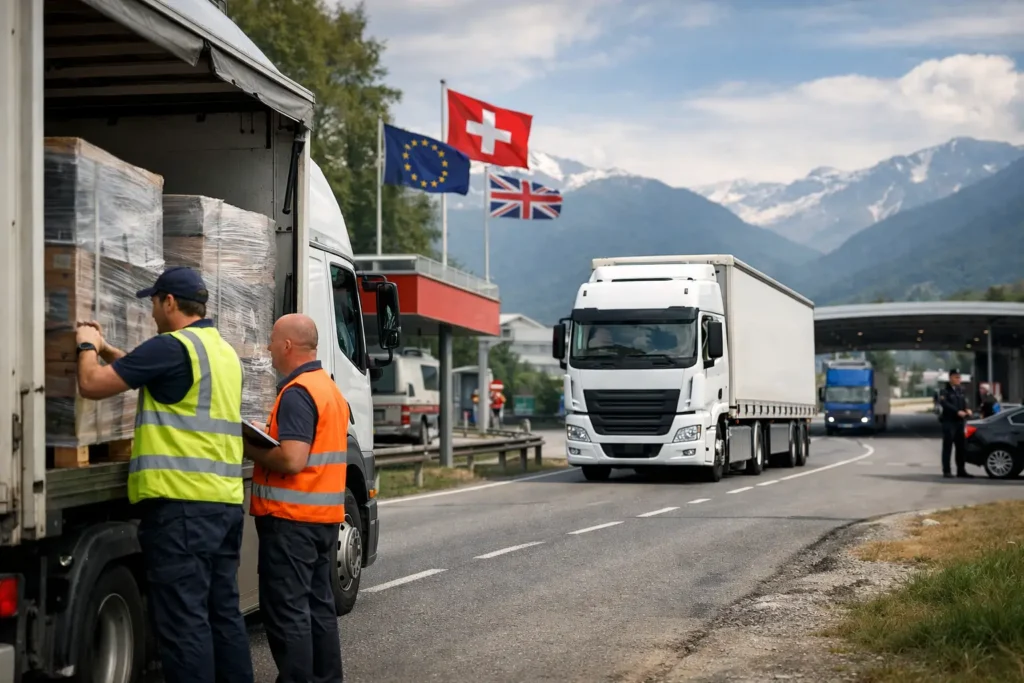
A production line does not stop because a shipment is technically “in transit”. It stops because the parts are not on site when they are needed. That is why an international road transport guide matters in practice: not as a theory document, but as a way to reduce delay risk, avoid customs mistakes and choose the right service level before costs escalate. For logistics managers moving goods across Europe, the pressure usually comes from three points at once – timing, documentation and communication. If one fails, the whole flow becomes harder to control.
What this international road transport guide should help you decide
For most B2B shippers, the real question is not whether road freight works. It is whether a given movement should go as standard groupage or dedicated load, whether the route crosses a customs border, and how much delay your operation can actually absorb.
That matters because international road freight across Europe is rarely a single decision. A shipment from northern Spain to Germany may be straightforward. The same freight to the UK, Switzerland or Turkey brings a different level of document control, border exposure and transit-time variability. Add an urgent delivery window, oversize dimensions or regulated industrial goods, and the transport plan has to be built around risk rather than price alone.
A useful guide starts with that operational reality. It should help you assess four things quickly: the route, the service urgency, the shipment profile and the compliance burden. If one of those is misjudged, the cheapest quote often becomes the most expensive outcome.
Route complexity changes the transport plan
Not all European lanes behave the same way, even when the distance looks manageable on paper. Border formalities, ferry dependencies, weather exposure and driving restrictions can all affect delivery performance.
The UK is a clear example. A road movement into Britain involves more than booking a vehicle and allocating a loading slot. Customs data, commodity codes, origin details and clearance timing can all affect whether the lorry moves straight through or waits. Official customs requirements continue to evolve, which is why many transport buyers monitor guidance from the UK government and the European Commission before launching sensitive flows. According to the European Commission, road freight remains one of the dominant freight modes in the EU, which means congestion and border pressure can have a direct operational effect on industrial supply chains.
Switzerland presents a different kind of challenge. It is geographically central for many European flows, but it sits outside the EU customs union. That means standard intra-EU habits do not apply. If your team treats a Swiss delivery like a routine EU movement, the problem may only become visible once the vehicle reaches the border.
Turkey adds another layer. Transit times can still be competitive, but customs preparation and document accuracy matter far more than on an internal EU route. If your consignee expects a fixed unloading date, that commitment should only be made once the paperwork has been checked in full.
An operational insight worth keeping in mind: the more border interfaces a route has, the less useful a broad estimated transit time becomes. On those lanes, proactive milestone communication is often more valuable than a nominal delivery promise.
Customs and documents are where avoidable delays start
In international road freight, many delays begin before collection. They start when shipment data is incomplete, when tariff codes are unclear, or when the commercial invoice does not match the goods actually loaded.
For supply chain managers, this is one of the most expensive blind spots because the lorry may be booked correctly, the collection may happen on time, and the problem still appears later at the frontier. The cost then spreads quickly: storage, missed unloading slots, production risk and extra administrative time.
A practical approach is to align transport booking with document validation, not treat them as separate steps. Before dispatch, confirm the consignor and consignee details, Incoterms, goods description, weight, dimensions, invoice values and any route-specific customs data. On UK, Swiss and Turkish flows, this discipline is especially important.
The International Road Transport Union regularly highlights the operational value of better border and transit processes, particularly where cross-border freight depends on speed and predictability. That matters for manufacturers working with narrow replenishment windows.
Consider a concrete example. A metal components supplier in France sends urgent parts to a customer in England after a production issue. The goods are ready by 14:00, and the customer wants delivery the next morning. If the carrier only focuses on vehicle availability, the movement looks feasible. If the customs data is checked immediately and any discrepancy is corrected before departure, the delivery has a realistic chance. If not, the vehicle can lose hours at the border and the urgency premium is wasted.
This is why experienced transport teams ask for shipment details that mirror procurement reality: origin, destination, loading date, weight, dimensions and nature of goods. It is not bureaucracy. It is delay prevention.
Choosing between standard, urgent and exceptional service
A common mistake in cross-border freight is applying one service model to every shipment. In reality, the right choice depends on the cost of failure.
Standard road freight is suitable when the route is stable, the loading window is flexible and the consignee can absorb normal transit variation. It remains the right option for a large share of industrial transport because it balances cost and reliability well.
Urgent transport is different. It should be used when a delayed delivery creates a measurable operational loss, such as halted production, line imbalance or a failed customer commitment. In those cases, the question is not whether express transport costs more. It does. The relevant question is whether the premium is lower than the cost of disruption.
For some flows, delivery in a few hours or in under 24 hours across Europe is the difference between continuity and escalation. But urgency only works if the operator can react quickly, assign the correct vehicle and maintain active communication throughout the trip. Speed without coordination simply moves the risk further down the route.
Exceptional shipments require another decision model again. Oversized, heavy or non-standard freight often needs route checks, permits, escort considerations and site-specific planning. Here, the transport provider is not just moving goods. They are managing constraints that can change collection timing, route feasibility and unloading conditions.
The trade-off is straightforward: tailored transport planning may cost more upfront, but forcing an unsuitable vehicle or service type onto a specialised load usually creates bigger problems later.
How to reduce risk before the vehicle is booked
The best-performing international flows are usually decided before dispatch day. They come from better shipment profiling and clearer escalation rules.
Start by asking what the delivery window really means. Is it a preference, a contractual requirement or a production-critical deadline? Those are not the same. Then assess whether the route includes customs exposure, restricted access, ferry dependency or seasonal disruption. Scandinavia in winter, for example, requires a different risk view from a routine Benelux movement.
Next, make sure the shipment profile is precise. Approximate weight and dimensions can be enough for an early budget estimate, but not for dependable planning. A wrong measurement can affect vehicle choice, loading sequence and border declarations.
It also helps to define who owns the operational decision if something changes in transit. If a consignee suddenly requests a new delivery slot, can your carrier reach the right contact quickly? Multilingual coordination becomes especially valuable when the route crosses several countries and the shipment is time-sensitive.
A short pre-booking check often prevents expensive surprises:
- Confirm whether the goods are standard, urgent or exceptional.
- Validate route-specific customs requirements before collection.
- Share exact weight, dimensions and loading constraints.
- Agree who receives progress updates and who can approve changes.
This kind of discipline matters because road freight performance is not only about movement. It is about decision speed when the plan shifts.
What strong transport management looks like in practice
Good international road transport is visible in the moments the customer does not have to chase for answers. That means rapid quoting, realistic transit commitments, active monitoring and someone accountable from first instruction to delivery.
For logistics buyers, responsiveness is not a soft benefit. It has direct value. If a quote arrives within 48 hours with the right assumptions, procurement can move faster. If shipment status is clear during transit, operations can plan labour and unloading. If issues are raised early, alternative actions are still possible.
This is especially relevant on complex European routes where timing, customs and consignee coordination overlap. A dedicated transport partner should not simply accept the order and hope the route behaves as expected. The service should be built around the shipment itself, whether that means a standard road move, an urgent dedicated van, or a specialist setup for non-standard freight.
After 40 years in international road freight, companies in this sector know that reliability rarely comes from a generic process. It comes from matching the service to the load and keeping the shipper informed at any time of the progress.
Transport decisions are easier when the operational picture is clear from the start. If your flows involve customs-sensitive routes, urgent deliveries or specialist loads, that planning discipline becomes even more valuable. MAP Transport supports European shippers with tailored road freight solutions built around delivery time, route complexity and shipment requirements.
Need support on your transport flows? Contact our team for a tailored solution.
Have a question or need a quote? Contact us at (+34) 943 62 95 77 (ask for Raquel) or by email at lo*******@**********rt.com
https://shorturl.fm/f8Kwe