
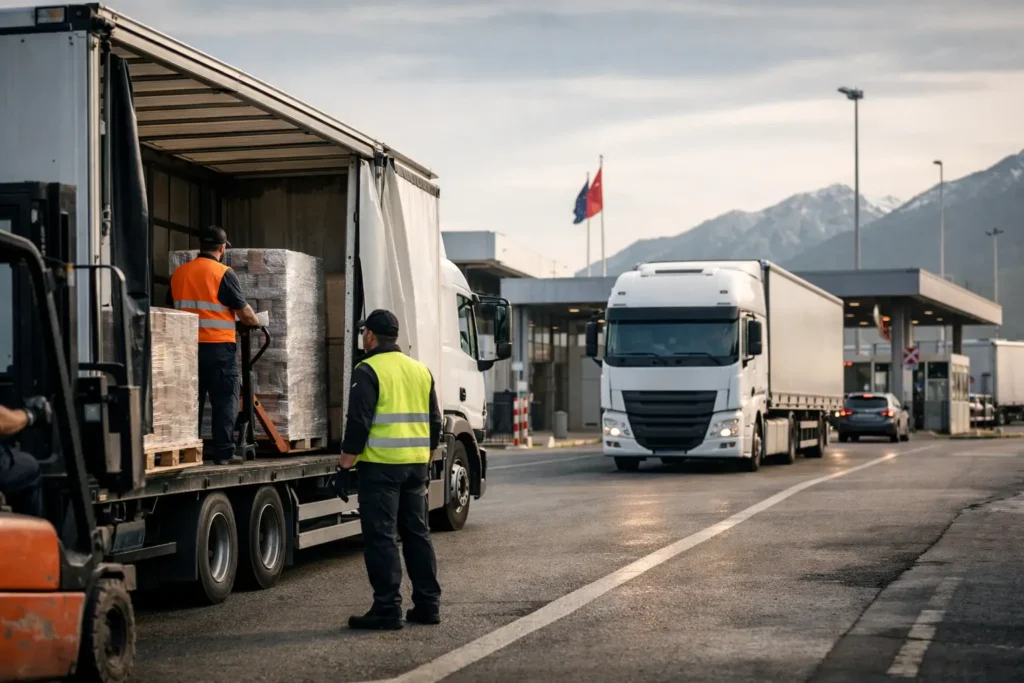
A missed delivery slot in Birmingham, a production line waiting in northern Italy, customs clearance pending at the Swiss border – this is where time definite road freight service levels stop being a sales phrase and start affecting cost, output and customer confidence. For supply chain managers, the real question is not whether a shipment is urgent, but how precisely the transport plan matches the delivery window, route risk and commercial impact. When service levels are chosen well, they reduce disruption. When they are chosen badly, they create avoidable cost, false expectations and operational pressure across the whole flow.
What time definite road freight service levels actually mean in practice
In operational terms, time definite road freight service levels define how tightly a road shipment is planned around a specific delivery commitment. That commitment may be same day, next day before a fixed hour, delivery within 24 hours, or a scheduled standard service with a narrow agreed arrival window.
What matters is not the label. What matters is the degree of control behind it. A genuinely time definite service is built around vehicle allocation, route feasibility, border conditions, driving time rules, loading readiness and contingency planning. If one of those elements is weak, the service level is only definite on paper.
This is especially relevant on European cross-border flows, where lead times can change quickly because of border checks, congestion, ferry timing, weather or local restrictions. According to the IRU, road transport carries the majority of inland freight in Europe, which means even small disruptions can have a wide operational impact when volumes are high and delivery slots are tight. That is why experienced shippers look beyond transit estimates and ask how the service level is actually managed.
When a standard service is enough – and when it is not
Not every shipment needs the highest priority option. A routine replenishment with a little stock cover can often move efficiently on a classic road freight plan. In those cases, paying for a tighter service level may protect nothing and simply increase transport spend.
The problem starts when planners treat all shipments as if they carry the same risk. A delayed pallet of packaging stock may be manageable. A delayed component for a just-in-time assembly line is not. The transport decision should reflect the cost of failure, not only the cost of the movement.
A practical way to assess this is to ask three questions. First, what happens operationally if the goods arrive six or twelve hours late? Second, is there a customs or border step that could shift the timing? Third, does the consignee have a hard booking slot or production dependency?
Take a shipment from northern Spain to southern Germany for a manufacturer replacing a failed machine part. A standard service may fit the route on average, but average is irrelevant if the line is down. In that case, an express or ultra-express solution with direct routing and active monitoring is usually the right commercial decision, even if the transport rate is higher. The avoided downtime often makes the difference obvious.
Time definite road freight service levels on complex cross-border routes
Time definite road freight service levels become more demanding when the route includes customs formalities or known transit friction. The UK, Switzerland and Turkey are good examples because timing is shaped not only by distance, but by document quality, border flow and local operating constraints.
On a UK route, a vehicle can lose valuable time if export or import data is incomplete before departure. On Swiss movements, customs accuracy matters because a small discrepancy can stop a fast shipment from being a fast delivery. On Turkey lanes, timing needs even more discipline because route planning, border waiting times and document handling can vary significantly by corridor.
This is where many service failures begin. A shipper books an urgent move, but the freight is not operationally urgent in the right way. The vehicle is ready, yet the documents are not. The delivery time is fixed, yet the loading address is still unclear. The expectation is premium, but the preparation is standard.
The European Commission continues to stress the importance of efficient freight corridors and smoother border processes, but real-world execution still depends on planning detail at shipment level. For transport buyers, the operational insight is simple: tighter service levels require tighter information discipline before collection.
How to choose the right service level without overpaying
The best approach is to match the service level to business impact, route complexity and shipment profile. That sounds obvious, but in practice many teams either over-spec urgent transport or under-spec critical freight.
A useful starting point is to separate shipments into three groups. The first is standard freight with flexible delivery tolerance. The second is priority freight where timing matters but a short delay is manageable. The third is time-critical freight where the delivery window directly affects production, compliance or customer service.
From there, the transport plan should be shaped around actual constraints. Weight and dimensions matter because they affect vehicle choice and route options. Collection readiness matters because a delayed loading can destroy a precise delivery promise. Cross-border document status matters because urgency does not remove customs requirements.
This is also where tailored road freight has a clear advantage over one-size-fits-all planning. A van for a smaller urgent consignment may be faster and more efficient than waiting for a larger vehicle cycle. For a larger but still time-sensitive shipment, a dedicated lorry with direct transit may protect the delivery schedule far better than a shared network movement.
For example, if a distributor needs a 1,200 kg consignment delivered from Belgium to eastern France before 08:00 next day for a retail promotion launch, the right question is not only price per shipment. The right question is whether the service level protects the booking time with enough certainty to avoid a failed store rollout.
The data and communication behind reliable service levels
A service level is only credible if communication supports it. Supply chain teams do not just need a promised arrival time. They need visibility on whether the plan is holding, whether a delay risk has appeared, and what corrective action is being taken.
This is one reason proactive follow-up matters so much in road freight. A precise service level with poor communication still creates uncertainty for production, purchasing and customer service teams. By contrast, a provider that flags issues early gives the shipper time to adapt.
There is also a measurable business case here. Even a short delay can trigger missed labour scheduling, late unloading, line stoppages or failed customer commitments. Major industry reporting has repeatedly shown how transport disruption feeds wider supply chain cost, especially where buffers are low and delivery windows are tight. In that environment, reliability is not just a transport metric. It is an operating margin issue.
The strongest operators usually focus on a few basics and execute them consistently: realistic transit commitments, fast quotation response, route-specific planning, multilingual coordination and live operational follow-up. Those are not glamorous points, but they are the reason time definite services work under pressure.
Why service levels should be reviewed lane by lane
Many transport buyers set one rule for urgent freight and apply it too broadly. In reality, service levels should be reviewed by lane, customer requirement and route volatility. A next-day commitment on a familiar intra-EU route is not the same as a next-day commitment involving border formalities or remote delivery points.
This matters for budgeting as well. If a lane repeatedly requires premium intervention because the standard plan is too weak, the problem may not be emergency frequency. It may be poor service-level design. Equally, if teams are routinely paying for express cover on flows with comfortable stock buffers, the transport model may be more expensive than it needs to be.
A lane-by-lane review usually reveals where cost and reliability can both improve. Some flows need a firmer premium option. Others need earlier booking discipline. Others simply need better shipment data at quote stage – origin, destination, weight, dimensions and loading constraints – so the transport plan fits the requirement from the start.
For companies moving freight across Europe, Turkey and neighbouring markets, this is where an experienced road freight partner adds value. The point is not to make every shipment faster. It is to apply the right service level to the right movement, with the right degree of control.
Time definite transport works best when the promise is realistic, the route is understood and the information is complete before wheels start turning. That is where years of cross-border road freight experience make a visible difference, especially on urgent or customs-sensitive flows. Need support on your transport flows? Contact our team for a tailored solution.
Have a question or need a quote? Contact us at (+34) 943 62 95 77 (ask for Raquel) or by email at lo*******@**********rt.com