
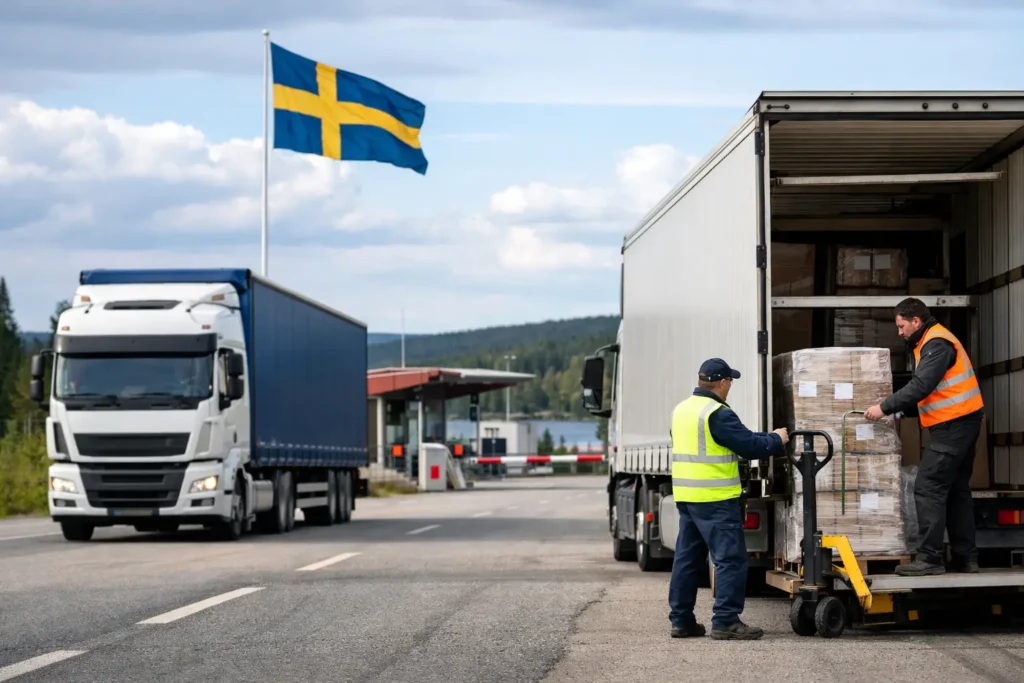
A delivery to Sweden can look straightforward on paper, then lose a day on the road because the loading slot ran late in Germany, the ferry missed its cut-off, or the consignee in the Stockholm area only accepts freight in a narrow morning window. For supply chain teams, road freight to Sweden is rarely about finding any carrier. It is about finding a partner that can protect delivery time, manage route choices, and react quickly when the plan changes.
Why road freight to Sweden needs tighter planning
Sweden is well connected to continental Europe, but it is not a simple point-to-point lane. The route structure matters. Most shipments move through Denmark and across the Oresund link, or combine road legs with short sea crossings depending on origin, urgency and cost target. That means transit time is shaped not only by mileage, but also by ferry timetables, bridge costs, weekend driving restrictions in certain countries, and the final delivery geography inside Sweden.
For a shipper sending industrial goods from Spain, France, Belgium or Italy, small planning errors can quickly become expensive. A late production release may push the vehicle onto a later crossing. An unloaded Friday can become a Monday appointment. If the cargo is urgent, that delay can affect line continuity, customer penalties or a service engineer waiting for parts.
This is why road freight to Sweden often rewards detailed pre-planning more than aggressive rate buying. According to the European Commission, road freight still carries the largest share of inland freight in the EU, which makes it the default mode for flexible cross-border industrial transport. Flexibility, though, only works when the operation is properly structured.
Route choice changes the result
Not every Sweden movement should be routed the same way. The right solution depends on origin, cargo profile, delivery deadline and whether the shipment is full load, part load or a dedicated express movement.
A standard industrial pallet consignment from northern France to Gothenburg may work well on a classic groupage or part-load model if the delivery window is flexible. A dedicated vehicle would usually be unnecessary and too expensive. On the other hand, if a manufacturer in northern Spain has a machine component that must reach Malmo in under 24 hours from collection, the answer is completely different. That requires an express set-up, driver planning built around legal driving time, and immediate control of the fastest viable corridor.
There is also a practical distinction between southern and northern Sweden. Deliveries into Malmo, Helsingborg or Gothenburg are typically easier to schedule than deliveries into central or northern industrial zones where final-mile distances are longer and weather disruption can have more impact. What looks like a two-day difference on a quote can actually be the difference between a stable supply plan and recurring expediting costs.
An experienced transport partner will assess whether the job calls for a standard service, a dedicated van or lorry for urgent freight, or a specialist vehicle for oversized cargo. Matching the vehicle to the shipment is basic operational discipline, but it is often where transport performance is won or lost.
Road freight to Sweden and the customs question
Sweden is in the EU, so many European shippers do not associate this lane with customs complexity. That is only partly true. If the movement starts and ends within the EU, customs formalities are lighter than on UK, Swiss or Turkish routes. But customs still enters the picture when the goods originate outside the EU, move under specific trade regimes, or involve supporting documentation linked to controlled products, residues or temporary movements.
This matters for companies with supply chains that combine several legs. A shipment may travel by road into the EU from Turkey, then continue onwards to Sweden. Or goods may be imported into a distribution point and re-dispatched north. In those cases, missing or inconsistent paperwork can stop the flow long before arrival in Sweden.
The operational point is simple: the transport booking should never be separated from the document check. Commercial invoices, packing details, commodity descriptions, weights, dimensions and delivery constraints all need to be aligned at booking stage. For specialist or sensitive freight, that review needs to happen even earlier.
For current customs guidance, many transport buyers monitor official information from the Swedish Customs authority and the EU’s trade resources. That is especially useful when flows involve non-EU origins or changed product classifications.
Winter, cut-off times and consignee rules
Weather is the obvious risk on Scandinavian routes, but it is not the only one. In practice, delivery performance on Sweden lanes is just as often affected by cut-off discipline and consignee requirements.
Winter conditions can lengthen driving times, especially on inland routes or during periods of ice and snow. That does not mean every winter shipment is problematic. It means your lead time should reflect seasonal reality. Building a plan around the absolute best-case transit time is a mistake many shippers only make once.
Cut-off times are another issue. If the vehicle misses the crossing or feeder connection because collection was delayed, the shipment can slide into the next available departure. On a time-critical movement, this is where proactive communication matters most. A good operator does not simply report the delay. They rework the route, assess whether a driver change or dedicated vehicle is justified, and tell the customer what is still recoverable.
Consignee rules also deserve more attention than they often get. Swedish delivery points, especially industrial and retail-linked sites, may have strict booking windows, unloading equipment requirements, pallet exchange expectations or advance notification rules. If these are not captured at the quotation stage, the result may be waiting time, failed delivery or extra cost.
A useful example is a spare-parts shipment moving from Belgium to a production site outside Jonkoping. The cargo itself may fit in a van and be ready to move immediately. But if the site only receives between 07:00 and 10:00 and requires a named contact plus advance vehicle registration, the transport plan has to be built around that reality from the start.
When urgent road freight to Sweden is the right call
Urgent transport is expensive when used badly and extremely valuable when used correctly. The key question is not whether express road freight costs more. It does. The real question is whether the extra cost is lower than the cost of downtime, missed installation, line stoppage or a contractual failure.
For Sweden, urgent road freight is often justified for automotive components, industrial spare parts, medical equipment support shipments and high-value production inputs. In those cases, waiting for the next standard departure may create a larger commercial problem than paying for a dedicated solution.
This is where service design matters. An urgent consignment should not be pushed through a standard network and simply labelled priority. It needs a genuine express set-up, with collection arranged in hours, direct routing, active follow-up and realistic communication on the achievable delivery time.
The International Road Transport Union regularly highlights the operational pressure created by driver availability, border processes and infrastructure disruption across Europe. For shippers, the lesson is practical: if the load is critical, book it as critical from the start. Trying to save a small amount on the transport line often creates a larger cost elsewhere in the supply chain.
What to check before booking a Sweden shipment
The most effective Sweden movements usually start with better shipment data. That sounds obvious, but in practice many delays begin with incomplete information.
Before booking, confirm the actual loading address and time window, not just the postcode. Check whether the delivery is to southern Sweden or further north. Be clear on stackability, loading metres, weight and whether the goods need a tail lift, timed delivery, call-before-delivery or dedicated equipment. If the shipment is urgent, define the latest acceptable delivery time rather than asking for the fastest possible option in general terms.
One operational insight is worth stressing: the earlier the carrier knows the real constraint, the better the solution. If your issue is not speed but delivery certainty before a production restart at 06:00, say so. That can change the route, vehicle and cost model completely.
For companies shipping regularly into Sweden, consistency also helps. Repeated lanes perform better when consignee rules, preferred delivery slots and document standards are already mapped. That reduces avoidable friction and improves quoting accuracy.
Reliable road freight to Sweden comes from disciplined planning, route knowledge and quick decisions when the original plan no longer holds. That is exactly where an experienced road freight specialist adds value – not with generic promises, but with practical control from collection through to delivery. Need support on your transport flows? Contact our team for a tailored solution.
Have a question or need a quote? Contact us at (+34) 943 62 95 77 (ask for Raquel) or by email at lo*******@**********rt.com