
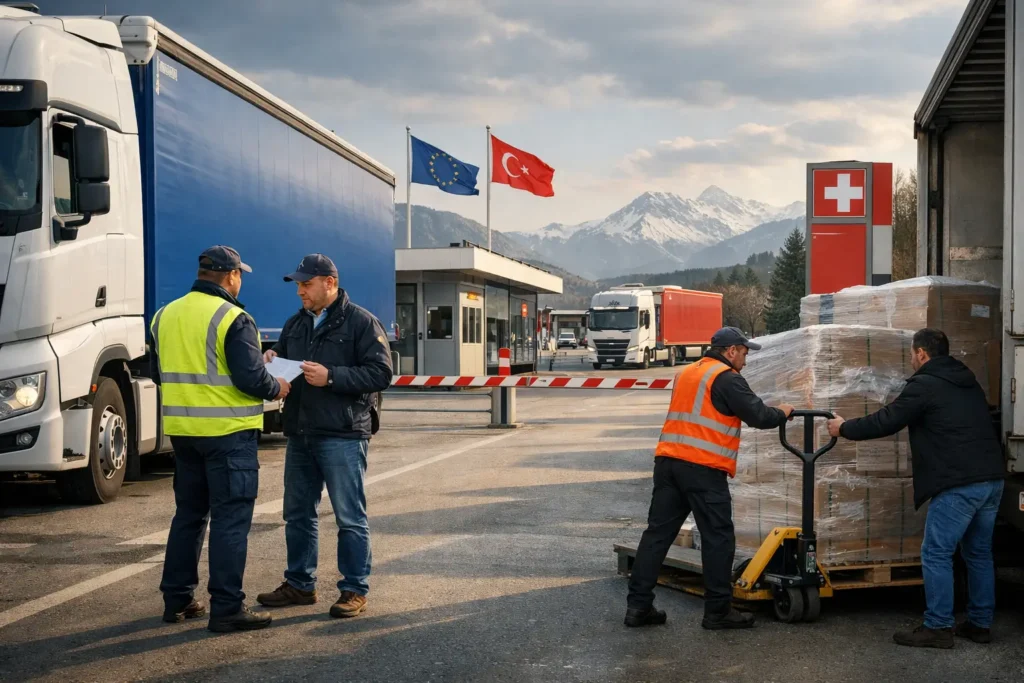
A production line waiting on components from northern Italy does not care that the delay started with a missed customs document in Switzerland or a driver-hour issue near the German border. It only sees downtime, pressure from customers and rising cost. That is why cross-border freight transport Europe is rarely just about moving goods from A to B. For supply chain managers, it is about protecting lead times across different regulations, road networks, customs procedures and service levels – especially when the route includes the UK, Switzerland or Turkey.
Why cross-border freight transport in Europe gets complicated fast
On paper, European road freight can look straightforward. Distances are manageable, infrastructure is mature and many markets are tightly connected. In practice, cross-border transport becomes fragile when one shipment depends on several moving parts lining up at the right time.
The first pressure point is border administration. Even within Europe, not every shipment moves under the same rules. EU internal movements differ sharply from flows involving non-EU countries such as the UK, Switzerland and Turkey. One missing commodity code, an incomplete invoice or unclear proof of origin can stop a lorry for hours. On urgent freight, that is often the difference between on-time delivery and production disruption.
The second issue is route volatility. Weather in Scandinavia, congestion around major Benelux corridors, weekend driving restrictions and ferry schedules can all change transit time. A route that worked well last month may not be the right option this week. This is where fixed transport planning tends to fail. The stronger approach is to match the shipment to the route and vehicle, not force every movement into the same operating model.
According to the European Commission, road freight remains the dominant inland freight mode in the EU, accounting for well over 70% of inland freight transport by tonne-kilometres in many reporting periods. That scale brings flexibility, but it also means major corridors are crowded and sensitive to disruption.
Customs control is often the real bottleneck
For many cross-border flows, customs is not a side issue. It is the route.
This is especially true on lanes involving the UK, Switzerland and Turkey, where customs clearance, transit procedures and supporting documents can decide whether goods move smoothly or sit still. Supply chain teams often focus first on haulage cost, but the larger risk is delay cost. If a shipment misses a delivery slot, creates a production gap or triggers contractual penalties, the cheapest rate quickly becomes the expensive option.
A simple example: a manufacturer shipping industrial parts from Spain to a customer in the UK may have a tight delivery window tied to site installation. If the commercial invoice wording is inconsistent with the packing list, or if the customs broker needs clarification on product classification, the vehicle can lose critical hours before clearance. In a standard service, that may be manageable. In an urgent movement, it can break the job entirely.
Operationally, the safest setup is to validate documents before loading, confirm Incoterms between seller and buyer, and keep one point of contact responsible for the shipment from quote through delivery. That sounds basic, but in real transport flows it is often the difference between control and confusion.
For current customs rules and trade procedures, many logistics teams monitor official guidance from the European Commission, HMRC and national customs authorities. The value is not theoretical compliance. It is fewer surprises at the border.
When urgent freight changes the transport decision
Not every shipment needs an express vehicle. Many do not. But when production stops, when a line-down risk appears, or when a customer imposes a narrow booking window, urgent road transport becomes a cost-control tool rather than a premium extra.
This is where supply chain managers need a realistic view of trade-offs. A full trailer is more economical for planned flows, but a dedicated van or direct lorry can be the better choice when speed matters more than consolidation. Express transport reduces handling points, shortens decision chains and usually improves predictability because the route is built around a single shipment.
Consider an automotive supplier with a rejected batch in eastern France and replacement goods ready in the Basque Country. Waiting for the next standard departure may save on transport spend, but if the customer in Belgium faces stoppage in under 24 hours, an urgent dedicated vehicle is often the rational decision. The freight invoice is higher, but the total business cost is lower.
That is the practical difference between buying transport and managing risk. The best operators do not push express on every job. They help customers decide when standard road freight is enough and when a faster service protects the supply chain.
Vehicle choice matters more than many buyers think
One common weakness in cross-border freight transport Europe is using the same equipment logic for every movement. It is efficient for the carrier, perhaps, but not always for the shipper.
A palletised export, a high-value urgent consignment and an oversized industrial component do not belong in the same service framework. Vehicle selection should reflect weight, dimensions, urgency, handling sensitivity and unloading conditions at destination. That can mean a standard tautliner for regular flows, a dedicated van for time-critical shipments, or specialist equipment for exceptional loads.
This has a direct impact on cost and reliability. Overspecifying capacity inflates spend. Underspecifying creates handling issues, delays or even refusal at loading and delivery points. For cross-border routes with customs or permit requirements, the wrong vehicle can create extra administrative friction as well.
An operational insight that experienced buyers recognise quickly: the quote stage is where many transport failures begin. If the carrier does not ask for exact dimensions, stackability, loading method, customs status and delivery constraints, the plan is probably too generic. Good cross-border transport starts with precise shipment data and a provider willing to adapt the service accordingly.
Complex European routes need active follow-up, not passive tracking
Tracking is useful, but tracking alone does not solve problems. In cross-border freight, what matters is not just knowing where the vehicle is. It is knowing what will happen next if conditions change.
Complex lanes such as mainland Europe to the UK, Germany to Turkey, or France to Switzerland benefit from active operational follow-up. That includes checking border status, monitoring driver progress against legal hours, confirming delivery appointments and updating the customer before an issue escalates.
For example, a shipment moving from Belgium to Turkey can face pressure at several points: transit timing, customs formalities, border queues and final-mile coordination. If communication only starts after a delay occurs, the consignee loses time to react. If the transport team flags a developing issue early, production, unloading or customer communication can be adjusted.
This is why multilingual coordination matters in practice. Border transport often involves shippers, consignees, drivers, customs agents and local contacts across several countries. Clear communication reduces error, especially when a shipment is urgent or documentation-sensitive.
MAP Transport has built its approach around that operating reality since 1985, managing road freight across 45 countries with service options for standard, urgent and exceptional shipments. For companies moving goods through customs-sensitive or time-critical routes, that kind of continuity matters.
How to reduce delay risk in cross-border freight transport Europe
Most delivery problems are not caused by one dramatic failure. They come from small preventable gaps that compound during transit.
The first priority is document accuracy. Before loading, verify invoice details, product descriptions, customs instructions, consignee information and any route-specific documents. The second is choosing the right service level. Standard freight is appropriate for many shipments, but urgent freight should be planned early when the business impact of delay is high. The third is route design. Avoid relying only on the shortest route if border congestion, restrictions or ferry timing make it fragile.
It also helps to work with one transport partner that can manage both routine and exceptional flows. That reduces handover risk and avoids re-explaining requirements each time a shipment becomes urgent or non-standard. For procurement and logistics teams, consistency is often as valuable as price.
If your flows involve the UK, Switzerland, Turkey or long-distance European lanes with tight delivery windows, the transport setup needs to be built around control, not optimism. That means realistic transit planning, rapid response when conditions change, and operational follow-up from collection to delivery.
Cross-border freight works best when the provider understands that a late lorry is rarely just a late lorry – it is a customer commitment, a production schedule and a cost line all at once. Need support on your transport flows? Contact our team for a tailored solution.
Have a question or need a quote? Contact us at (+34) 943 62 95 77 (ask for Raquel) or by email at lo*******@**********rt.com