
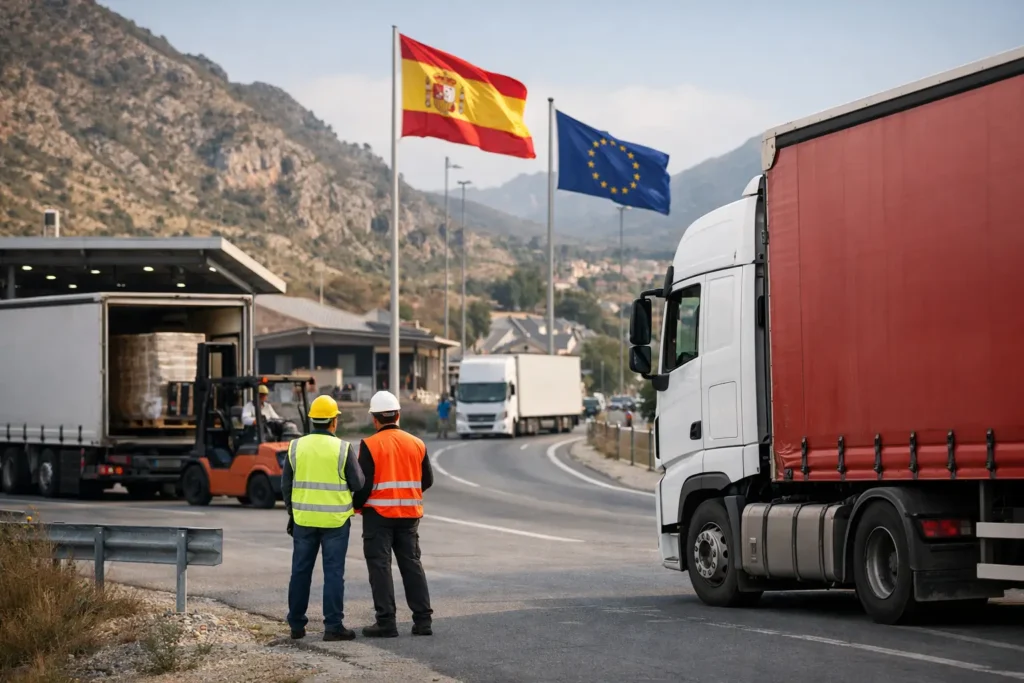
A late collection in Barcelona can easily become a missed slot in Lyon, a production delay in Belgium, or a customer complaint in the UK. That is the real pressure behind Spain transport for manufacturers, distributors and procurement teams – not just moving goods from A to B, but keeping lead times, customs paperwork and delivery promises under control. Spain remains a major freight gateway for European industry, yet the route is rarely simple. Long distances, border formalities on certain corridors, and urgent shipment demands all require tighter planning than many standard lanes.
Why Spain transport needs tighter planning than many EU lanes
Spain is one of Europe’s key industrial and trading markets, with strong flows in automotive, food, chemicals, metal products and consumer goods. According to Eurostat, Spain is among the EU’s largest economies and a major trading partner for cross-border goods movements, which means road capacity is under constant pressure on the busiest corridors.
For logistics managers, the challenge is less about whether capacity exists and more about whether the right capacity is available at the right moment. A standard pallet shipment from Madrid to northern France may be straightforward in principle, but once you add a fixed unloading slot, temperature sensitivity, export paperwork for a UK final destination, or a late factory release, the transport plan changes completely.
This is where many freight decisions become expensive. Choosing a vehicle because it is available rather than because it fits the load profile often creates avoidable cost or delay. On Spain lanes, where mileage is significant and timing windows matter, that mismatch shows up quickly.
Main Spain transport corridors and what they mean operationally
The most common road freight flows involving Spain run through France into Benelux, Germany and Italy, with additional traffic towards Portugal and, for more complex programmes, onwards to the UK, Switzerland and Turkey. Each corridor brings a different operational reality.
The Spain-France-Benelux axis is usually the most time-sensitive for industrial freight. It carries high volumes and works well when bookings are made early, loading times are realistic and delivery slots are firm. Problems tend to start when consignments are released late in the day and still expected to meet next-day or two-day targets.
Spain to the UK adds another layer. Even if the collection and linehaul are well planned, customs clearance and border management can affect final transit performance. For regular exporters, this is less about drama at the border and more about paperwork discipline. Missing commodity details, unclear incoterms, or inconsistent invoice data can stop a shipment that was otherwise running on time.
Spain to Switzerland is similar. The route is efficient when documents are correct, but customs formalities still need careful handling. Supply chain teams sometimes underestimate how much delay can come from a small discrepancy between commercial documents and the load itself.
Spain to Turkey, or flows connecting into the Caucasus, require even more control. These are not lanes for loose planning. Transit time, security, document accuracy and vehicle suitability all matter more once the shipment moves beyond simpler intra-EU movements.
Customs and compliance risks that affect Spain transport
Within the EU, many Spain transport movements benefit from fewer formal border barriers, but that should not create a false sense of simplicity. Compliance still matters, particularly when shipments connect with non-EU destinations or regulated products.
The highest-risk situations usually involve three things: incomplete commercial paperwork, incorrect goods descriptions, and unclear responsibility between shipper, consignee and carrier. On paper, these look minor. In practice, they can lead to detention, storage charges or rejected deliveries.
A common example is a Spanish exporter shipping metal components to the UK via road freight. The goods are ready, the collection is booked, and the customer expects delivery within 48 hours. But if the invoice value, customs code or origin data is incomplete, the issue does not appear at loading – it appears later, when correction takes time and the promised lead time is already gone.
Operationally, the safest approach is to validate documentation before vehicle dispatch, not during transit. The European Commission customs guidance and IRU operational resources both reinforce the same point: delays are often caused by process failure rather than road conditions alone.
For procurement and logistics teams, that means transport buying should include a documentation check as part of the service, especially for UK, Swiss and Turkish flows. It is not an add-on. It is part of protecting delivery performance.
When urgent Spain transport makes sense – and when it does not
Not every delayed shipment needs express service. That sounds obvious, yet many companies still pay premium rates because the issue was not identified early enough. Urgent Spain transport is valuable when the cost of downtime, line stoppage or contractual penalty is higher than the extra freight cost.
A practical example would be an industrial supplier in Zaragoza missing a scheduled outbound departure for parts needed in northern Italy. Waiting for the next standard groupage or full-load window may save transport cost, but if the consignee is feeding production, the real cost sits elsewhere. In that case, a dedicated van or direct lorry movement can protect the customer relationship and avoid a larger commercial loss.
That said, urgent transport only works well if someone is actively managing the chain. Fast collection alone is not enough. The route needs to be checked for driving constraints, loading access, handover points and delivery readiness. A shipment can leave quickly and still lose hours if the consignee is not prepared to receive it.
This is why experienced shippers separate urgency from panic. The best urgent moves are planned in minutes, but with discipline. Vehicle type, route, documents and contact points all need confirmation before departure.
How to reduce cost and delay on Spain freight flows
The biggest gains usually come from operational basics done consistently well. For Spain transport, that means treating each movement according to its real requirement rather than pushing everything into the same service model.
If the load is standard and time allows, a classic road freight solution will often give the best balance of cost and reliability. If the shipment is time-critical, direct express capacity is usually cheaper than a production stoppage. If the freight is oversized or non-standard, specialist planning from the start is far less costly than trying to fix loading or route issues later.
There are four practical habits that improve performance on Spain lanes:
- Book earlier on long-distance routes where possible, especially before peak periods.
- Confirm dimensions, weight and loading constraints before quoting, not after vehicle assignment.
- Align commercial paperwork with the actual goods for UK, Switzerland and Turkey movements.
- Share realistic collection and delivery windows so the transport plan reflects site conditions.
One operational insight matters more than it seems: poor site information causes avoidable failure. If a collection point has restricted access, crane loading, limited opening hours or mandatory PPE rules, the carrier needs that detail in advance. On long-haul Spain routes, one failed loading attempt can damage the entire delivery plan.
For companies moving regular freight, it also helps to work with a partner that can match vans and lorries to shipment profile instead of forcing every consignment into a fixed model. That flexibility is especially relevant when balancing standard movements with occasional urgent or exceptional loads.
Choosing the right freight partner for Spain transport
The right question is not simply who can cover Spain. Many operators can. The better question is who can manage the shipment when conditions change.
For a supply chain manager, useful indicators are straightforward: response speed, clarity on transit options, handling of customs-sensitive routes, and communication during the move. If a provider cannot explain the trade-off between standard and urgent service, or cannot flag risk points before departure, that weakness usually appears later as delay or extra cost.
This is particularly relevant for flows that extend beyond simple EU distribution. Spain shipments to the UK, Switzerland or Turkey need stronger coordination than a basic domestic collection. The same is true for oversized freight, where route checks, permits or handling requirements can affect the schedule from day one.
At MAP Transport, this is managed through tailored road freight services rather than a one-size-fits-all model. Standard loads, urgent deliveries within hours, and exceptional shipments each require different planning logic. You can review the company’s road freight services, request details through the contact page, or read more on complex European transport operations in the blog section.
A reliable Spain lane is rarely about speed alone. It is about choosing the right service level, validating risk early and keeping the consignee informed at each stage. That is what protects cost control and delivery performance when the route becomes less predictable.
For teams managing regular import and export flows, Spain remains a market where disciplined planning pays off quickly. When the route includes customs exposure, urgent delivery pressure or non-standard freight, specialist coordination becomes even more valuable.
Need support on your transport flows? Contact our team for a tailored solution.
Have a question or need a quote? Contact us at (+34) 943 62 95 77 (ask for Raquel) or by email at lo*******@**********rt.com