
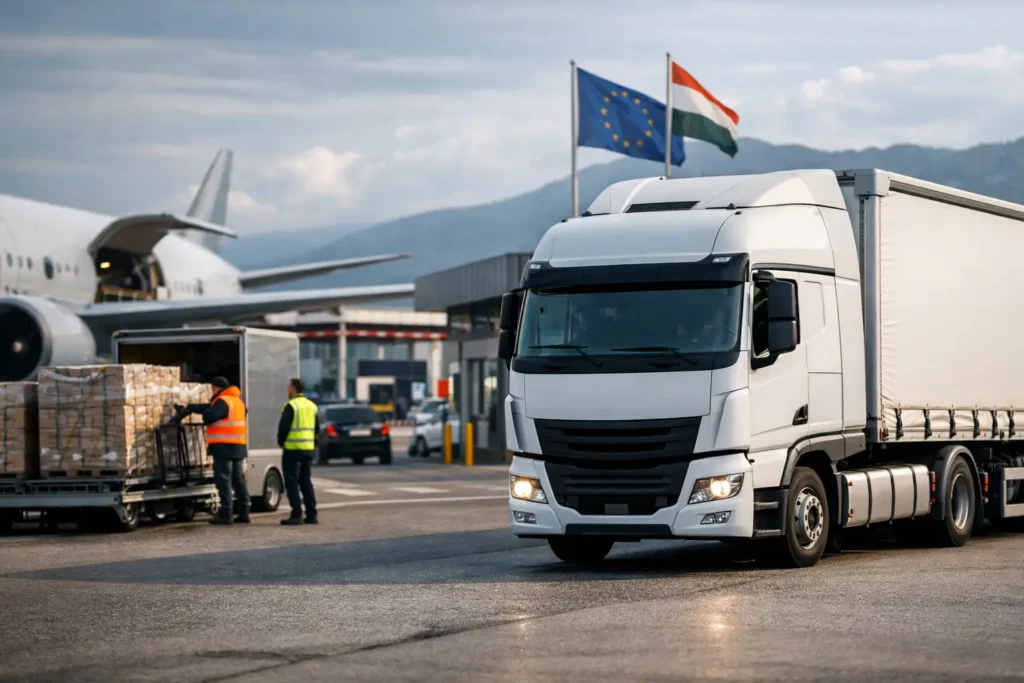
A production line in northern France is waiting for a replacement component from Germany. A distributor has committed stock to a customer in the UK, but the final pallets are still in Belgium. In both cases, standard transit may be cheaper, but a missed delivery date can cost far more than the transport itself. So, when should businesses use express freight? The answer is not simply whenever a shipment is urgent. Express road freight is a controlled response to a specific operational risk: preventing downtime, avoiding a contractual failure, protecting a critical customer relationship, or recovering a disrupted supply flow.
When should businesses use express freight rather than standard road transport?
Express freight is justified when the cost of delay is materially higher than the premium for a dedicated, time-critical vehicle. That assessment should include more than a late-delivery penalty. Consider lost production hours, labour standing idle, expedited sourcing, missed installation slots, retailer chargebacks and the effect on a strategic customer.
For routine replenishment, a consolidated or standard full-load service remains the sensible choice. It uses capacity more efficiently and gives procurement teams better control of transport spend. Express transport becomes the right option when the usual timetable no longer protects the operation.
A practical example is a machinery manufacturer in Spain awaiting a failed hydraulic unit from Italy. If the machine is down for two days, the customer may lose output and postpone a planned handover. A dedicated van collected immediately and delivered directly can restore the schedule within hours. Sending the same unit through a standard groupage network may add several handling points and one or two unnecessary days.
The distinction matters because road freight carries a major share of European trade. According to Eurostat, road transport accounts for roughly three quarters of inland freight transport in the EU by tonne-kilometres. For supply chain teams, even a small disruption in that flow can quickly become a production or service issue.
The operational triggers that make express freight worthwhile
The strongest case for express freight usually starts with a clear trigger. A line-stop risk is the most obvious: a missing component, tooling part or controlled spare that prevents manufacturing from continuing. In this situation, direct collection, dedicated capacity and live progress updates are more valuable than the lowest possible rate.
Express also suits urgent product launches and short-notice customer orders. For example, an industrial supplier may need to deliver replacement parts to a site in Scandinavia before a scheduled maintenance shutdown ends. Missing the slot could mean waiting weeks until the next shutdown window. A planned express movement protects the agreed service date and avoids a costly rescheduling exercise.
Other valid triggers include rejected goods that must be replaced quickly, a stockout at a key distribution point, urgent samples for approval, and a delayed inbound shipment that threatens an onward export. These cases require a decision based on commercial impact, not emotion. “Urgent” should be defined by a measurable consequence if delivery slips.
Assess the route before committing to an express service
A vehicle can move quickly, but border formalities, document errors and restricted collection times can still stop an urgent shipment. This is especially relevant on complex routes involving the UK, Switzerland, Turkey and onward movements towards the Caucasus.
For UK-bound freight, the vehicle schedule must allow for export and import customs processes, correct commodity information, and the agreed responsibility for declarations. An express vehicle arriving at the border without complete documentation is not an express solution. The same applies to Switzerland, where customs clearance sits outside the EU customs territory, and to Turkey, where documentation and transit planning need close attention.
Before booking, confirm the collection address, delivery deadline, cargo description, weight, dimensions, number of packages and any handling constraints. Also establish whether the consignee can receive outside normal hours. A direct vehicle has limited value if it arrives at 22:00 and the site cannot unload until the following morning.
For regulated goods, residues or items requiring specific paperwork, involve the transport partner before collection rather than treating compliance as an afterthought. The fastest plan is usually the one that identifies the constraints first.
Calculate the cost of delay, not just the freight rate
Express freight is a premium service, and it should be treated as such. A dedicated vehicle usually means fewer stops, no terminal handling, direct routing and priority planning. Those benefits carry a higher price than standard transport, particularly when collection is required at short notice or the route crosses a customs border.
The decision becomes clearer when the business calculates the cost of one missed day. Start with direct exposure: production downtime, labour, penalties, replacement purchasing and lost sales. Then add less visible costs, such as management time, customer confidence and the knock-on effect on subsequent deliveries.
A simple internal rule can help: use express freight where the likely cost of delay is greater than the transport premium by a meaningful margin. For a low-value, non-critical pallet, waiting for the next scheduled departure may be entirely appropriate. For a small component that keeps a high-value production asset running, a dedicated express van is often the lower-cost choice overall.
This approach also prevents express services becoming a substitute for weak planning. If the same lane requires urgent transport every month, investigate the root cause. Forecasting gaps, unrealistic supplier lead times, late purchase orders or insufficient safety stock may need attention. Express freight should protect exceptions, not quietly become the default.
Choose the vehicle and service level to match the shipment
Time-critical does not always mean a large lorry. Many urgent shipments are compact but commercially critical: an electrical drive, mould, spare part, prototype or boxed industrial equipment. A dedicated van may be faster to position, easier to book at short notice and better suited to direct delivery into constrained sites.
Larger pallets, higher weights or multiple consignments may require a dedicated lorry. The right choice depends on the shipment’s dimensions, loading requirements, route, security needs and delivery commitment. Sending an oversized vehicle for a few cartons wastes budget; selecting a vehicle that cannot safely carry the load creates risk before the journey begins.
A useful operational brief should cover four areas:
- What is the latest acceptable delivery time, not just the preferred time?
- What happens operationally and financially if the delivery misses that point?
- Are customs documents, commercial invoices and consignee details complete?
- Does the cargo need special handling, enhanced security or a specific vehicle type?
With these details, a transport specialist can determine whether standard freight, express delivery or a tailored exceptional shipment plan is appropriate. This is where rapid quotation matters. A quote should reflect the actual service required, rather than applying a one-size-fits-all rate to a time-sensitive problem.
Build express freight into contingency planning
The best express decisions are made before the crisis reaches the loading bay. Supply chain managers should identify critical parts, priority customers and lanes where a missed delivery would have disproportionate impact. Pre-agreed escalation contacts, document templates and clear authorisation limits reduce wasted time when an urgent movement is needed.
It is also worth reviewing each express shipment afterwards. Was the urgency caused by a supplier delay, transport disruption, border issue or internal planning change? Did the vehicle type and routing meet the required delivery time? This review turns an expensive exception into useful operational intelligence.
For urgent cross-border movements, accountability matters as much as speed. A transport partner should coordinate collection, vehicle selection, customs readiness and delivery follow-up, while keeping the customer informed at any time of progress. With 40 years of experience in European road freight, MAP Transport supports businesses that need direct, tailored solutions when timing cannot be left to chance.
The right express shipment is not the one moved fastest at any cost. It is the one that prevents a defined business failure, clears the route’s real constraints and arrives exactly when the operation needs it.
Need support on your transport flows? Contact our team for a tailored solution.
Have a question or need a quote? Contact us at (+34) 943 62 95 77 (ask for Raquel) or by email at lo*******@**********rt.com