
A production line in Birmingham is waiting for a replacement component from northern Spain. The shipment weighs only 320 kg, so paying for an entire vehicle may look excessive. Yet if it misses the collection window, it could sit at a consolidation point, face a customs query at the UK border and arrive two days late. That is the real decision behind dedicated van vs groupage freight: not simply vehicle capacity, but the cost of delay, handling and reduced control. For supply chain managers moving goods across Europe, the right choice depends on urgency, route complexity, freight profile and the consequences of a missed delivery.
Dedicated van vs groupage freight: the operational difference
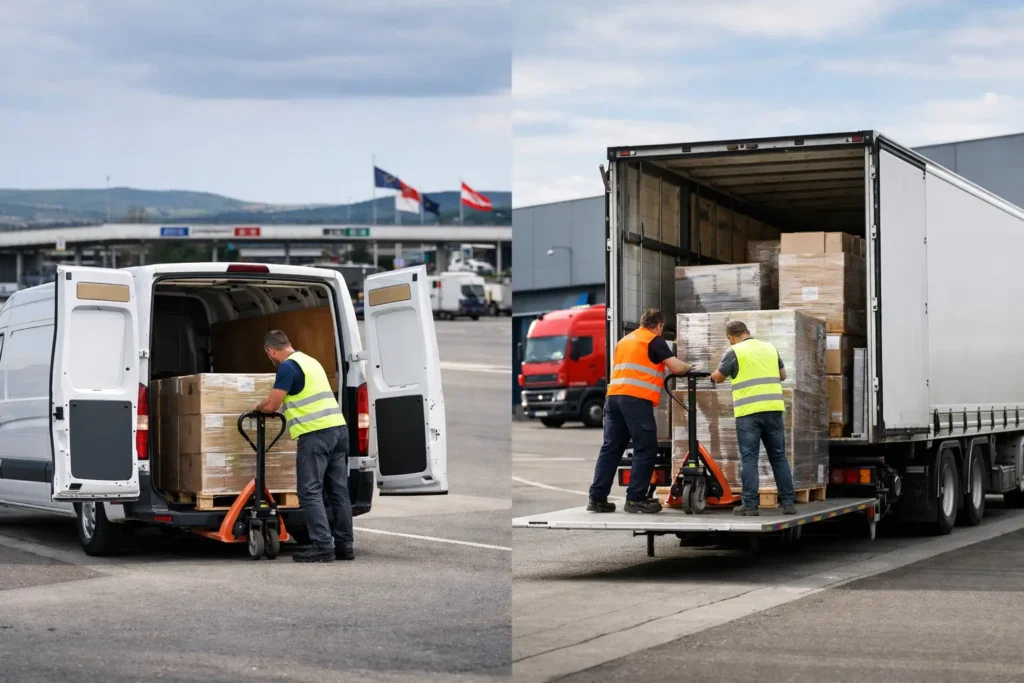
A dedicated van is assigned to one customer’s consignment. It collects directly from the supplier and travels to the consignee without sharing space, collection slots or routing priorities with other loads. The vehicle and driver are planned around the shipment’s requirements, including collection time, delivery appointment and any border process involved.
Groupage freight combines several compatible consignments in a shared vehicle or network. It is often the most economical solution for palletised or part-load freight that is not time-critical. However, it normally involves consolidation, sorting and transhipment, with timing shaped by the wider network rather than one shipment alone.
The distinction matters because every handling point creates another dependency. Eurostat data shows that road freight accounts for roughly three quarters of inland freight transport in the EU by tonne-kilometres. Road remains highly flexible, but that flexibility only delivers value when the service model matches the shipment’s operational risk.
For example, a standard pallet movement from France to Belgium with a flexible delivery date can be an efficient groupage movement. A machine part needed in Turin by 08:00 the next morning is a dedicated-van job, even when its weight is modest. The freight is the same; the consequence of lateness is not.
When groupage is the better commercial choice
Groupage works well when the delivery date has reasonable flexibility and the goods can move safely through a planned consolidation network. It spreads vehicle costs between shippers, making it particularly suitable for regular flows of one to 10 pallets, lower-value stock replenishment and orders where the receiving site can accept a broader delivery window.
It can also be the sensible choice for stable European lanes. If a distributor ships weekly pallets from Germany to the Netherlands and holds adequate buffer stock, groupage offers predictable planning and a lower unit cost than reserving a vehicle. The key is to plan around the network cut-off, not around an assumed direct-transit time.
Before choosing groupage, confirm four operational points:
- the latest collection time that still meets the required delivery date;
- the number of planned handling or cross-dock points;
- whether the consignee has strict booking or unloading requirements; and
- whether the goods need documents checked before a border crossing.
Groupage becomes less attractive when a shipment is fragile, highly valuable, difficult to handle, or tied to a narrow production slot. Lower transport spend can be quickly outweighed by a missed installation, a rejected delivery or costly downtime.
When a dedicated van protects delivery performance
A dedicated van is not only an express option. It is a control option. It gives the shipper a direct collection-to-delivery movement, a named operational plan and fewer handovers. That can reduce the risk of damage, loss of visibility and timing drift caused by network consolidation.
It is especially relevant for urgent transport, prototypes, replacement parts, trade-critical documents travelling with goods, confidential products and shipments where the receiving site will only accept delivery within a short appointment window. A van can often collect late in the day and deliver within hours or the following morning on major European routes, subject to driving-time planning and border conditions.
Consider a supplier in the Basque Country sending an urgent tooling component to a manufacturer near Coventry. With groupage, the freight may first travel to a hub, wait for departure, then require export formalities and UK import clearance before final delivery. With a dedicated vehicle, collection, documentation checks and border timing can be coordinated as one movement. It does not remove customs requirements, but it removes unnecessary network stages at the point where time matters most.
The premium for a dedicated service should be assessed against the exposure it avoids. If one hour of production stoppage costs more than the difference between groupage and dedicated transport, the decision is usually straightforward.
Complex borders change the dedicated van vs groupage freight calculation
Cross-border transport is not equally complex on every lane. Movements within much of the EU can be planned around standard commercial documents and delivery requirements. Routes involving the UK, Switzerland, Turkey or onward connections towards the Caucasus require closer control of customs data, transit documentation and timing at the border.
For UK movements, an incomplete commercial invoice, inconsistent commodity description or missing importer information can delay clearance. In a groupage load, one issue affecting a consolidated movement may create knock-on delays for other consignments. A dedicated van isolates the shipment operationally, allowing the team to focus on one document set, one driver and one delivery requirement.
That does not mean dedicated transport is automatically necessary for every UK or Swiss shipment. A routine, well-documented pallet flow with sufficient lead time can move successfully by groupage. The decision changes where the delivery deadline is fixed, the cargo is essential, or the paperwork is unusually sensitive.
An operational insight often missed at tender stage is that customs readiness should be treated as a collection condition, not a task for later in transit. Confirm the invoice, packing list, EORI details, Incoterms, commodity codes and party responsible for import formalities before the vehicle is dispatched. A fast van cannot recover time lost to incomplete border documentation.
Build the service choice around risk, not weight alone
Weight and pallet count are useful starting points, but they are poor final decision criteria. A 200 kg emergency part may justify a dedicated van, while a two-tonne stock replenishment shipment may be ideal for groupage. The better question is: what happens to the operation if this consignment arrives late, damaged or without the correct documentation?
Use groupage where cost efficiency is the priority and the delivery plan has tolerance. Use a dedicated van where direct routing, speed, security or precise delivery coordination are more valuable than shared capacity. For some companies, the best model is not one or the other but a clear transport policy: standard replenishment moves by groupage, while line-stopping parts, urgent customer orders and complex-border consignments move on dedicated services.
This approach also improves purchasing decisions. Rather than requesting a rate for an undefined “urgent shipment”, provide the origin, destination, collection deadline, delivery deadline, weight, dimensions, commodity, customs status and consequences of delay. A transport partner can then recommend the right vehicle and service level rather than forcing the freight into an unsuitable network.
A practical decision before requesting a quote
If the consignment has a fixed deadline, a high cost of delay, restricted handling requirements or customs exposure on a route such as the UK, Switzerland or Turkey, start by pricing a dedicated van. It provides the clearest view of what direct control costs.
If the goods are standard, properly packaged, non-urgent and part of a repeatable lane with delivery flexibility, groupage is likely to offer stronger cost efficiency. Ask for the planned transit time, not just an estimate, and establish what happens if the cargo misses the consolidation cut-off.
MAP Transport has coordinated international road freight since 1985, matching standard, express and specialist movements to the actual risk of each shipment. The objective is not to sell the largest vehicle or the fastest option by default. It is to protect delivery performance with the service level the flow genuinely needs.
A well-chosen transport model turns freight from a last-minute escalation into a controlled part of the production and purchasing plan.
Need support on your transport flows? Contact our team for a tailored solution.
Have a question or need a quote? Contact us at (+34) 943 62 95 77 (ask for Raquel) or by email at lo*******@**********rt.com