
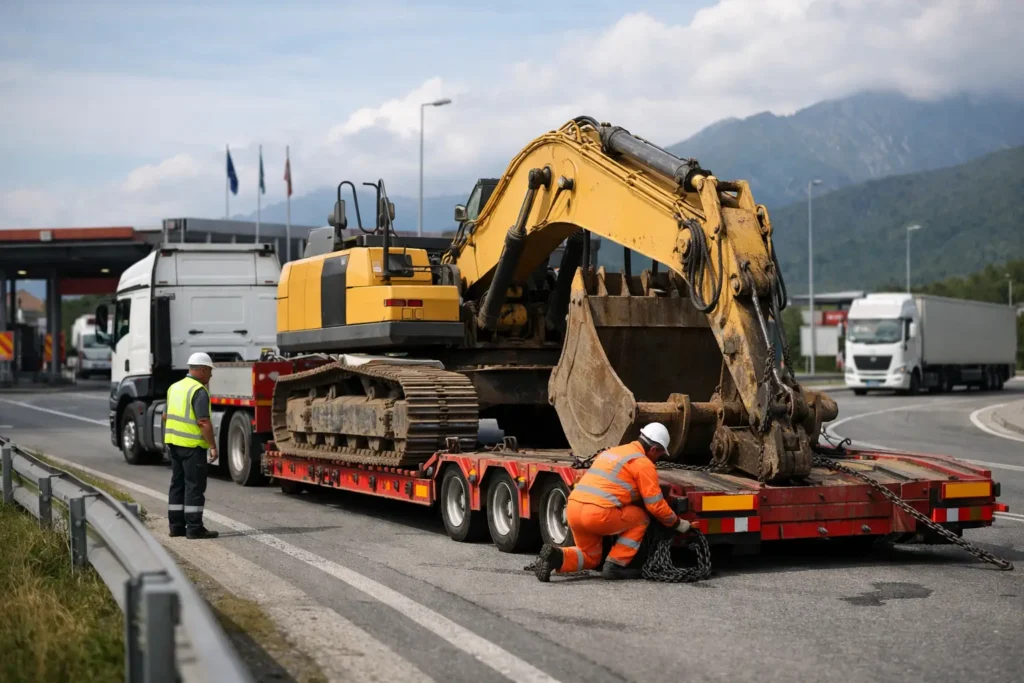
A production line does not wait because an abnormal-load permit is still being processed. In this case study of heavy machinery transport with permits, a manufacturer needed a 76-tonne industrial press moved from northern Spain to the Midlands within a fixed installation window. The physical distance was manageable. The operational risk was not: different permit rules, route constraints, UK customs formalities and a delivery site with limited access. The shipment succeeded because planning started with the real constraints, not with the vehicle availability. For supply chain managers, that distinction protects both the installation programme and the transport budget.
The shipment: a fixed delivery date with little margin
The cargo was a hydraulic press for a metal components manufacturer. It measured 10.8 metres long, 3.4 metres wide and 3.6 metres high once secured for road movement. At 76 tonnes gross load weight, it required specialist equipment, country-specific authorisations and an approved route rather than a standard international freight booking.
The destination had booked a mobile crane, installation engineers and a temporary production shutdown. Missing the unloading slot would not simply mean a late delivery. It would generate standing time, rescheduling costs and a further interruption to the factory commissioning plan.
The target transit was seven calendar days from collection to site arrival. That included permit lead times, the road movement through France, the Channel crossing, UK customs clearance and a timed final delivery. The operational objective was clear: arrive at the site at 07:00 on the agreed day, with no unplanned hold at a border, ferry terminal or road restriction.
Case study heavy machinery transport with permits: planning backwards
The transport plan began with a route survey and cargo data validation. A common mistake is to provide the machinery’s catalogue dimensions rather than its transport dimensions. Packaging, lifting points, cradles and securing arrangements can change the actual width, height and axle loads that authorities must assess.
For this movement, the planning team confirmed the final loaded dimensions before applying for permits. The route was then checked for bridge limitations, roundabouts, roadworks, overhead restrictions and the availability of suitable stopping points. One initially proposed route was rejected because of a temporary restriction on a key French road section. Finding this before permit submission avoided a late amendment and a potential two-day delay.
The permit programme covered Spain, France and the UK, with requirements varying by territory and route. Some authorities focus heavily on gross weight and axle configuration; others assess width, height, travel periods and escort conditions in greater detail. A permit is not a blanket permission to take any road. It applies to a specific vehicle configuration, load and authorised itinerary.
The most useful operational insight was to build contingency into the route before the shipment departed. A credible alternative route was prepared for the French section, but it was not treated as interchangeable. If used, it would need to remain within the approved conditions. This is why abnormal-load planning cannot be reduced to obtaining documents shortly before collection.
Customs and the Channel crossing needed the same attention
The UK leg added another layer of control. While the machinery was European-manufactured, the movement still required complete commercial and customs documentation for export and import processing. The haulier, customs representatives, shipper and consignee needed aligned references, values and commodity details before the unit approached the port.
For a time-sensitive exceptional shipment, customs errors can be more damaging than a slow road section. A discrepancy in the commercial invoice or import declaration may hold the load at the terminal, while an abnormal vehicle cannot simply be redirected to a conventional parking area. The ferry booking also had to reflect the unit’s dimensions and loading requirements.
The team scheduled the Channel crossing with time to absorb a routine terminal delay while preserving the approved UK delivery time. That trade-off mattered. Choosing the fastest theoretical crossing can look attractive on a spreadsheet, but a slightly earlier sailing with more recovery time often creates a safer plan for machinery transport.
The movement was monitored at key milestones: collection, permit-controlled road sections, terminal arrival, departure, customs release, UK entry and final approach. The consignee received updates before each decision point, not only after a problem appeared. For an operations manager, that visibility makes it easier to coordinate the crane crew and site access arrangements.
The final-mile delivery was planned as a project
Heavy machinery transport is frequently won or lost in the final five kilometres. The press had to enter an industrial estate with a narrow approach road and reverse into a designated unloading position. The delivery could only take place before normal site traffic increased, and the crane could not be repositioned once the lifting operation began.
A pre-delivery call confirmed that the access road was clear, the unloading area had been isolated and the nominated site contact was present. The escort and delivery team followed the approved arrival sequence. The vehicle reached the site at 06:45, allowing a final safety check before the 07:00 unloading slot.
The result was delivery on the planned date, with the crane operation completed before the factory’s main shift began. A 15-minute early arrival was more valuable than it may sound. On a project involving a hired crane, restricted access and external installation engineers, that margin reduced pressure without breaking the delivery protocol.
What this case shows about permit-led transport
The shipment demonstrates that the permit itself is only one part of the control process. The real value comes from connecting dimensions, route engineering, authority lead times, customs, port bookings and site readiness into one operating plan.
For procurement and supply chain teams, four details should be confirmed at quotation stage:
- Final cargo dimensions, weight and axle-load information, including cradles and transport frames.
- Exact collection and delivery addresses, plus photographs or site constraints where access is limited.
- Required delivery date and whether crane, escort or out-of-hours unloading is already booked.
- Customs status and the responsible parties for export, import and supporting commercial documents.
It also depends on the route. A movement within the EU may mainly be a permit and road-access exercise. A shipment to the UK, Switzerland or Turkey can require closer customs coordination alongside the exceptional-load planning. For urgent machinery replacements, the question is not simply whether a lorry can be dispatched quickly. It is whether the permissions, border process and delivery conditions can support the promised arrival time.
Building a safer request for quotation
A precise request gives the transport provider the information needed to identify risk early. Send the load weight, length, width, height, origin, destination, collection readiness date and required delivery window. If the machinery is being moved for a shutdown, installation or repair, say so. That context changes how the route, contingency time and vehicle solution should be organised.
Since 1985, MAP Transport has coordinated complex road freight movements across Europe, including exceptional shipments where timing, documentation and route compliance must work together. The aim is not to make a difficult movement sound simple. It is to identify the constraints early enough to manage them properly and keep the consignee informed throughout transit.
A well-planned heavy machinery move gives the receiving site something more useful than a tracking update: confidence that the people, equipment and production plan can be ready when the load arrives.
Need support on your transport flows? Contact our team for a tailored solution.
Have a question or need a quote? Contact us at (+34) 943 62 95 77 (ask for Raquel) or by email at lo*******@**********rt.com