
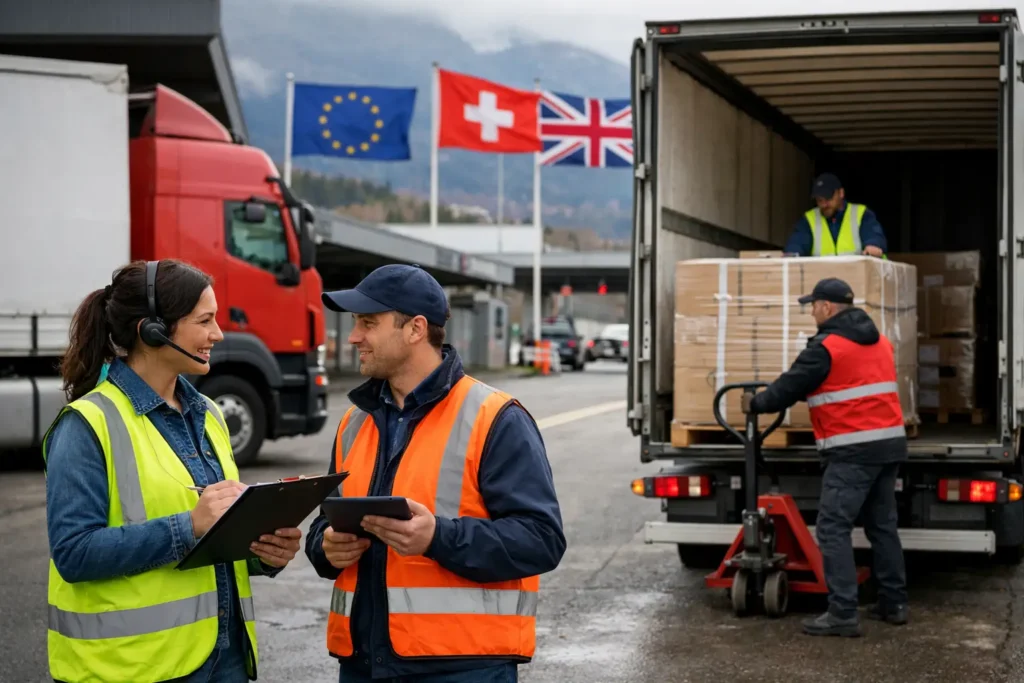
A missing translation in a customs email can hold a lorry at the UK border. A misunderstood unloading instruction can send a time-critical consignment to the wrong gate. For supply chain managers, multilingual logistics support for European shipments is not a customer-service extra: it is a control point for delivery time, documentation accuracy and accountability. This matters most where several parties are involved – shipper, consignee, driver, customs agent and site security – and where the route crosses borders with different requirements. Clear communication reduces avoidable waiting time before it becomes an expensive production or customer-service problem.
Why language creates operational risk in road freight
European road freight involves more than 27 EU member states, alongside major non-EU trading partners such as the UK, Switzerland and Turkey. A shipment may be planned by a procurement team in the UK, collected in Spain, cleared through Swiss customs and delivered to a manufacturing site in Germany. Even when English is the working language, local instructions, customs queries and delivery-site procedures are often issued in the national language.
The risk is not simply that someone fails to understand a message. It is that a message is understood too late, by the wrong person, or without the operational context needed to act on it. A consignee may say that delivery is possible “in the morning”, while the site’s booking office requires a specific slot, a vehicle registration number and a named driver before access is approved. If that detail is not confirmed in the language used by the receiving site, the vehicle may wait outside the gate.
For routine palletised freight, the cost may be manageable. For urgent machinery parts, regulated industrial residues or high-value components, the consequences rise quickly. A delayed part can stop a production line; an unclear customs instruction can cause a missed delivery appointment; an incorrectly translated loading restriction can result in the wrong vehicle being assigned.
Multilingual logistics support for European shipments at key handovers
The most valuable communication does not happen only at collection and delivery. It is needed at each handover where information can change the transport plan. In practice, that includes quotation, booking, collection, border formalities, live transit updates and final proof of delivery.
At quotation stage, multilingual support helps establish facts that are often lost in short transport requests: whether the loading site needs a vehicle with specific access arrangements, whether goods are stackable, whether a delivery slot is fixed, and whether documentation must accompany the driver. These details determine the vehicle type, route and realistic transit time.
During transport, a specialist team should be able to speak directly with the relevant party rather than relying on relayed messages. This is particularly useful when a driver needs confirmation from a French loading office, a German consignee moves its slot, or a Turkish customs representative asks for a corrected document. One accountable coordinator can clarify the issue, document the decision and update the customer without creating a chain of partial translations.
The principle is simple: the closer communication is to the person who can act, the less room there is for delay. That does not mean every shipment needs support in several languages. A repeat route between two established sites may run efficiently with a familiar process. The value increases when the route, cargo, consignee or border procedure is unfamiliar.
Border routes where clarity protects delivery time
Non-EU movements deserve particular attention because language and customs status must be managed together. The UK, Switzerland and Turkey can all introduce document checks, border queues and requests for further information. A transport plan that works on an EU-only route may not provide enough time or control for these crossings.
Consider an urgent shipment of replacement industrial components from northern Spain to a customer in the Midlands. The consignee needs delivery before a planned maintenance window closes the following morning. The movement requires export formalities from the EU and import clearance into the UK, while the receiving site has a strict arrival process. If the customs documentation is incomplete, or if a delivery contact does not receive the arrival update in a usable form, the express vehicle can lose the advantage gained on the road.
A multilingual coordinator should confirm the commercial invoice, packing information, commodity description, contact details and clearance responsibilities before collection. During transit, the team should monitor whether the border process is progressing as expected and communicate any action required immediately. For an urgent load, waiting until the customer asks for an update is too late.
Switzerland creates a similar need for precision. It sits at the heart of European industrial supply chains but remains outside the EU customs union. Turkish routes add further complexity due to distance, border procedures and the need to coordinate with local parties. On these lanes, a cheap rate that does not include active follow-up can become costly when a query appears after the lorry is already moving.
What to provide when requesting a cross-border quote
Good multilingual coordination starts with a usable brief. Transport teams can move faster when they receive the commercial and operational facts together, rather than having to chase missing information while collection time approaches.
For every request, provide origin and destination postcodes, ready date and time, delivery deadline, total weight, dimensions, number of packages, cargo description and whether the goods are stackable. Add the loading and unloading contacts, their preferred language where relevant, and any site restrictions such as booking requirements, restricted access hours or vehicle limitations.
For customs-sensitive movements, also specify who is responsible for export and import formalities, whether a customs agent has been appointed, and which documents will be ready before collection. Vague instructions such as “documents to follow” are a warning sign on an urgent route. If the documents are not ready when the vehicle arrives, an express service may become a waiting vehicle with an express price.
An operational insight often missed by procurement teams is that language should be treated as shipment data. If the delivery site communicates only in Italian, Polish or Turkish, include that in the booking instruction. It helps the transport provider allocate the right coordinator from the outset instead of trying to solve a communication gap under pressure.
Matching the service level to the communication risk
Not every shipment needs the same level of intervention. Standard road freight is appropriate for planned, repeatable movements where collection and delivery details are stable. However, standard does not mean unattended. It should still include clear status communication and a named team able to resolve exceptions.
For a critical spare part, a production-line requirement or a last-minute customer commitment, an express vehicle can deliver in a few hours or in under 24 hours across many European routes. The service level must include rapid decision-making as well as speed on the road. If an issue arises at collection, the coordinator needs authority and language capability to speak with the site, reorganise the plan and keep the consignee informed.
Exceptional shipments require an even earlier exchange of information. Oversized or heavy loads may need specific loading equipment, route checks, permits or delivery-site preparation. A translated measurement or misunderstood unloading requirement is not a minor administrative error. It can prevent the load from being handled safely or require the entire plan to be changed.
The practical question is not “Do we need multilingual support?” It is “What is the cost if a critical instruction is misunderstood?” On a low-risk recurring lane, the requirement may be limited. On a first-time delivery to a controlled industrial site, a UK import movement or an urgent shipment into Turkey, it should be part of the transport plan.
Building one accountable communication route
Supply chain teams benefit when they know who owns the next action. That means avoiding a situation where the customer is asked to interpret messages from the driver, chase a customs contact, then explain the outcome back to the carrier. One freight partner should coordinate the operational conversation and escalate only the decisions that genuinely need the shipper’s approval.
This approach also improves reporting. Rather than receiving generic updates, the customer should be informed of meaningful milestones: vehicle assigned, goods collected, border formalities progressing, delivery appointment confirmed and delivery completed. Where an exception occurs, the update should state the issue, the action being taken and any effect on the expected arrival time.
MAP Transport has managed international road freight since 1985, coordinating standard, express and exceptional movements across Europe and on complex routes to the UK, Switzerland, Turkey and the Caucasus. The aim is not to add another contact layer. It is to give customers a team that can act quickly, communicate clearly and stay responsible from quote to delivery.
The best time to identify a language or customs risk is before the vehicle is booked. Share the full shipment brief early, agree the communication route and make sure every party knows what happens if the plan changes.
Have a question or need a quote? Contact us at (+34) 943 62 95 77 (ask for Raquel) or by email at lo*******@**********rt.com
Need support on your transport flows? Contact our team for a tailored solution.