
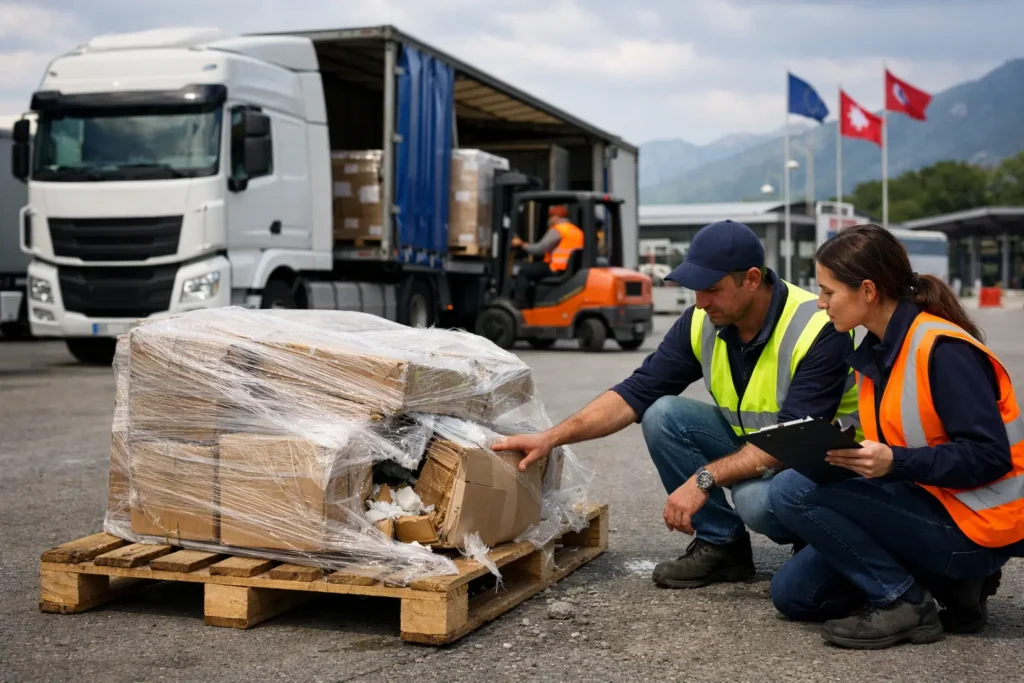
A damaged consignment is rarely just a claims issue. For a manufacturer, distributor or industrial supplier, it can stop a production line, trigger a rejected delivery, consume time across quality and purchasing teams, and weaken a customer relationship built over years. The top causes of freight damage are usually preventable, but prevention depends on decisions made before collection: packaging specification, vehicle selection, loading method, route planning and communication at each handover. This matters even more on cross-border road movements, where customs holds, transhipments and urgent delivery requirements can put otherwise sound freight under pressure.
Damage often starts before collection
The first loading is the point at which many future damage claims are created. Packaging may be designed for warehouse storage rather than road transport. A pallet can support product weight while stationary, yet fail when exposed to braking, cornering, vibration or another pallet shifting against it.
Common weaknesses include uneven weight distribution, overhanging cartons, insufficient edge protection and stretch wrap used as a substitute for structural stability. Stretch wrap holds a load together; it does not make an unstable pallet safe for transport. Similarly, damaged or lightweight pallets can collapse under concentrated weight, particularly when goods are moved by forklift more than once.
A practical check before booking is simple: could the pallet tolerate being tilted slightly, handled from two sides and secured beside another load without the product moving? If the answer is no, the packaging needs attention before the lorry arrives.
For high-value components, metal parts, machinery and fragile goods, specify the freight condition in the transport instructions. Record whether pallets may be double-stacked, whether goods must remain upright, and where forks may enter. Clear handling instructions are more effective when they appear on the unit load itself, not only in an email sent to a transport provider.
Top causes of freight damage during loading
Poor load restraint is one of the top causes of freight damage because it turns routine driving forces into movement inside the vehicle. A load that shifts by only a few centimetres can crush cartons, bend packaging corners or create enough space for a heavier pallet to fall.
The right approach depends on the cargo and vehicle. Curtainsider equipment offers flexibility for general freight but requires proper internal restraint. Fragile or irregular freight may need a vehicle with suitable lashing points, load bars, anti-slip material, straps, protective blankets or dedicated positioning. Exceptional shipments require a separate securing plan rather than standard pallet-freight assumptions.
Consider a 26-pallet full load. If one pallet is damaged, that represents 3.8% of the shipment by pallet count. Yet if that pallet contains a critical production component, the commercial impact may be closer to 100% of the delivery. This is why loading plans should account for product criticality, not merely available floor space.
Weight distribution matters as much as restraint
Heavy freight positioned against light, crushable cartons creates an avoidable risk. So does loading a dense item where it can move into empty space during braking. The loader should know the weight of each unit, its dimensions and any stackability restrictions before the vehicle is assigned.
This is especially relevant for mixed collections. A vehicle collecting from several suppliers can be correctly loaded at the first stop but become unstable after later freight is added. Route sequence, collection order and unloading order must be planned together. It is an operational detail that protects both the goods and delivery time.
Handling errors multiply at transfer points
Every additional touchpoint introduces another chance for impact damage, incorrect forklift handling or exposure to unsuitable conditions. Fork damage to a pallet base, punctured cartons and broken bands often occur during loading, unloading or cross-docking rather than while the vehicle is travelling.
Direct road transport reduces these touchpoints. It is often the safer choice for urgent, sensitive or high-value freight, even where a consolidated service appears cheaper on the initial rate. The trade-off is cost: dedicated or express capacity can cost more, but it can reduce handling risk and provide tighter control over collection and delivery timing.
A realistic example is a time-critical shipment of electrical control units from northern Spain to the UK. If it is consolidated through multiple depots, each transfer creates a new handling event and makes delivery dependent on the wider network. A dedicated van or express vehicle may collect and deliver with no transhipment, while allowing the shipper to receive progress updates throughout the journey.
Damage prevention also requires evidence. Before loading, photograph any visible packaging defects and note them on collection paperwork. At delivery, ask the consignee to inspect the external condition before signing where practical. This does not eliminate damage, but it creates a clear record and allows a response before the problem becomes a disputed claim days later.
Route disruption and customs delays can damage goods
A route is not only a distance calculation. Border procedures, waiting times, road restrictions and weather can all affect freight condition. This is particularly relevant on movements involving the UK, Switzerland, Turkey and onward routes towards the Caucasus, where customs documentation and border timing need to be planned as carefully as vehicle capacity.
When documents are incomplete or data does not match the cargo, a vehicle can be held at a border for hours or longer. For temperature-sensitive products, goods with limited packaging resilience, or equipment required for a fixed installation window, that delay can become a damage risk. It may also prompt rushed unloading or reloading arrangements once clearance is obtained.
The operational control is to validate the shipment data before collection: commodity description, number of packages, weights, values, origin information and the documents required for the route. For specialist or regulated materials, handling instructions and compliance documentation must be aligned with the actual goods, not copied from a previous shipment.
Urgent transport requires particular discipline here. A fast vehicle cannot recover time lost because paperwork was not ready. The best option may be an express service, but only after the route, border requirements and delivery booking have been checked. Speed without preparation is simply a more expensive way to create a delay.
Vehicle mismatch is a preventable risk
Selecting a vehicle based only on pallet spaces or price can expose freight to damage. The dimensions, centre of gravity, loading method and sensitivity of the goods should drive the transport plan. A standard curtainsider may be appropriate for stable industrial pallets, while oversized machinery, long profiles or non-standard units may require specialist equipment and a controlled loading process.
The same principle applies to small urgent consignments. A van can be the right choice for delivery within hours, but not if the shipment needs side loading, particular restraint equipment or protection from contact with other cargo. The vehicle must fit the goods, not force the goods to fit the vehicle.
Before requesting a quote, provide these details accurately:
- Collection and delivery postcodes, including site access restrictions and booking times.
- Number of packages, dimensions, gross weight and whether the freight is stackable.
- Product value, fragility, centre-of-gravity concerns and required handling position.
- Customs status and documentation needs for cross-border movements.
- Delivery deadline and whether a direct, dedicated vehicle is required.
This information allows the transport plan to be designed around the actual risk. It also prevents late changes that can lead to unsuitable equipment arriving on site.
Turn damage prevention into a transport control process
The most effective shippers do not treat freight damage as an isolated carrier problem. They build controls into each shipment flow. Packaging teams define transport-ready standards; dispatch teams verify labels and documents; procurement teams share critical delivery requirements; and the freight partner confirms the vehicle, route and loading approach.
For recurring lanes, review claims and near-misses by cause. If corner damage appears repeatedly, investigate pallet quality, load bars, vehicle space or warehouse handling. If problems occur on a particular cross-border route, review border waiting times, documentation quality and whether direct service is more appropriate. The aim is not to add process for its own sake. It is to remove the recurring point of failure.
MAP Transport has managed international road freight since 1985 and can match standard, urgent and exceptional shipments to the right transport setup, with personalised follow-up from collection to delivery. A detailed brief at the start creates more control later, especially when the route includes customs formalities or a delivery slot that cannot move.
The most useful question is not simply, “What will it cost to move this freight?” Ask what could cause it to arrive damaged, delayed or rejected – and make that risk part of the booking decision.
Need support on your transport flows? Contact our team for a tailored solution.
Have a question or need a quote? Contact us at (+34) 943 62 95 77 (ask for Raquel) or by email at lo*******@**********rt.com