
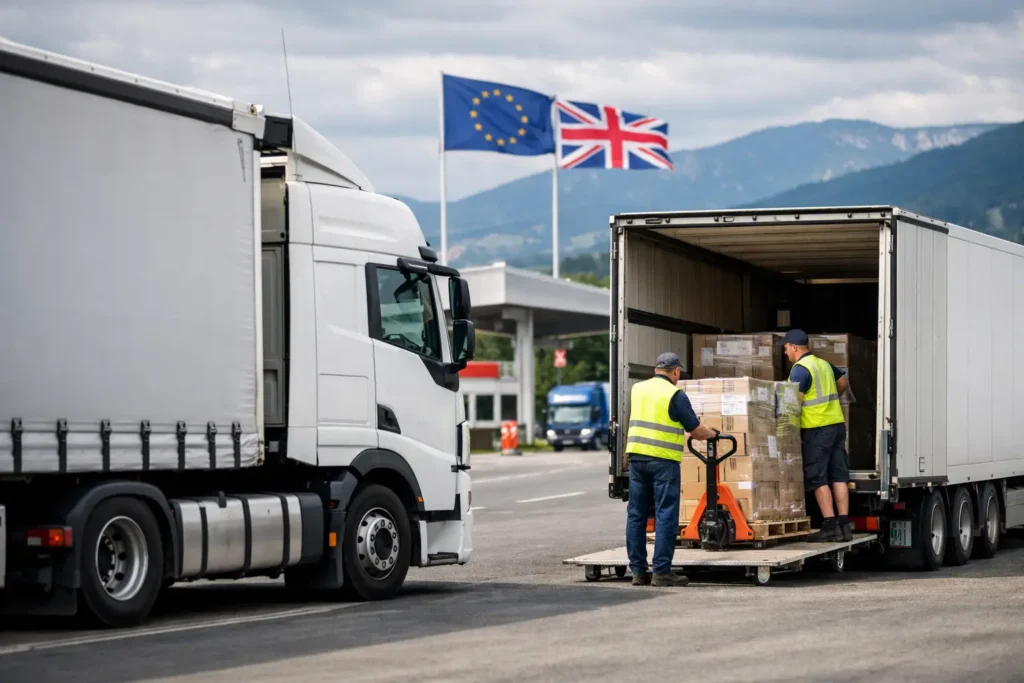
A production line waiting for a critical component, a customer facing a missed launch date, or a customs hold at the UK border can turn an apparently routine shipment into a costly operational problem. So, what is dedicated road transport in practical freight terms? It is a service in which one vehicle and its journey are assigned exclusively to your consignment, rather than carrying freight for several customers. For supply chain teams, the value is not simply speed. It is greater control over collection times, routing, handling, communication and delivery performance when a shared network would add risk.
What is dedicated road transport and when does it make sense?
Dedicated road transport uses a van, lorry or specialist vehicle for one customer’s shipment from collection to delivery. The vehicle does not stop to collect or unload other customers’ goods, and the transport plan is built around the requirements of that specific load.
That differs from groupage, where several consignments share vehicle capacity and follow a consolidated route. Groupage is often the economical choice for flexible, smaller shipments. Dedicated transport becomes the stronger option when the consequences of delay, additional handling or uncertain departure times outweigh the higher transport cost.
It is particularly relevant where you need a fixed collection slot, a direct movement, controlled handling or a clear chain of responsibility. Common cases include urgent industrial parts, high-value equipment, sensitive components, full loads with a strict delivery booking, and consignments travelling on routes with demanding border processes.
The decision should be based on the cost of service failure, not only the price per pallet. If a delayed €5,000 component stops a production line or postpones a customer delivery worth far more, a dedicated vehicle can be the lower-cost decision overall.
The operational benefits of dedicated transport
The main benefit is control. With a dedicated vehicle, collection and delivery timings are planned around your order, rather than around a network’s consolidation schedule. This reduces the number of handovers and removes uncertainty caused by other consignments joining the route.
It also improves visibility. Your transport provider can confirm the vehicle assignment, monitor progress and give informed updates when conditions change. This matters when purchasing, production and customer-service teams all need a reliable answer to one question: when will the goods arrive?
A dedicated movement can also reduce handling risk. Fewer loading operations mean fewer occasions for goods to be misplaced, damaged or exposed to unsuitable conditions. For machinery, metal parts, fragile equipment or confidential goods, that reduction in touchpoints is operationally significant.
There is a capacity advantage too. A dedicated vehicle is selected for the shipment, not for a mixed load built around other customers’ freight. That may mean a van for a fast, compact consignment, an articulated lorry for a full industrial load, or specialist equipment for an exceptional shipment. The objective is appropriate capacity, not automatically the largest vehicle available.
Dedicated road transport on complex cross-border routes
Direct road transport is especially useful on routes where border formalities can disrupt a tightly planned delivery. UK, Switzerland and Turkey movements require more than a driver and a delivery address. The shipment needs correct commercial documentation, customs data, commodity information and clear coordination between the exporter, importer, broker and carrier.
For example, a manufacturer in northern Spain may need to send replacement tooling to a customer in the Midlands after an unexpected equipment failure. If the goods travel as groupage, they may wait for consolidation, pass through additional hubs and face a less predictable border timetable. A dedicated van can collect quickly, travel directly towards the port or Channel crossing, and keep the shipper informed while customs formalities are managed in advance.
That does not mean dedicated transport eliminates customs risk. Missing information, incorrect values, unclear commodity descriptions or an importer not ready to clear the goods can still stop a vehicle. The difference is that a dedicated plan gives the logistics team more control over timing and escalation when a problem occurs.
The same principle applies to Switzerland, Turkey and onward routes into the Caucasus. Border wait times can vary, and documentation must match the goods precisely. A provider with multilingual coordination can resolve questions faster between factories, customs representatives, drivers and receiving sites in different countries.
Where dedicated transport delivers the strongest return
Dedicated road transport is not the default answer for every lane. It is a premium service, so it should be used where its operational benefits are measurable. It generally offers the strongest return in four situations:
- A delivery window is fixed and missing it would create production, contractual or customer-service consequences.
- The goods are urgent, high-value, sensitive or unsuitable for repeated handling.
- The route includes customs complexity, difficult delivery access or a requirement for close coordination.
- The load requires a particular vehicle type, specialist securing or exceptional-shipment planning.
Consider an industrial distributor with a planned delivery of standard stock to France and a separate urgent consignment of replacement parts to Sweden. Sending both by dedicated transport may not be sensible. The routine stock can move on a standard service with a cost-efficient lead time, while the replacement parts warrant an express dedicated vehicle because the recipient’s operation is waiting.
This is the practical distinction procurement teams should make: use standard road freight where transit flexibility is acceptable; use dedicated capacity where timing certainty and reduced handling are worth paying for.
Planning a dedicated shipment without creating avoidable delay
A dedicated service only works well when the booking information is complete from the start. Before requesting a quote, confirm the collection and delivery postcodes, available dates and times, total weight, dimensions, number of packages, loading method and any access restrictions at either site.
For cross-border freight, provide the commercial invoice, packing list, commodity details and customs instructions early. If the shipment is travelling to the UK, Switzerland, Turkey or another non-EU destination, clarify who is responsible for import clearance and whether the consignee is prepared to act when the goods reach the border.
One operational insight is often overlooked: a direct vehicle cannot compensate for a site that is not ready. A missed collection slot, unavailable forklift, incomplete export paperwork or closed receiving bay can remove the very time advantage you paid for. Aligning production, warehouse, customs and delivery teams before collection is therefore as important as selecting the right transport service.
When requesting a quotation, explain the commercial priority as well as the physical details. “Delivery required before 10:00 on Tuesday because a shutdown is planned” allows the transport provider to assess whether standard, express or ultra-express service is appropriate. A good plan includes contingencies for traffic, ferry capacity, border processes and site access rather than promising an unrealistic transit time.
Choosing the right dedicated transport partner
The right partner should ask operational questions, not simply provide a rate. They should establish what is being moved, why the deadline matters, whether customs formalities apply and what vehicle is genuinely required. This avoids paying for unsuitable capacity or discovering too late that the delivery site cannot accept the planned vehicle.
Experience matters most on exceptional and urgent flows. An oversized load, a time-critical van movement or a UK shipment with incomplete customs alignment all need active coordination, not passive booking confirmation. Look for a provider that can communicate clearly across languages, give a prompt quotation and remain accountable from collection through delivery.
Since 1985, MAP Transport has managed tailored road freight movements across 45 countries, with standard, express and exceptional-shipment options selected according to the load and delivery requirement. Supporting more than 200 customers each year, the focus is on matching the transport plan to the risk on the route, whether that is an urgent European delivery or a customs-sensitive movement beyond the EU.
Make dedicated transport a deliberate decision
Dedicated road transport is most valuable when a shipment has little room for uncertainty. It gives your team a direct vehicle, fewer handling points and tighter control of the journey, but it should be justified by the commercial impact of delay or disruption. For regular flows, reviewing which consignments truly need dedicated capacity can protect both your service level and your transport budget.
The most useful question is not whether dedicated transport is faster. It is what a late, damaged or poorly coordinated delivery would cost your business on this particular shipment.
Need support on your transport flows? Contact our team for a tailored solution.
Have a question or need a quote? Contact us at (+34) 943 62 95 77 (ask for Raquel) or by email at lo*******@**********rt.com