
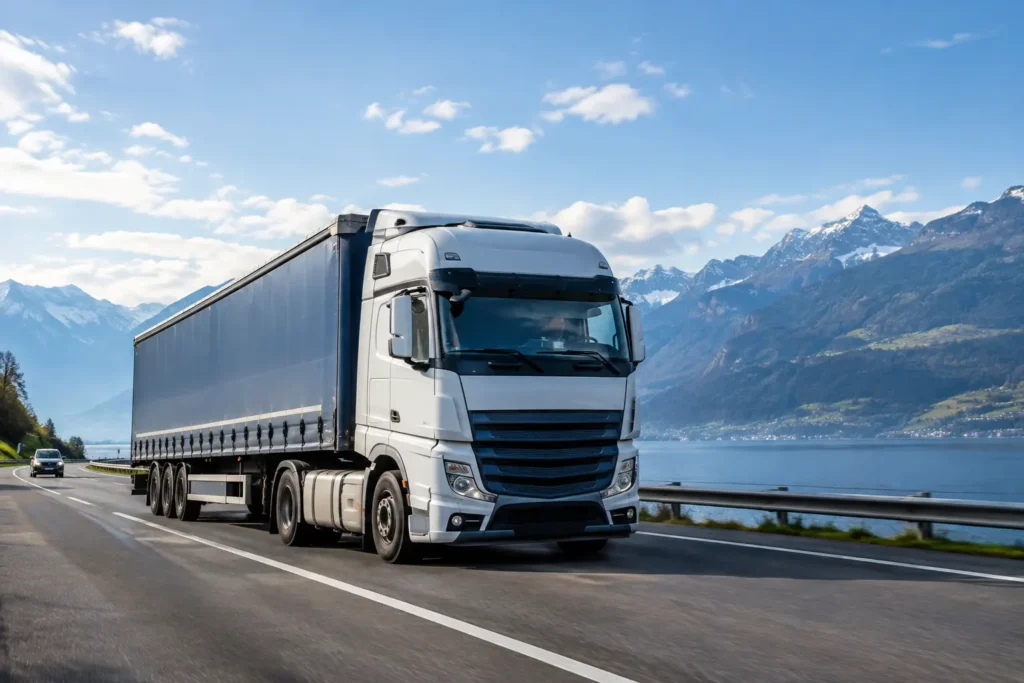
A production line in the Midlands is waiting for components from northern Italy. A distributor has a fixed delivery slot in Switzerland. A Turkish supplier needs export documents checked before a lorry reaches the border. In each case, shared capacity may look economical until another collection, hub delay or routing change puts the deadline at risk. A dedicated lorry service for Europe deliveries gives supply chain teams control over the vehicle, the route and the delivery sequence. It is not the right choice for every shipment, but where timing, security or border complexity matter, direct road transport can protect a much larger commercial commitment.
When dedicated lorry service for Europe deliveries makes sense
Dedicated transport means a vehicle is assigned to one customer’s consignment for a defined journey. The load is collected, driven directly to its destination or agreed delivery points, and managed around the shipment’s actual requirements rather than a network timetable.
This matters because road freight remains central to European supply chains. Road transport accounts for roughly three quarters of inland freight movement in the EU when measured in tonne-kilometres. For manufacturers and distributors, the issue is rarely whether road is available. The question is whether the service model gives enough certainty for the value and urgency of the goods being moved.
A dedicated vehicle is usually justified when a delay would stop production, miss a customer appointment, create contractual exposure or leave high-value goods moving through unnecessary handling points. It can also be the practical option for consignments that do not fit standard groupage constraints, such as long steel profiles, machinery parts, temperature-sensitive materials or goods requiring carefully managed loading and unloading.
There is a cost trade-off. A dedicated lorry may have a higher direct price than a part-load service because the customer is paying for exclusive capacity. Yet the comparison should include the cost of disruption: expedited replacement parts, lost production hours, missed installation teams, storage charges and time spent chasing updates. The lowest freight rate is not always the lowest transport cost.
Direct routing reduces handling risk and uncertainty
Every additional cross-dock, consolidation point or unplanned stop creates another handover. For routine, low-risk freight with flexible dates, that model can work well. For a critical consignment, it increases the number of points where damage, misrouting or delay can occur.
With a dedicated vehicle, the transport plan can be built around the shipment rather than a standard lane. That includes collection time, driver instructions, secure parking requirements, preferred border crossing, delivery appointment and contingency actions if traffic, weather or customs checks affect the route.
Consider a machine manufacturer sending a replacement assembly from Bilbao to a customer site near Stuttgart. The part must arrive before an engineering team begins work at 07:00 the following morning. A standard service may involve collection, terminal handling and an onward departure that cannot be guaranteed. A dedicated van or lorry can collect late in the day, run directly through France and deliver against the agreed site procedure. The operational gain is not simply speed. It is a transport plan that is accountable to the installation deadline.
For high-value or confidential loads, fewer handling events also support better security. The carrier can define who receives the goods, how proof of delivery is obtained and when status updates are escalated. This is especially valuable where a missed handover may expose commercially sensitive components or customer information.
Customs routes need more than a fast vehicle
A direct vehicle cannot solve incomplete paperwork. On routes involving the UK, Switzerland, Turkey or the Caucasus, customs readiness is often the deciding factor between an on-time delivery and a vehicle waiting at the border.
Before collection, the transport team should confirm the commercial invoice, packing list, commodity description, values, Incoterms, exporter and importer details, customs representation arrangements and any permits relevant to the goods. The correct process varies by route and shipment type. For example, a Swiss delivery requires a different customs workflow from an intra-EU movement, while UK traffic demands close coordination between export and import declarations.
The practical value of dedicated transport is that customs milestones can be integrated into one controlled journey. If documents need correction, the issue is visible before the vehicle reaches a crossing. If a pre-booked inspection, transit procedure or border timing affects the route, the driver and operations team can be instructed accordingly.
A common mistake is to treat customs as an administrative task separate from transport planning. It is not. A missing reference number can leave a time-critical load stationary, regardless of how quickly it was collected. For urgent transport, document validation should begin at quotation stage, not after the vehicle has been assigned.
Choose the vehicle around the shipment and delivery constraint
The right dedicated service starts with the load profile, not a generic vehicle type. Weight, dimensions, stackability, loading equipment, site restrictions and required delivery time all influence the plan.
A small urgent consignment may need a dedicated van because it can be positioned quickly and access restricted industrial sites. A full manufacturing load may require an articulated lorry, while an oversized unit may need specialist equipment, route checks and permits. For exceptional shipments, a low-loader or other tailored solution may be essential, and collection or delivery may need crane coordination.
Supply chain managers should provide accurate shipment data at the outset. The most useful information is origin and destination postcodes, ready date and deadline, number of packages, gross weight, dimensions, goods description, loading method, delivery constraints and customs status. With this information, the transport provider can assess whether a Classic Service movement is sufficient, whether an Xpress or UltraExpress vehicle is needed, or whether the shipment calls for specialist planning.
This is also where consolidation versus dedicated capacity should be assessed honestly. If the freight can accept a two-day delivery window and has no special handling risk, a shared service may be the sensible commercial decision. If the consignee has one unloading slot, the goods are needed for production, or the route crosses a complex border, dedicated capacity is often the safer choice.
Build visibility into the transport plan, not after a delay
A dedicated journey should still be actively managed. Visibility is more than a location update on a screen. It means a named operations team understands the delivery commitment, monitors progress and communicates early when an issue could affect the agreed plan.
Useful updates include vehicle allocation, collection confirmation, border status where relevant, significant route events and proof of delivery. The frequency should match the shipment’s criticality. A routine full-load delivery may only need milestone communication. A line-down movement or delivery to a site with a fixed engineer appointment may require proactive contact throughout transit.
Operational escalation should also be agreed before collection. If a motorway closure affects the estimated arrival time, who can authorise a revised unloading slot? If customs request extra information, which contact can supply it immediately? If the consignee cannot receive the goods, is secure holding permitted? Answers to these questions prevent a manageable disruption becoming an expensive failure.
MAP Transport has coordinated international road freight since 1985, supporting more than 200 customers each year with tailored vehicle selection, multilingual coordination and follow-up from quotation to delivery. For Europe-wide movements, including demanding UK, Swiss, Turkish and Caucasus routes, the objective is straightforward: match the transport service to the commercial risk of the shipment.
A dedicated vehicle is a decision about control
Dedicated road freight should be selected when control over timing, handling and route execution has a clear business value. It is particularly effective for urgent parts, high-value goods, fixed delivery appointments, difficult border movements and non-standard loads. The strongest results come from sharing complete shipment information early, checking customs readiness before collection and setting communication rules that reflect the cost of delay.
The next useful step is to review the journeys that repeatedly generate escalation, premium costs or delivery uncertainty. Those are often the flows where a tailored direct service can make the biggest difference.
Need support on your transport flows? Contact our team for a tailored solution.
Have a question or need a quote? Contact us at (+34) 943 62 95 77 (ask for Raquel) or by email at lo*******@**********rt.com