
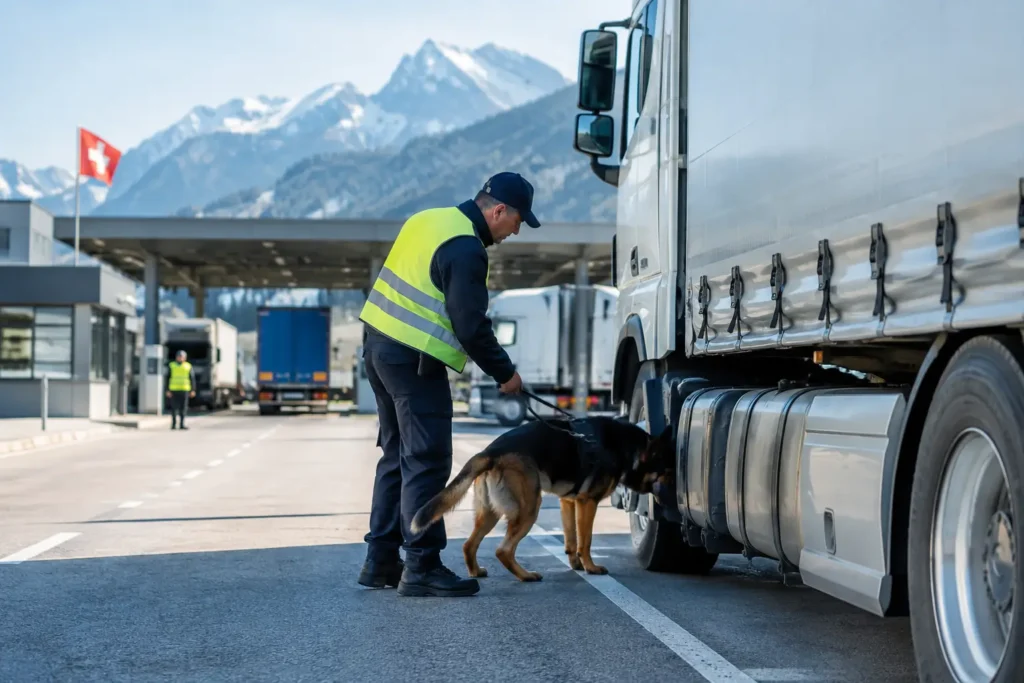
A loaded lorry can be delayed for hours by something as small as a broken seal, an unauthorised stop or a document shared with the wrong contact. For supply chain managers, freight security is therefore not a separate compliance task. It is a direct control over delivery performance, customer confidence and the cost of disruption. The risk rises on cross-border movements where drivers, customs agents, consignees and subcontractors all need accurate information at the right moment. On routes involving the UK, Switzerland or Turkey, security failures can quickly become clearance failures – and missed production slots.
Freight security begins before the vehicle is assigned
The most effective security decisions are made at quotation and planning stage, not once the vehicle is already en route. A shipment profile should establish what is being moved, who can release it, where it may stop and what proof is required at delivery. This is particularly relevant for high-value industrial components, confidential prototypes, regulated residues and urgent spare parts.
A vague booking instruction creates room for mistakes. The carrier needs the collection and delivery addresses, loading windows, weight, dimensions, commodity description, packaging condition, reference numbers and the named contacts authorised to make changes. For exceptional shipments, the security plan must also reflect permits, routing restrictions and safe parking options.
Vehicle selection matters as much as route selection. A dedicated van for an urgent box of production-critical components has a different risk profile from a full lorry load of palletised metal goods. Consolidating freight can reduce cost, but it can add handling points and limit control over timings. For time-critical or sensitive cargo, a dedicated service is often the better operational decision.
MAP Transport has coordinated road freight across 45 countries for 40 years. That experience matters because a secure movement is built around the actual shipment and route, rather than a standard process applied to every load.
Control the handovers that create the most risk
Freight rarely fails because one person ignores every procedure. It more commonly fails at a handover: collection staff release goods to an unverified driver, a consignee changes an unloading slot by phone, or a driver receives a new delivery address without an agreed escalation process.
A practical freight security plan sets out who is allowed to give instructions and how changes are confirmed. Collection and delivery contacts should be verified before dispatch, while any change to an address, delivery date, reference or release instruction should be confirmed through the agreed operational channel. This protects against both fraud and ordinary misunderstandings between sites.
Consider an urgent shipment of replacement machine parts travelling from northern Spain to a manufacturing site in the Midlands. The production team asks for delivery before 08:00, but the receiving contact changes during the night shift. Without a named escalation contact and advance delivery instructions, the driver may arrive at a closed gate with no authority to unload. A dedicated urgent service only protects the deadline if the delivery handover is equally well organised.
Operational insight: security updates should be useful, not constant. The right milestones are collection confirmation, border or customs status where relevant, material delays, arrival notice and proof of delivery. Too many unfiltered messages can hide the one exception that needs a decision.
Secure documents and customs data on complex routes
On EU-only movements, security is often focused on cargo custody and delivery authorisation. Once a route crosses into the UK, Switzerland, Turkey or onward towards the Caucasus, document control becomes just as important. Incomplete or inconsistent data can leave a vehicle waiting at the border, even when the load itself is properly secured.
The commercial invoice, packing list, commodity description, values, Incoterms, exporter and importer details must match the actual transaction. For certain movements, transit documents, export declarations, import references or supporting certificates may also be required. The exact requirements depend on the goods, origin and destination, so assumptions are expensive.
The risk is not limited to a rejected declaration. If a customs query arrives after a lorry reaches the border and the responsible person cannot respond, the delay can affect driving-time planning, delivery slots and the availability of secure parking. On an express movement, a missing customs reference can turn a delivery measured in hours into an overnight problem.
Confidentiality is also part of document security. Share commercially sensitive invoices, values and customer details only with parties who need them to execute or clear the shipment. A controlled distribution list and a single operational contact reduce the chance of outdated documents being used at the wrong stage.
Protect the route, not just the load
A vehicle can be sealed and still be exposed if the route has not been planned realistically. Secure freight transport considers authorised stops, driver rest requirements, border queues, restricted access at collection and delivery sites, and the practical consequences of a delay.
For a standard international movement, the plan may allow for scheduled rest breaks and monitored progress. For urgent transport, the priority is usually to minimise unnecessary stops, maintain direct communication and assign a vehicle that can meet the required transit time. For exceptional loads, the route must account for permits, escorts where required, physical access and safe holding areas.
There is a trade-off. The shortest route is not always the most reliable route, particularly when it involves a congested border, a difficult ferry connection or a delivery site with narrow receiving hours. A route that adds distance but protects a confirmed unloading appointment may offer a lower total risk.
Four controls make a measurable difference in day-to-day operations:
- Confirm collection, delivery and emergency contacts before vehicle dispatch.
- Define authorised instruction channels for address, timing and release changes.
- Plan stops and border crossings around the cargo value, delivery commitment and driver hours.
- Escalate exceptions early, while the customer can still change a production plan or unloading slot.
These controls do not remove every incident. They ensure that when a disruption occurs, it is visible early enough to manage rather than explain afterwards.
Match security controls to the shipment’s real exposure
Not every load requires the same level of oversight. Applying maximum controls to low-risk freight can add cost and slow booking. Applying a light-touch process to a sensitive shipment can expose the customer to theft, delay or reputational damage. The right approach depends on value, commodity, urgency, route complexity, handling points and the consequence of a late delivery.
For example, a routine full load between two EU industrial sites may require clear instructions, traceable collection and delivery confirmation. A high-value consignment moving through multiple borders needs more detailed documentation control, planned communications and stronger management of stops. A same-day replacement part may need a dedicated van, direct routing and a single accountable operations contact.
Security also supports cost control. A late delivery can create line stoppages, missed installation teams, demurrage exposure or an expensive emergency replacement shipment. Preventing one avoidable border delay can be worth substantially more than the marginal cost of better planning at the start.
Make accountability part of freight security
A security procedure is only credible when someone owns the movement from booking to proof of delivery. Supply chain teams should expect clear answers to practical questions: Who is monitoring the shipment? Who will contact us if a border delay develops? Who can make a vehicle or route decision? How will delivery be evidenced?
This is where a specialist freight partner adds value. The role is not simply to find available capacity. It is to coordinate vehicle choice, instructions, documents, route risks and communication so that the goods reach the consignee with fewer avoidable surprises.
For regular lanes, reviewing exceptions is worthwhile. Look at late collections, unplanned stops, customs holds, delivery refusals and recurring contact failures. The pattern often reveals a correctable issue in booking data, site procedures or route design. Security improves when it becomes part of transport performance management rather than an isolated incident report.
The best freight security arrangements are rarely the most visible ones. They are the disciplined checks that keep a confidential shipment moving, give a driver clear authority at the gate and allow the consignee to receive goods exactly when promised.
Have a question or need a quote? Contact us at (+34) 943 62 95 77 (ask for Raquel) or by email at lo*******@**********rt.com
Need support on your transport flows? Contact our team for a tailored solution.