
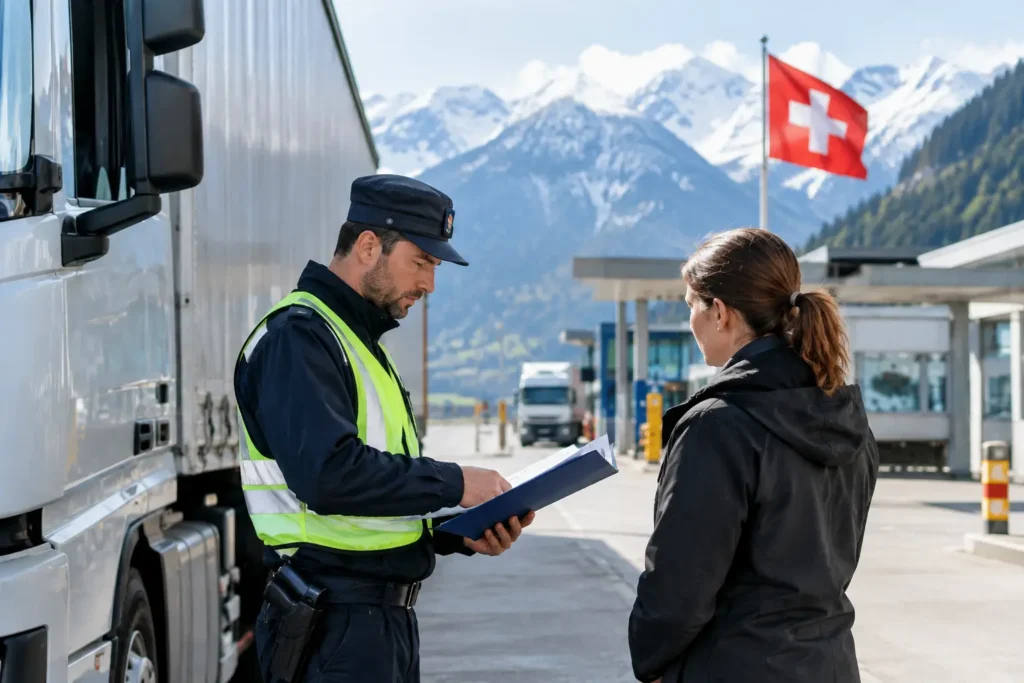
A lorry can be loaded, sealed and ready to leave Milan for Zurich, yet still lose a working day at the border because the invoice describes the goods as “machine parts”. That description is not enough for a customs declaration. For supply chain teams moving industrial goods, knowing how to manage Swiss customs paperwork is a practical control point: it protects delivery dates, limits unexpected charges and avoids an urgent shipment becoming a stationary one. Switzerland sits outside the EU customs union, so every EU-Switzerland road movement needs the right export, import and, where applicable, transit process planned before collection.
Start Swiss customs paperwork before the vehicle is booked
Swiss customs compliance is not a document task to complete once the lorry is on its way. It begins when sales, procurement and logistics agree what is being sold, who is responsible for import formalities and where the goods will be cleared.
The first question is whether the shipment is a permanent sale, a return, a repair, a temporary admission or goods moving for processing. The commercial route changes the paperwork and the financial exposure. A permanent sale of components from France to a Swiss manufacturer is handled differently from a faulty production tool returning to its EU supplier after repair.
You also need to establish the importer of record. This party is responsible for the Swiss import declaration, duties and import VAT. Do not assume that the consignee will accept this role simply because their address appears on the delivery note. Confirm it in writing and align it with the agreed Incoterms 2020 rule. A mismatch between the contract, invoice and customs instruction is a common source of clearance queries.
Switzerland’s standard VAT rate is 8.1%. Duty treatment, however, depends on the goods, origin and customs classification. Switzerland abolished many industrial import tariffs in 2024, but this does not remove the need for a correct declaration, nor does it apply in the same way to agricultural products and other controlled categories. The operational lesson is clear: reduced duty does not mean reduced paperwork.
Build a file to manage Swiss customs paperwork
A clear shipment file gives the customs representative, driver and receiving team one version of the truth. It should be ready before the vehicle is allocated, particularly when loading closes late in the day or the delivery is time-critical.
For most standard B2B road freight movements, the file should contain:
- A commercial invoice showing seller, buyer, currency, Incoterms rule, accurate goods description, quantity, value and country of origin.
- A packing list that matches the invoice and identifies packages, gross and net weight, dimensions where relevant, and any serial or batch numbers needed by the buyer.
- The correct commodity code for each product line, supported by a description that states what the item is, what it is made of and its intended use.
- Export declaration data for the EU departure country, including the exporter’s EORI number where required.
- Import and transit instructions, including the nominated customs broker, importer details and any reference numbers already issued.
The invoice deserves particular attention. “Steel parts” may be commercially understandable but is weak customs language. “Laser-cut stainless-steel brackets for industrial conveyor assemblies” gives the declarant a far better basis for classifying the goods. It also helps distinguish similar-looking products with different tariff treatment or licensing requirements.
Value must be credible and consistent. Customs authorities can question unusually low values, missing freight costs where these affect the customs value, or invoices that show a currency but no payment terms. For no-charge movements such as samples, warranty replacements or returns, use a realistic customs value rather than entering zero. Goods can be free of charge commercially while still requiring a declared value for customs purposes.
Choose the right clearance and transit route
Not every Swiss road shipment should follow the same border process. The appropriate route depends on collection point, destination, delivery urgency, commodity, broker availability and whether goods must travel under customs control before final clearance.
For a straightforward EU-to-Switzerland delivery, the goods are normally exported from the EU and imported into Switzerland at an authorised customs point. If clearance is completed away from the physical border, a transit movement may be needed. This allows the vehicle to cross the border while the goods remain under customs supervision until they reach the inland office or approved destination.
Transit is useful, but it adds dependencies. The movement must be opened correctly, references must be passed to the driver, and closure at destination must be confirmed. If one party assumes another party will close the transit procedure, the transport can be delivered while the customs file remains open. That creates avoidable administrative risk and can delay later consignments.
A practical example: an Italian supplier sends a 4-tonne urgent machine component to a production site near Basel. The buyer needs it before the next shift, so the vehicle can be dispatched as an express movement. But speed only works if the commercial invoice, commodity code, importer authorisation and broker instruction are supplied before collection. Sending these documents after the van has reached the border turns a delivery-in-hours service into a clearance wait.
Protect urgent freight with document cut-off times
Urgent transport to Switzerland should not mean rushing incomplete paperwork. It means setting a realistic document cut-off before loading and escalating gaps immediately.
For same-day or overnight movements, nominate one person on the shipper’s side who can approve values, classification and origin information outside standard office hours. Give the carrier and customs contact a direct telephone number, not a generic mailbox. A missing decision at 18:00 can otherwise sit unresolved until the following morning.
Use a simple operational check before dispatch: do the invoice quantities match the packing list, does the consignee name match the importer instruction, has the customs agent accepted the file, and does the driver have the references required for the selected border route? These are small checks, but they prevent the high-cost failure of discovering an error after the vehicle has passed its last viable diversion point.
For exceptional shipments, paperwork needs even earlier attention. Oversized industrial equipment may require route permits, lifting arrangements, escorts or special timing restrictions alongside customs declarations. Customs clearance is only one part of the plan, but an incomplete declaration can still hold the entire movement. Build the customs timetable into the route plan rather than treating it as a separate administration task.
Keep origin claims and product controls under review
A preferential origin claim can reduce or remove customs duty when goods meet the relevant rules of origin under the EU-Switzerland trade arrangements. It is not the same as the country from which the goods are shipped. A component sent from Germany may have been manufactured elsewhere, and the evidence required for preference must support the claim.
Do not add origin wording automatically because it appeared on a previous invoice. Product composition, supplier sourcing and processing can change. Procurement teams should alert logistics when a bill of materials changes, especially for metal products, chemicals, electronics and goods incorporating components from several countries.
Some shipments also need permits, certificates or extra controls. This can apply to regulated residues, dual-use items, certain chemicals, food products, animal-origin goods and products subject to sanctions restrictions. The correct approach depends on the commodity and transaction, so identify controlled goods during order review, not when the lorry is at the loading bay.
Make customs accountability part of carrier handover
Your transport partner cannot correct data it has not received, but it should make document readiness visible before committing to collection. A useful handover records the collection and delivery addresses, weight and dimensions, goods description, invoice value, Incoterms rule, importer, customs broker, border plan and urgency level. It also identifies who can make decisions if customs asks a question during transit.
This is where tailored road freight management adds value. A standard full-load shipment may allow more flexibility. A delivery needed before a production line stops may require a dedicated vehicle, pre-agreed broker coordination and active follow-up at every customs stage. With 40 years of cross-border experience, MAP Transport plans transport around the actual shipment and customs route rather than forcing urgent, standard and exceptional consignments into one process.
Good Swiss customs paperwork is less about producing more documents and more about ensuring every party works from accurate, timely information. Treat the file as part of delivery performance, and your team has far more control over cost, risk and arrival time.
Have a question or need a quote? Contact us at (+34) 943 62 95 77 (ask for Raquel) or by email at lo*******@**********rt.com
Need support on your transport flows? Contact our team for a tailored solution.