
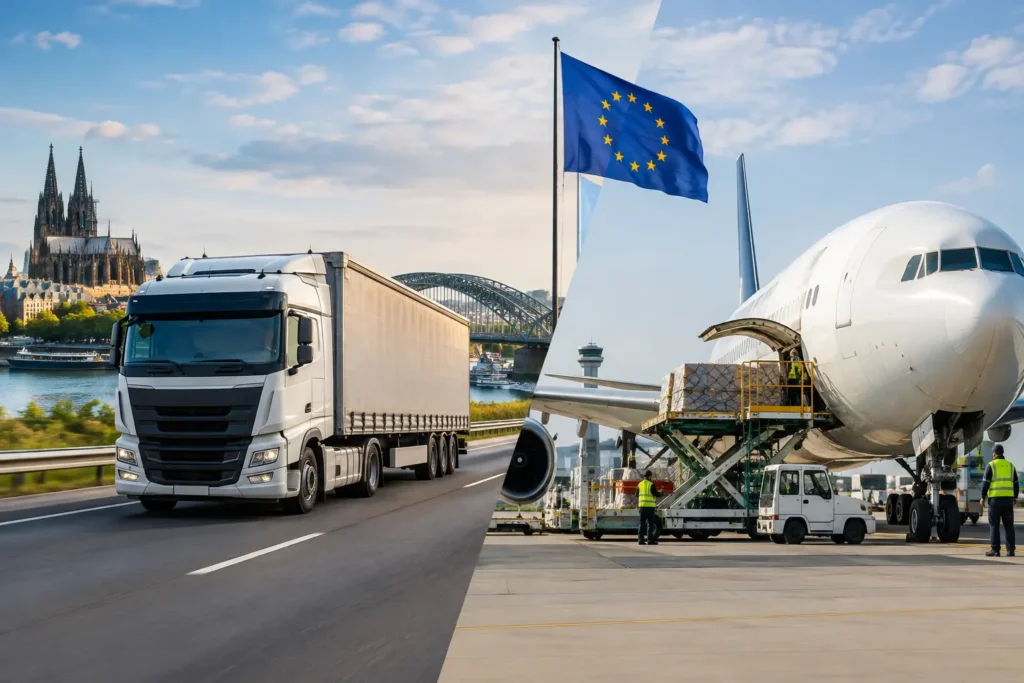
A production line in northern Spain is waiting for a replacement part from Germany. A customer in the UK has a fixed delivery slot. A shipment for Turkey needs customs documents checked before departure. In each case, the question of road freight versus airfreight is not simply about choosing the fastest mode. It is about protecting delivery commitments at a cost the business can justify, while keeping control of customs, handling and communication. For many European flows, road transport can deliver the practical speed that planners need without the price and transfer risk associated with air cargo.
Road freight versus airfreight: start with the real deadline
Airfreight is usually the right choice when a shipment must cover a long distance in a very short time and its high value, low weight or business impact supports the premium cost. But a flight time is not the same as a door-to-door lead time. Goods still need to be collected, delivered to the airport, screened, booked, loaded, unloaded, cleared and transferred to the final consignee.
That distinction matters on European lanes. A direct dedicated van from Paris to Munich, for example, can often collect and deliver within the same day or overnight. The distance is around 850 km by road, but the shipment avoids airport acceptance cut-offs, cargo build-up, handling at two terminals and final-mile collection. For an urgent pallet or several cartons, the operationally fastest option may therefore be road transport rather than air.
Supply chain managers should define the deadline in practical terms: requested collection time, delivery appointment, acceptable transit window and consequence of failure. A shipment needed at 08:00 tomorrow is not automatically an airfreight shipment. It may be an express road movement with a dedicated vehicle, live monitoring and a driver operating to a pre-agreed delivery plan.
Cost is more than the freight rate
Airfreight prices are driven by chargeable weight, which is calculated from either actual weight or volumetric weight. Light but bulky cargo can therefore become disproportionately expensive. Road freight is generally priced around vehicle capacity, lane, urgency, equipment and whether the load shares space with other consignments or requires a dedicated vehicle.
For standard industrial movements, this difference can be decisive. Road accounts for roughly three quarters of inland freight tonne-kilometres in the EU, reflecting its role in moving palletised goods between factories, suppliers and distribution points. It is particularly effective where origin and destination are both within Europe and transit time is measured in one to three days rather than a few hours.
The comparison should include all costs, not only the quoted transport charge. Consider airport handling, security screening, collection and final delivery, storage caused by missed cut-offs, packing requirements and the internal cost of managing exceptions. A lower airfreight rate can lose its advantage if the cargo misses a flight and waits for the next available service.
Road freight also gives planners useful flexibility. A standard groupage or full-load movement can suit routine replenishment, while a dedicated van or lorry can be allocated when production risk rises. This lets procurement teams match spend to the actual urgency instead of defaulting to the most expensive mode.
When urgent road transport beats airfreight
The strongest case for express road freight is often a time-critical European shipment that needs direct control from collection to delivery. Dedicated vehicles reduce handovers and can collect from sites that are far from airports or have restricted loading hours.
Take a machine component required at a plant in Switzerland after an unplanned breakdown. Airfreight may appear attractive, but the movement must still be collected, delivered to an airport, accepted before cut-off, flown, cleared into Switzerland and transported to site. A dedicated road vehicle can collect directly from the supplier, travel under one operational plan and complete customs formalities at the border with the documentation prepared in advance.
This does not mean road is always faster. If the part is moving from Europe to a distant intercontinental destination, airfreight will normally remain the only viable option. The point is that for European, UK, Swiss and Turkish lanes, door-to-door urgency should be assessed before selecting the transport mode.
An operational insight: ask providers for the latest safe collection time and committed delivery time, rather than asking only for transit hours. This exposes whether the proposed solution includes terminal processes, border procedures and delivery-site constraints.
Customs can change the road freight versus airfreight decision
Customs complexity is often underestimated in urgent transport planning. UK, Switzerland and Turkey are major examples because cross-border freight requires accurate commercial paperwork, commodity information and customs declarations. A missing invoice detail, unclear Incoterm or incorrect goods description can delay either road or air cargo.
Road has an advantage when a transport partner coordinates the collection, border timing and delivery as one movement. The driver and operations team can work to a defined customs plan, with documents reviewed before collection wherever possible. For air cargo, the customs process can involve additional parties: the origin handler, airline, destination agent and final-mile carrier. More handovers can mean more points where a document issue becomes visible too late.
For example, a distributor sending urgent industrial components from Italy to a customer in the UK may need export clearance, import entry preparation and evidence that the goods match the commercial invoice and packing list. If the delivery is booked for a morning site slot, the transport plan must allow for border timing and possible checks. The fastest physical route is of little value if customs data is incomplete.
Before confirming either mode, verify the commodity description, value, origin, Incoterms, EORI details, importer arrangements and whether the goods need specialist declarations. For regulated residues, oversized equipment or non-standard loads, plan even earlier. The right vehicle and documentation process must be selected together.
Choosing the right service level for each flow
The most reliable approach is to segment shipments by business consequence, not just weight or destination. Routine stock movements can use a planned road service. Production-critical orders may need express road transport. Exceptional dimensions, high weight or unusual loading requirements need a specialist road solution from the outset.
A practical decision framework should consider four questions:
- What is the latest delivery time that protects the customer, production line or project?
- Is the cargo suitable for airport handling, security requirements and airline capacity limits?
- How many transfers will occur between collection and final delivery?
- Do customs, border crossings or delivery-site restrictions create a risk that needs active coordination?
This approach prevents a common error: using airfreight to compensate for poor planning on a lane that road can cover reliably. It also prevents the opposite error of booking standard road freight for a shipment where a few hours of delay would stop production.
For recurring lanes, record actual collection-to-delivery performance, customs dwell time, access constraints and the causes of exceptions. After a few movements, this data shows where a premium express service genuinely reduces risk and where standard road freight offers better value.
Build resilience into urgent freight decisions
Transport decisions are easiest when there is no pressure. The difficult calls happen at 16:00 when a supplier reports a late-ready load, a customer will not accept delivery after 10:00, or a border document needs correction. A pre-agreed escalation process makes those moments manageable.
Provide the transport partner with the origin and destination postcodes, ready time, weight, dimensions, goods description, customs status and required delivery deadline. With this information, a specialist can assess whether a standard lorry, dedicated van or another tailored arrangement is appropriate and provide a realistic plan rather than an optimistic estimate.
MAP Transport has managed cross-border road freight since 1985, including time-critical and complex movements across Europe, the UK, Switzerland, Turkey and the Caucasus. For urgent or sensitive shipments, the value lies in having a team that can coordinate vehicle selection, paperwork and progress updates as one accountable process.
The best choice is the mode that reaches the consignee when promised, with the fewest avoidable handovers and a cost proportionate to the risk. Treat speed as a door-to-door outcome, not a flight schedule, and transport decisions will support the wider supply chain rather than create another exception to manage.
Have a question or need a quote? Contact us at (+34) 943 62 95 77 (ask for Raquel) or by email at lo*******@**********rt.com
Need support on your transport flows? Contact our team for a tailored solution.