
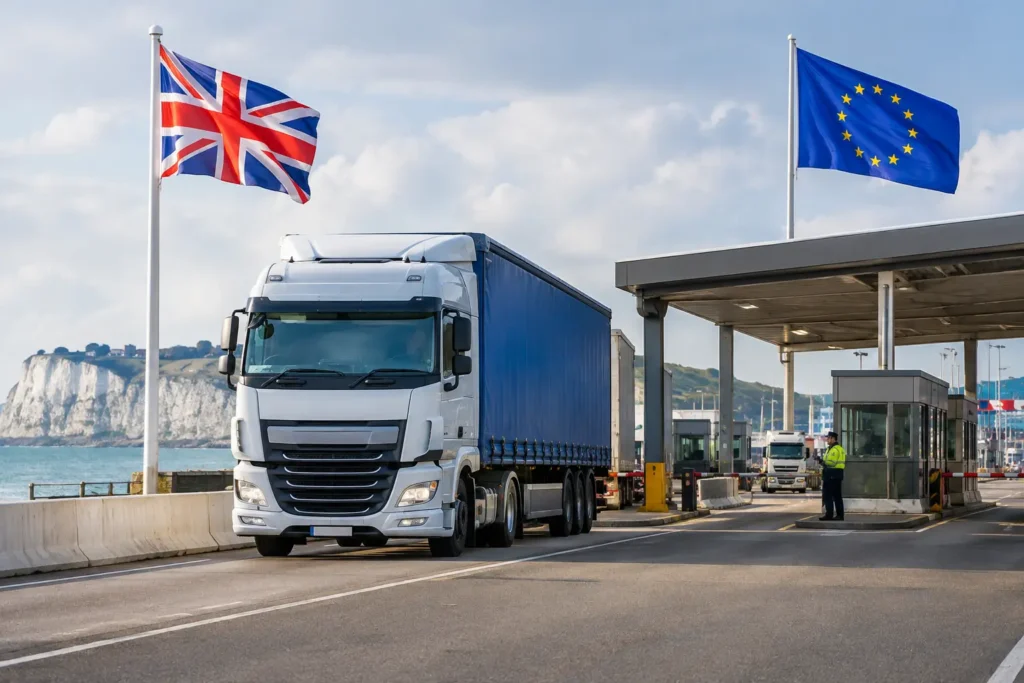
A production line does not stop because a lorry was late. It stops because a customs reference was missing, a commodity code was challenged, or collection was booked before the goods were actually ready. That is the operational reality of UK EU freight transport after Brexit. For supply chain managers, the route may look familiar on a map, but it requires a different level of planning than an intra-EU movement. Reliable performance depends on getting the paperwork, border process, vehicle choice and delivery plan aligned before the vehicle is dispatched.
Why UK EU freight transport needs a different planning model
The UK-EU route is a road transport corridor with a customs border at its centre. Goods moving between Great Britain and the EU generally need export and import declarations, clear commercial documentation and correctly assigned responsibility for customs formalities. Northern Ireland arrangements can differ depending on the movement and the goods involved, so they should never be treated as an administrative footnote.
The main risk is not simply transit time. A standard collection from Birmingham to northern France or Benelux can be physically straightforward, yet lose hours at the port or terminal if a declaration has not been accepted, the invoice values do not match the customs entry, or a consignee has not completed the required import action. A lower transport rate quickly becomes expensive when a production delivery misses its slot or a customer receives incomplete information.
An operationally sound booking starts with facts: collection and delivery addresses, ready time, Incoterms, commodity description, number of packages, weight, dimensions, customs party details and whether the goods need temperature control, ADR handling or specialist equipment. These are not quotation formalities. They determine whether the movement can proceed as planned.
Customs readiness is the first delivery-time control
Customs preparation should begin before collection is confirmed, not when the vehicle is approaching the Channel. The exporter and importer need to know who is making each declaration, which EORI numbers apply and whether duties or VAT are payable. Where a customer uses a customs agent, the transport plan must include a clear handover process and named contacts for exceptions outside normal working hours.
A frequent issue is the commercial invoice. Generic descriptions such as “parts”, “samples” or “equipment” create unnecessary questions. A usable invoice identifies the goods clearly, includes the agreed value and currency, origin where required, Incoterms and relevant commodity codes. Packing lists must also reflect the actual shipment. If eight pallets are collected but the declaration records seven, the problem is not solved by telling the driver that the missing pallet is “probably included”.
For regular lanes, establish a repeatable pre-departure check:
- Are exporter and importer details correct and active?
- Do invoice, packing list and customs data match exactly?
- Has the customs declaration been accepted before the vehicle reaches the border?
- Is the driver carrying the references and instructions needed for the chosen crossing?
- Does the delivery site understand the arrival window and unloading requirements?
This discipline matters most when lead times are tight. Customs data can be prepared early, while final quantities and collection timing are still being confirmed. Waiting until the goods are loaded concentrates every risk into the final hour.
Choose the vehicle around the shipment, not the lane
UK EU freight transport is often planned around a default full-load lorry, even when that is not the best operational decision. The right vehicle depends on cargo volume, loading method, urgency, delivery access and the cost of a delay. A smaller dedicated van can be a better option for critical components, while a curtain-sided lorry, box vehicle or specialist equipment may be necessary for routine palletised freight, high-value cargo or non-standard dimensions.
Consider a manufacturer in the Midlands sending a 450 kg replacement machine component to a plant near Antwerp. The component is needed before the next morning’s production shift. Groupage may offer a lower headline price, but it adds handling points, cut-off times and less control over the onward schedule. A dedicated express vehicle, supported by pre-cleared customs documentation and direct driver communication, is likely to reduce the total business risk.
The reverse is also true. A non-urgent shipment of standard industrial goods from Belgium to England may be well suited to a planned road freight service, provided the customs process, collection window and delivery booking are secured. Paying for express transport where the receiving operation has flexibility is not good cost control. The goal is a service level matched to the consequence of late delivery.
Build realistic lead times around crossings and handovers
A route plan should include more than driving distance. It must account for collection availability, loading time, motorway restrictions, Channel crossing capacity, border presentation, driver hours and final-mile delivery rules. The fastest theoretical route can be the least reliable if it depends on a narrow ferry departure or an unconfirmed unloading slot.
For time-critical movements, contingency needs to be designed into the plan. This may mean selecting a crossing with alternatives, using a dedicated vehicle rather than a multi-drop network, or arranging customs support that can respond quickly if documentation is questioned. It also means communicating honestly with internal stakeholders. “Delivered tomorrow” is not a service promise unless the collection readiness, documents and border process support it.
An effective escalation process is particularly valuable for Friday collections, public holiday periods and urgent consignments arriving after a plant has closed its goods-in department. A vehicle arriving on time but unable to unload is still a delivery failure from the customer’s perspective.
Managing urgent and exceptional UK-EU movements
Urgent transport and exceptional loads amplify the normal border requirements. For an express shipment, every delay matters because there is little recovery time. For oversized, heavy or unusual freight, route surveys, permits, loading methods and escort requirements may also affect the schedule. These details should be assessed before a collection commitment is made.
Industrial suppliers sometimes need to send replacement tooling, large fabricated components or sensitive equipment from the UK into continental Europe at short notice. The transport provider must coordinate more than a vehicle. They need to assess dimensions and axle weights, confirm safe loading arrangements, verify customs documentation and maintain communication with the shipper, consignee and any third parties involved.
There is a useful rule for complex movements: urgency does not remove planning requirements. It makes early, accurate planning more valuable. A photograph of the freight, loading-site constraints and exact dimensions can prevent the wrong vehicle being sent, avoiding a costly re-collection and lost border slot.
What to measure on your UK-EU lanes
Cost per shipment is necessary, but it is not enough to manage cross-border road freight performance. Track the reasons behind delays and distinguish carrier transit issues from documentation, readiness or receiving-site failures. This creates a more accurate basis for supplier reviews and internal process improvements.
Useful measures include on-time collection, on-time delivery, customs-related holds, time from enquiry to quote, damage or handling incidents, and the number of updates provided during exception management. A transport partner that identifies a documentation gap before dispatch provides more value than one that only reports a delay after the vehicle has reached the border.
MAP Transport has coordinated European road freight since 1985 and supports more than 200 customers each year with standard, express and exceptional shipments. For UK-EU flows, the practical advantage is tailored coordination: matching the vehicle and service level to the cargo, then maintaining clear follow-up from quotation to delivery.
The strongest UK-EU transport plan is rarely the cheapest option on a rate sheet. It is the one that protects production, customer commitments and the people responsible for explaining a delay when something goes wrong.
Need support on your transport flows? Contact our team for a tailored solution.
Have a question or need a quote? Contact us at (+34) 943 62 95 77 (ask for Raquel) or by email at lo*******@**********rt.com