
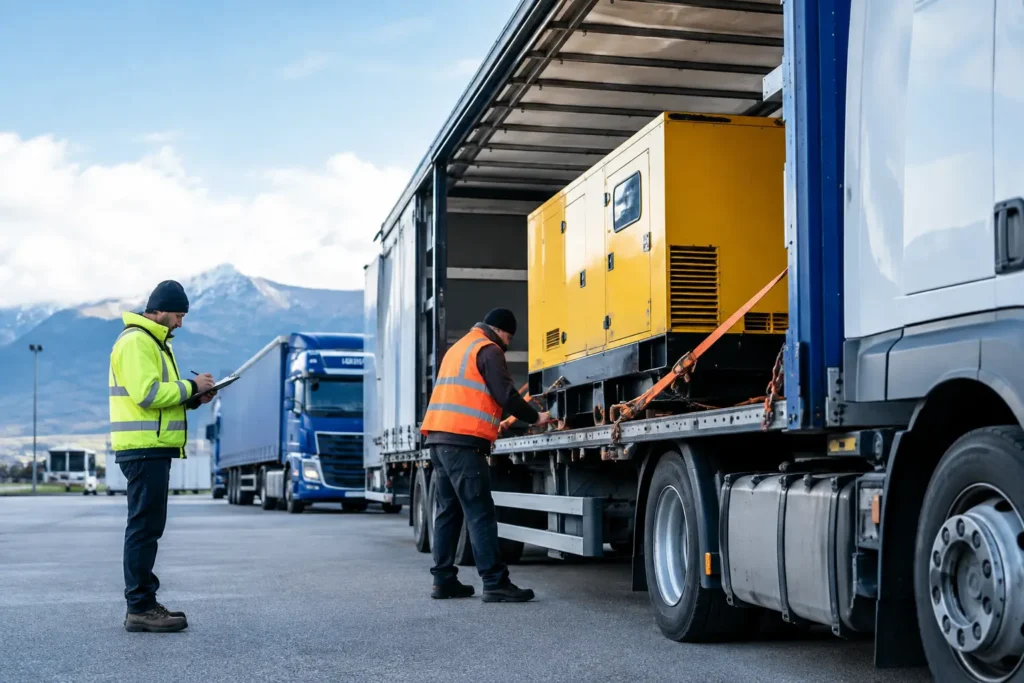
A generator transport case is rarely just a collection problem. For an industrial site, construction project or emergency power provider, the real risk is losing operational time because the generator arrives late, cannot be unloaded safely, or is held at a border with incomplete paperwork. The transport plan must account for the unit’s dimensions, lifting points, fuel status, delivery access and the route’s customs requirements before a vehicle is assigned. That preparation matters most on urgent cross-border movements, where a missed collection window can quickly become a costly outage.
What a generator transport case needs before collection
The first decision is whether the consignment can move as standard freight or requires an exceptional shipment plan. Generator sets vary widely: a compact backup unit may fit in a curtain-sided lorry with suitable load restraint, while a containerised or high-capacity unit may need a low-loader, specialist loading equipment or permits for its dimensions and weight.
A precise transport brief should include the gross weight, length, width and height, the collection and delivery addresses, site contact details, and photographs where access is uncertain. It should also confirm whether a forklift, crane or loading ramp is available at each end. “Loading available” is not sufficient information if the site has a forklift with inadequate capacity or a narrow entrance that prevents a long articulated vehicle from turning.
The generator’s condition also affects the plan. A unit containing fuel, oil or batteries may require additional checks, particularly where it is being transported for repair, hire or temporary use rather than sold outright. The transport team needs to know whether it is operational, packed in a protective transport frame, secured to a skid, or moving inside an enclosure. These details determine both the vehicle type and the safest method of securing the load.
Choosing the right vehicle for generator transport
Vehicle selection should follow the generator, not the other way round. A standard tautliner can be cost-effective where the unit is palletised or mounted on a stable base and both sites have loading capability. However, it may not be the right answer for a generator that needs side loading, crane lifting or careful positioning close to a plant room.
For a generator transport case involving a heavy unit, a low-loader or flatbed arrangement can reduce loading risk and avoid height restrictions. The trade-off is that specialist equipment can require more planning, may face route constraints and is not always available at short notice. If delivery is time-critical, the planner must balance the fastest available solution with the vehicle that can genuinely complete the job without a failed delivery attempt.
The load must be restrained from its designated points, with the securing method matched to the unit’s weight distribution. Loose accessories, cables, exhaust components and control panels need separate protection. This is not an engineering detail to leave until collection: poorly prepared equipment can delay loading, damage the generator in transit and create a dispute over liability.
A practical operational rule is to confirm four points before booking:
- verified weight and external dimensions;
- loading and unloading equipment, including lifting capacity;
- site restrictions such as time slots, security clearance and vehicle access; and
- whether the generator is moving permanently, temporarily or for repair.
Customs can decide the delivery date
A generator travelling within the EU may avoid customs formalities, but complex routes often involve the UK, Switzerland, Turkey or the Caucasus. In these movements, documents must match the physical goods and the commercial purpose of the shipment. A generator sent to a UK project for temporary use, for example, should not be documented in the same way as a permanent sale.
The EU Union Customs Code sets the framework for customs procedures, while the UK uses its own import and export processes following Brexit. Depending on the movement, the shipper may need a commercial invoice, packing list, commodity classification, export declaration, proof of origin and documents supporting temporary admission or return after repair. Turkey and onward Caucasus routes can add transit documentation and border coordination to the plan.
Consider a 12-tonne standby generator moving from northern Spain to a data centre project in the UK. The vehicle may be ready within hours, but an incorrect consignee VAT number, unclear Incoterms or missing evidence that the unit will return can stop progress at the border. In this case, the faster vehicle is not the faster solution. Documentation must be checked before collection, and the driver must receive clear instructions for the relevant crossing.
Eurostat has consistently shown road freight as the dominant mode for inland goods transport in the EU, accounting for more than three quarters of tonne-kilometres. That scale makes road transport highly flexible, but it does not remove border risk. On a generator movement, even a two-hour delay can mean a missed delivery slot, additional site waiting and a disrupted installation programme.
Planning urgent generator deliveries without cutting corners
Urgent generator transport usually follows a breakdown, a project change or a customer deadline that cannot move. The temptation is to dispatch the first available van or lorry. That can work for a small, properly prepared unit, but it becomes expensive when the vehicle arrives to find no ramp, no lifting equipment or a generator that exceeds the declared weight.
The right approach is to run the transport and site-readiness checks in parallel. While the carrier confirms capacity and driver availability, the shipper should verify collection readiness, release documents, customs clearance responsibilities and the receiving site’s delivery hours. For urgent routes, a named contact at both ends is essential. A driver cannot solve a closed gate or an unapproved security booking alone.
Express road transport can be the appropriate option where downtime is more costly than the premium for dedicated capacity. A direct van may be suitable for control equipment or a compact generator, while a dedicated lorry can be arranged for larger equipment. Where the unit is oversized, the urgency must be assessed realistically: permits, escorts and route restrictions may set the actual lead time, regardless of how quickly a vehicle can be sourced.
Reducing risk at collection and delivery
The best generator transport case is controlled from the first call to final proof of delivery. Before collection, the equipment should be inspected, photographed and recorded against the transport documents. Any existing damage, exposed connections or loose items should be noted. This protects both the shipper and carrier if a question arises after delivery.
At delivery, the site team should be ready to receive the generator, not merely informed that it is arriving. That means confirming the unloading area is clear, the lifting plan is understood and the authorised recipient is present. If the unit is being delivered to a remote industrial location, temporary project site or high-security facility, these checks become even more valuable.
Communication is a performance tool, not an administrative extra. Supply chain managers need to know when collection is confirmed, whether the vehicle has crossed the border, and whether a delay threatens the delivery slot. Clear updates allow the receiving team to adjust labour, cranes and installation schedules before costs build up.
A tailored plan protects uptime
Generator movements expose the weakness of one-size-fits-all freight planning. The cheapest standard service may be suitable for a routine, accessible EU delivery. A time-critical replacement, a UK temporary import or an oversized unit for Turkey needs a different level of coordination, documentation control and vehicle matching.
MAP Transport has managed international road freight since 1985 and plans each movement around the equipment, route and deadline rather than forcing a generator into a standard booking process. The useful starting point is simple: provide the weight, dimensions, collection and delivery points, required delivery date and any site or customs constraints. From there, the transport plan can be built around the risks that would otherwise threaten uptime.
A generator should arrive ready for the next stage of work, not create a new problem at the gate. Have a question or need a quote? Contact us at (+34) 943 62 95 77 (ask for Raquel) or by email at lo*******@**********rt.com
Need support on your transport flows? Contact our team for a tailored solution.