
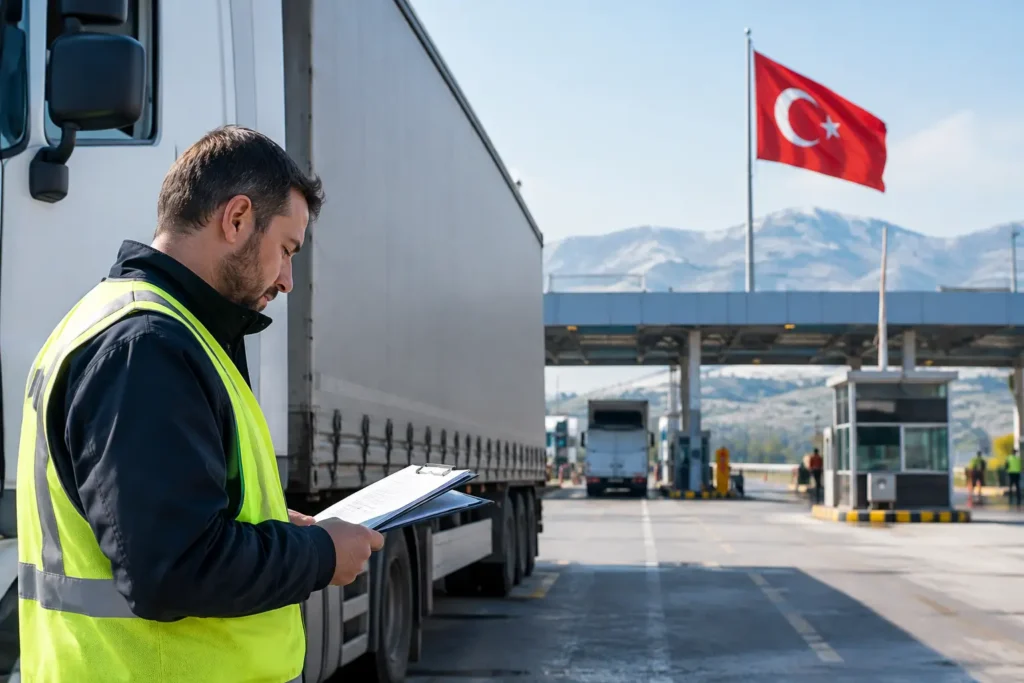
A lorry can be loaded, sealed and ready to leave within the hour, yet still lose a working day at the border because the document pack does not match the cargo, vehicle or customs movement. For supply chain teams moving goods between Europe and Turkey, that risk is especially costly: a missed delivery slot can halt production, trigger demurrage or force an urgent recovery plan. To prepare Turkey transit documentation properly, the paperwork must be treated as part of the transport plan, not as an administrative task completed after collection. The right customs procedure, accurate commercial data and clear handover between shipper, broker and carrier are what protect the delivery window.
Why Turkey transit documentation needs early planning
Turkey is closely connected to European trade, but it is not part of the EU customs territory. That distinction affects every cross-border road movement. Goods may need an export declaration, a transit movement, proof of status, commercial paperwork and, depending on the product and route, licences or certificates.
The central operational question is not simply, “What documents do we have?” It is, “Which customs procedure will cover this consignment from departure to discharge?” The answer depends on the goods’ customs status, origin and destination, whether Turkey is the final destination or a transit country, and whether the shipment will move under a TIR procedure or a Common Transit movement.
Turkey is a contracting party to the Common Transit Convention. In practical terms, that can allow a single electronic transit procedure to cover a movement through participating countries, subject to the correct guarantee and customs offices. However, a transit declaration does not replace the commercial documents needed to identify the goods. It must align with them.
MAP Transport has operated international road freight flows since 1985 across 45 countries. That experience matters on Turkey routes because documentation decisions affect vehicle routing, border choice, collection time and the contingency plan if an authority requests clarification.
Prepare Turkey transit documentation before the vehicle arrives
The strongest document packs are built from verified shipment data. Do not ask the haulier to resolve missing commodity codes, inconsistent weights or unclear Incoterms while the lorry is waiting at collection. The shipper, customs representative and transport coordinator should agree the information before loading.
For most commercial road movements, the core pack will include the CMR consignment note, commercial invoice, packing list and relevant export declaration. The CMR should reflect the actual parties, collection and delivery places, package count, gross weight and goods description. The invoice and packing list must support the same facts. Discrepancies as small as a different pallet count can lead to questions at a customs office.
The customs element may include a transit accompanying document with an MRN, or TIR documentation where that procedure is selected. The vehicle should not depart until the driver or transport operator has the references and instructions needed for presentation at the office of departure, border crossing and office of destination.
Three checks deserve particular attention:
- The commodity description must be specific enough to support the tariff classification. “Metal parts” is rarely adequate when customs data requires the nature and intended use of the goods.
- The gross weight, package count and marks should match across the invoice, packing list, CMR and transit declaration.
- The exporter, importer, EORI details where applicable, consignee and customs agent must be correctly identified, including the agreed importer of record.
Where goods are subject to controls, the pack may also require certificates, permits or conformity documentation. Food, chemicals, waste, dual-use items and certain industrial products demand extra scrutiny. A standard transport document cannot compensate for a missing regulatory approval.
Choose the right transit procedure for the route
There is no single document model for every Turkey movement. Selecting the wrong procedure can result in delays, additional guarantees or a movement that cannot be discharged correctly at destination.
A Common Transit movement is often used where goods travel between the EU and Turkey under customs control. The transit declaration generates an MRN, and the goods move between designated customs offices. Whether T1 or T2 status is appropriate depends on the customs status of the goods and the movement involved. This should be confirmed with the customs declarant, rather than assumed from the country of manufacture or invoice origin.
TIR may be suitable for certain international road journeys, particularly when a sealed vehicle or container is moving across multiple borders under the TIR system. It can reduce repeated formalities at intermediate frontiers, but it requires the appropriate authorisation, guarantee arrangements and compliant loading conditions. It is not automatically the best option for every shipment.
For example, an industrial supplier sending eight pallets of machined components from northern Spain to Bursa may use a Common Transit procedure following export clearance. If the invoice says eight pallets at 2,400 kg but the loading team adds a ninth pallet of samples without updating the declaration, the problem is not merely clerical. The vehicle may face a customs query, the transit movement may need amendment and the planned delivery appointment can be lost.
For urgent production-critical freight, the documentation cut-off should be set before the vehicle is allocated. An express van may save hours on the road, but it cannot recover time lost because an MRN has not been released or an export entry is awaiting correction.
Build a document-control process around the real handovers
Documentation failures usually occur at handover points: sales to logistics, logistics to customs broker, broker to carrier, or carrier to driver. A controlled process should define who owns each task and when the information is frozen.
Start with a shipment instruction containing collection and delivery addresses, commodity codes, goods value, Incoterms, package details, gross weight, customs status and contact details for the exporter, importer and customs representatives. The transport provider can then verify vehicle suitability, timing and border sequence before confirming the collection.
Next, set a document deadline based on the transport service. Standard road freight allows more planning time, while time-critical transport requires data to be final much earlier in the operational window. If a delivery is needed in under 24 hours, the customs instruction cannot wait until the lorry is en route.
Finally, maintain a release check before departure. Confirm that the export has been cleared where required, the transit reference has been issued, the driver has the correct papers or digital references, and the receiving customs office can discharge the movement. This is a simple control, but it prevents expensive assumptions.
Reduce border delay risk with practical checks
Borders do not create every delay, but they expose every weakness in the file. Congestion, inspections and working-hour restrictions cannot always be avoided. Incomplete or contradictory data can.
The most useful operational insight is to plan documentation against the route, not just the destination. A movement via Bulgaria, Greece or another entry point may involve different timings, facilities and driver instructions. Where a border queue develops, the team needs to know whether the transit procedure remains valid, who can respond to a customs query and what delivery communication should be issued to the consignee.
For oversized or exceptional shipments, the documentation plan must be integrated with permits, route approvals and escort requirements. A border delay for a standard pallet shipment is inconvenient; for a specialist movement with timed permits, it can make the planned route unusable.
Keep version control tight. Send one final, approved document pack to the parties who need it, rather than allowing multiple invoice versions to circulate by email. If a commercial detail changes after departure, escalate it immediately to the customs representative and transport coordinator. Quietly replacing a document at destination is rarely a reliable solution.
Make documentation part of delivery performance
Reliable Turkey freight is not achieved by choosing the fastest lorry alone. It comes from matching the vehicle, route, customs procedure and document pack to the shipment’s real requirements. That may mean a standard groupage plan for a routine flow, a dedicated vehicle for a factory-critical load, or specialist coordination for abnormal dimensions.
For supply chain managers, the practical measure is straightforward: review every border delay as an operational event. Was it caused by congestion, a missing document, incorrect data, unclear responsibility or poor timing? The answer should feed into the next shipment instruction, not disappear once the goods arrive.
A transport partner that coordinates customs-facing details alongside collection, vehicle allocation and progress updates can remove pressure from internal teams, particularly when delivery windows are tight or routes are complex. MAP Transport supports tailored road freight planning for Europe-Turkey flows, with close follow-up from quote through to delivery.
Have a question or need a quote? Contact us at (+34) 943 62 95 77 (ask for Raquel) or by email at lo*******@**********rt.com
Need support on your transport flows? Contact our team for a tailored solution.