
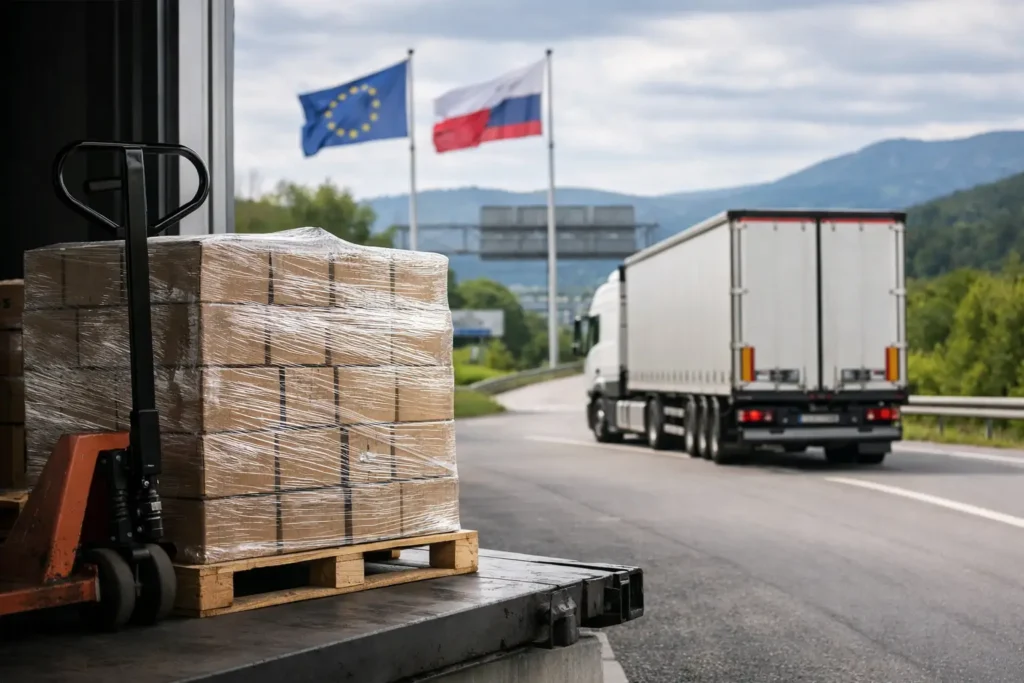
A pallet that leaves your site in good order can still end up delayed at a border, refused at delivery, or priced far above budget if the shipment is booked with incomplete information. In European road freight, the detail behind the pallet matters as much as the pallet itself.
For manufacturers, distributors and procurement teams, the real question is not simply how to ship pallets to Europe. It is how to do it with predictable cost, delivery-time control and minimal disruption to your customer or production schedule. That means planning the load, the route, the paperwork and the service level together rather than treating transport as a last-minute booking.
how to ship pallets to Europe without avoidable delays
The fastest way to create problems is to request transport with only a collection postcode and a rough weight. A dependable cross-border pallet movement starts with accurate shipment data. The carrier or freight partner needs the pallet count, exact dimensions, total gross weight, nature of goods, pickup and delivery access conditions, and the required delivery window.
This information determines far more than price. It affects vehicle choice, route planning, transit time, handling method and whether the load can move as standard freight or needs a more specific solution. A light but oversized pallet may require a different vehicle from a dense industrial pallet with a small footprint. Equally, a delivery to a city centre site or production plant with booking restrictions needs tighter planning than a standard warehouse drop.
If you are moving regular goods with flexible lead times, a standard road freight service is usually the most cost-effective option. If the pallet contains urgent production parts, time-critical stock or replacement machinery components, the rate will be higher but the service should be built around speed and direct routing. That distinction matters. Paying for express when standard will do wastes budget. Booking standard when your line is down costs far more.
Start with the pallet itself
Before any route is discussed, the goods need to be packed for cross-border handling. Pallets are often reloaded, grouped with other freight or moved through terminals depending on the service used. Poor wrapping, uneven weight distribution or overhanging cartons raise the risk of damage and refusal.
The pallet should be stable, evenly stacked and clearly labelled. Height and footprint must match what has been declared at booking stage. If the load exceeds standard pallet dimensions, say so early. Non-standard freight can still move efficiently, but only if the transport plan reflects the real measurements.
For heavier industrial goods, think about lifting points, fork entry and load security before collection day. If the goods cannot be safely handled with standard warehouse equipment, specialist planning may be needed. That is especially relevant for machinery, metal products and awkward loads that sit outside typical pallet profiles.
Documents make or break cross-border pallet transport
Most delays in European freight are not caused by distance. They are caused by missing, inaccurate or inconsistent paperwork. The exact document set depends on origin, destination and commodity, but several basics come up repeatedly.
Your commercial invoice or pro forma invoice must match the goods being moved. Descriptions should be clear and usable for customs or compliance review where required. The packing list should reflect pallet count, contents, weights and dimensions. Collection and delivery addresses must be complete, including contact names, postcodes and any site-specific instructions.
Where routes involve customs formalities, the margin for error narrows. Commodity codes, values, origin information and supporting declarations need to align. If you are shipping regulated, hazardous or residue-related goods, make that known at the start so the transport can be assessed correctly.
A specialist road freight partner can help coordinate these details before departure, which is often the difference between a smooth crossing and a pallet waiting while someone tries to correct paperwork mid-transit. If you want a clearer view of road freight coverage and operational support, see the services overview at https://www.maptransport.com.
Choosing the right service level
Not every pallet to Europe should move in the same way. The right mode depends on urgency, value, handling sensitivity and the consequences of delay.
For routine shipments, groupage or standard road freight is often the sensible choice. It keeps costs under control, especially for regular export flows, and works well when transit time can be planned into the supply chain. The trade-off is that it may involve more stops or transfers than a dedicated direct vehicle.
For urgent pallets, a direct van or dedicated lorry provides tighter control. The shipment is collected and driven to destination with minimal interruption, which reduces both transit time and handling risk. This is usually the better choice for production-critical spares, urgent customer orders or stock shortages where every hour matters.
Then there are pallets that are not really standard pallets at all – overweight units, unusual dimensions or freight with loading constraints. These need a service built around the cargo, not squeezed into a standard booking process. In those cases, the vehicle type, loading plan and any route restrictions should be checked in advance.
If your shipment sits outside standard dimensions or handling limits, specialist planning for exceptional shipments is often the safer route. If speed is the issue rather than size, dedicated express transport can reduce downtime and protect service commitments.
Route planning across Europe
European road freight looks simple on a map and much less simple in operation. Transit time is affected by border procedures, weekend driving rules, local holidays, urban delivery restrictions and the availability of suitable vehicles in the right place at the right time.
This is why realistic planning matters. A quote based only on kilometres rarely tells you enough. Two destinations with similar distance can have very different operational profiles. A pallet moving from northern France to Belgium is one thing. A pallet moving from Spain into eastern Europe, or beyond into Turkey, is another.
For procurement and logistics teams, the practical point is this: ask for a transport plan, not just a rate. You need to know the likely transit window, the collection cut-off, any document requirements, and what level of visibility you will have while the goods are moving.
A provider handling regular international road transport should be able to explain those variables clearly and set expectations before collection, not after a delay has happened.
Cost control depends on accuracy
When companies ask how to ship pallets to Europe at the best price, the answer is usually the same: declare the shipment properly and choose the service that fits the need. Hidden costs often come from reclassification, waiting time, failed delivery attempts, incorrect dimensions or urgent rebooking after a service mismatch.
If the delivery site has no forklift, state that. If there is a booking slot, provide it. If the pallet is stackable, declare it accurately. If the consignee requires advance documents or security clearance, build that into the booking from the start.
Low headline rates can become expensive if the service is not operationally suitable. A slightly higher rate with reliable planning, multilingual coordination and proactive follow-up often protects margin better than a cheaper option that leaves your team chasing updates.
Communication during transit
For B2B shippers, service quality is measured during exceptions, not only during routine movements. You need to know who is monitoring the shipment, who can be reached quickly, and how issues will be escalated if timings change.
That is particularly important for first-time export lanes, urgent customer deliveries and production-linked freight. A good transport partner will not wait for you to ask where the pallet is. They will give progress updates, flag risks early and provide a workable answer if a delivery window moves.
This level of control matters when your customer is expecting goods for a manufacturing run, installation or distribution schedule. Freight is only successful when it arrives in a way that supports the next operation.
What to prepare before requesting a quote
If you want a fast, usable quote for a European pallet shipment, have the shipment facts ready. Origin, destination, number of pallets, dimensions, total weight, goods description, readiness date and required delivery timing should all be confirmed internally before you send the request.
That allows the transport team to match the shipment to the right vehicle and service level from the outset. It also reduces the back-and-forth that can slow bookings when a pallet needs to move quickly.
MAP Transport S.A. has supported European freight movements since 1985 across 45 countries, with standard, express and specialist options depending on the urgency and load profile. If your business needs a no-obligation quote with clear follow-up and road freight planning built around the shipment rather than a generic rate card, the best next step is to prepare the exact pallet details and request pricing early.
A well-shipped pallet is rarely about luck. It is usually the result of accurate data, the right vehicle, correct documents and a transport partner who treats each movement as an operational responsibility rather than just another booking.