
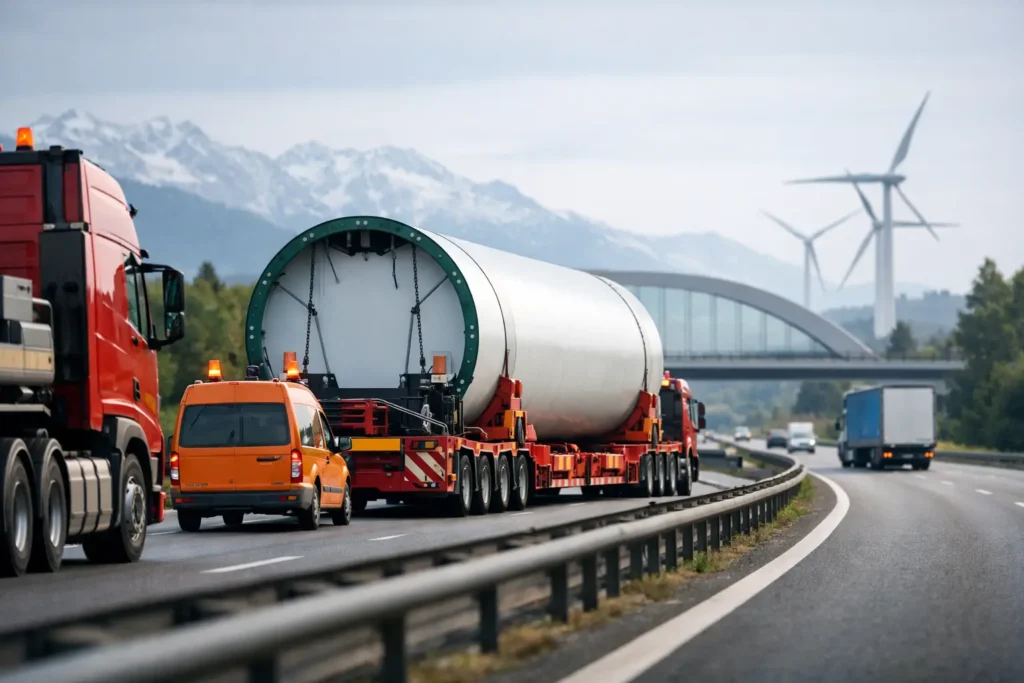
A machine is ready to leave the factory, production at the destination is scheduled around its arrival, and then the real question lands on the logistics desk: can this load actually move across borders without delay? That is where oversized load transport Europe stops being a simple booking exercise and becomes a matter of planning, permits and control.
For procurement teams and logistics managers, the stakes are clear. A late standard pallet is a problem. A delayed oversized unit can hold up installation crews, site access, crane bookings and downstream production. When the cargo is heavy, wide, long or unusually shaped, the transport plan has to be built around the load rather than forcing the load into a standard network.
oversized load transport Europe is a planning exercise first
Cross-border exceptional transport is rarely difficult because of one single factor. More often, risk builds through a combination of dimensions, axle weight, road restrictions, escort requirements and country-specific permit rules. A load that is straightforward in one lane can become far more complex once it needs to cross several jurisdictions.
That is why the first step is not vehicle dispatch. It is technical assessment. Weight, length, width, height, load distribution, lifting points, loading method and delivery access all affect the plan. So do origin and destination constraints. A manufacturing plant with a wide loading yard is one thing. A final delivery point near urban infrastructure, low bridges or restricted roads is another.
At this stage, experienced operators will also look at whether a direct road solution is realistic or whether timing, route limitations or handling risks call for an alternative setup. There is no value in promising speed if the route itself does not support it.
What defines an oversized load in Europe?
There is no one-size-fits-all answer because thresholds vary by country, route and permit authority. In practical terms, oversized cargo usually means a shipment exceeds standard legal road dimensions or weights and cannot travel as ordinary freight. That may include industrial machinery, steel structures, plant components, construction equipment or non-standard assemblies.
The detail matters. Two loads with similar total weight may require very different transport plans if one has awkward dimensions or unusual weight concentration. Height is especially sensitive because bridge clearances and overhead infrastructure can remove otherwise efficient routes. Width can trigger escort needs or night-time movement windows. Length can complicate turning circles and site access.
For shippers, the key point is simple: accurate dimensions and cargo information at quotation stage save time later. Understated measurements, incomplete drawings or late-loading changes are common reasons for delays and revised costings.
Permits, escorts and route checks
In oversized load transport Europe, permits are not an administrative afterthought. They are often the pacing item that determines when a shipment can legally move. Different countries apply different lead times, supporting document requirements and movement restrictions. Some routes may also require police notification, pilot vehicles or authorised escorts.
This is where cross-border experience makes a practical difference. A planner needs to know not only which permits are required, but also how they interact with the actual route, transit timing and border sequence. Public holidays, regional restrictions and weather exposure can all shift the workable delivery window.
Route surveys can be equally important. If a load is close to infrastructure limits, a desk-based route check may not be enough. Site access, turning radii, gradients, temporary roadworks and local restrictions need to be validated before the vehicle arrives. It is far cheaper to adjust a route plan early than to have a loaded vehicle stopped with nowhere suitable to proceed.
For businesses shipping specialist freight regularly, this level of preparation is one reason to work with a partner that already manages exceptional shipments as part of its core service rather than treating them as occasional one-offs.
Vehicle selection affects both cost and risk
The right trailer is not simply the one that can carry the weight. It is the one that fits the cargo profile, the route and the delivery conditions with the least operational risk. Depending on the load, that may mean a low-loader, extendable trailer, semi low-loader or another specialist configuration.
There is always a trade-off between transport efficiency and operational flexibility. A lower deck height may help with clearance, but equipment availability and route compatibility still need to be considered. A more specialised vehicle may reduce permit constraints in one country while increasing mobilisation cost elsewhere. The best solution depends on the full movement, not a single leg of it.
That is why professional oversized transport planning starts with the cargo and builds the equipment plan around it. For manufacturers and industrial suppliers, this protects both the schedule and the cargo itself.
Timing expectations: fast decisions, realistic transit
Oversized cargo does not move at parcel speed, and serious operators should say that plainly. What matters is not making generic promises but setting out what can be done quickly and what requires lead time.
A responsive transport partner should be able to assess the shipment fast, identify likely constraints, and issue a clear quotation based on dimensions, weight, collection point and delivery point. From there, permit applications, route validation and equipment booking can begin. For urgent industrial projects, speed at the planning stage often matters more than making unrealistic promises about wheels turning the same day.
MAP Transport has built its operation around that kind of responsiveness, with quotations within 48 hours and service coverage across 45 countries. Where standard freight can move through classic service or urgent consignments through express transport, exceptional loads require a dedicated plan with close operational follow-up.
The documentation burden is heavier than many expect
Oversized road freight brings more paperwork than conventional shipments, especially on international lanes. Beyond permits, you may need detailed cargo specifications, loading diagrams, technical drawings, route notes, customs support on relevant corridors and site handling instructions. If the cargo includes regulated industrial material or sensitive equipment, confidentiality and security controls also become more significant.
This is not just about compliance. Good documentation improves execution. It gives drivers, escort teams, planners and receiving sites the same picture of what is moving and how it should be handled. It also reduces the risk of disputes over dimensions, loading methods or delivery readiness.
For operations teams, that means one practical rule: share complete information early. If a machine has removable parts, if the final access road is narrow, or if unloading requires a specific time slot, the transport planner needs that before the vehicle is assigned.
Communication is part of the service, not an extra
When a high-value oversized load is in transit, silence is not efficiency. Buyers and project teams need updates they can act on. Has the permit been approved? Has the collection happened on schedule? Is the convoy moving according to plan? Has the delivery slot changed?
A dependable freight partner gives you visibility throughout the movement and takes ownership when a route issue, weather delay or authority restriction appears. That matters even more for cross-border shipments, where language barriers and local coordination can slow down decision-making if nobody is actively managing the file.
For many industrial customers, this is the real difference between a transport provider and a transport partner. The provider accepts the booking. The partner monitors progress, communicates clearly and adjusts when conditions change. If you are comparing options, it is worth checking not just rates but also how the operator manages updates, escalation and multilingual coordination. A good starting point is the company contact page – if the communication is slow before the booking, it rarely improves once the cargo is on the road.
How to prepare your next oversized shipment
The fastest way to improve delivery reliability is to brief the job properly. At minimum, prepare the exact dimensions, gross weight, loading address, delivery address, preferred collection window, unloading method and any technical drawing that clarifies the cargo shape. If there are site restrictions, mention them immediately.
It also helps to be clear about priorities. Some shipments are schedule-critical because installation teams are booked. Others allow more flexibility if it reduces permit complexity or cost. When those commercial priorities are visible from the start, the transport plan can reflect them.
If your business moves specialist equipment, fabricated steel, plant machinery or other non-standard units across borders, oversized load transport Europe should be treated as an engineered process. The right partner will assess the route, secure the permits, match the correct vehicle and keep your team informed from collection to delivery.
When the load is exceptional, dependable execution is what protects the project. If you have dimensions and collection details ready, request a quote early and give the transport team room to build the movement properly.