
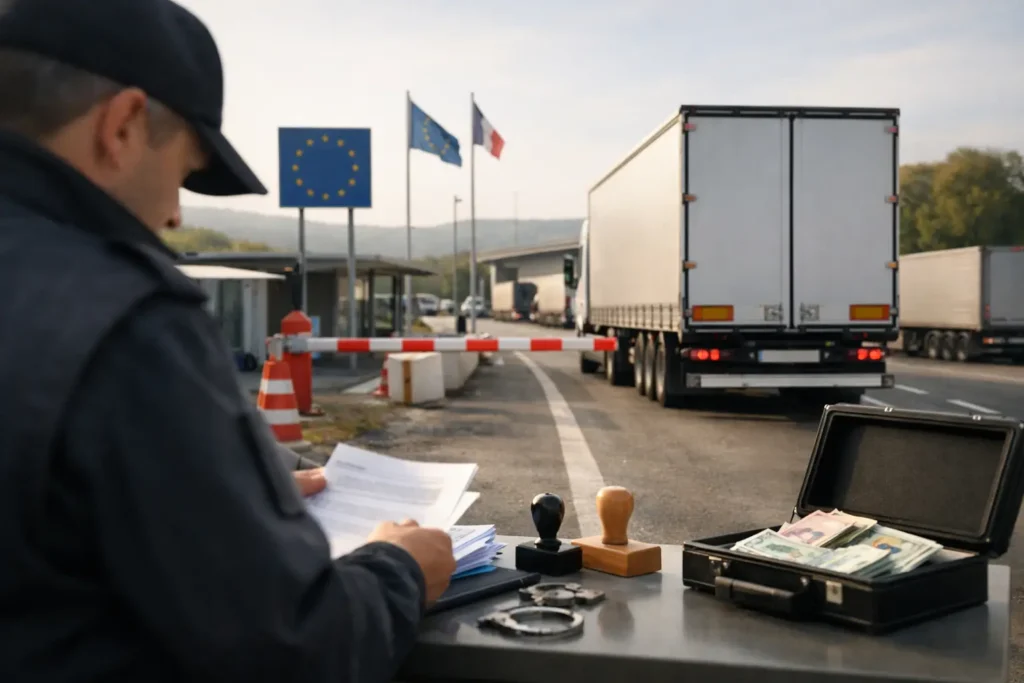
A lorry can be loaded on time, the route can be planned properly, and the rate can look competitive on paper – then customs turns a straightforward European movement into a margin problem. That is the hidden cost of customs in European road freight. It rarely sits in one line on an invoice. More often, it appears as waiting time, warehouse disruption, missed delivery slots, extra administration and avoidable pressure on your supply chain team.
For shippers moving goods between the EU and non-EU markets, or across routes with customs-sensitive controls, the risk is not only that a border formalities issue delays one load. The bigger issue is that the delay spreads. Production schedules shift, unloading appointments are lost, vehicles are tied up, and customer service teams start managing problems instead of planning the next movement.
Why customs costs are often underestimated
Most transport buyers know to ask about freight rate, fuel impact and transit time. Fewer build a realistic customs risk cost into lane pricing. That is understandable, because customs costs are not always predictable in the same way as a toll or a ferry charge.
A shipment may clear with no issue one week, then face questions the next because the commodity description is too vague, the supporting documents do not match, or the declared value triggers additional checks. On some lanes, a minor discrepancy can create several hours of delay. On urgent freight, several hours can be the difference between delivery as planned and a failed supply commitment.
That is why the hidden cost of customs in European road freight is not just about duty and broker fees. It is about the operational consequences of uncertainty.
Where the hidden cost of customs in European road freight really shows up
Delay at border and clearance points
The most visible cost is waiting time. A vehicle that cannot proceed is still consuming resources. The driver is on the clock, the vehicle is unavailable for the next job, and the delivery window may already be slipping.
For manufacturers and distributors, this matters beyond transport spend. A delayed inbound load can leave a production line short of components. A delayed outbound load can trigger contractual issues or customer penalties. If the goods are time-critical, the original saving on a lower transport rate can disappear very quickly.
Storage, demurrage and handling
If a shipment is stopped for document correction or inspection, storage costs may start building. That can happen at a terminal, customs area or bonded facility depending on the route and the shipment profile. If pallets need to be moved, re-presented or partially inspected, handling charges can follow.
These costs are especially frustrating because they often come from paperwork issues rather than physical transport execution. A load can be packed correctly, secured correctly and dispatched correctly, yet still incur extra charges because the paperwork was not prepared with enough precision.
Internal administration time
This is one of the least measured costs. When customs issues arise, someone inside your business has to deal with them. That may be a logistics manager, a buyer, a warehouse lead or a finance contact checking invoices and commodity values.
None of that time is free. If your team spends half a day chasing corrected commercial documents, answering clearance queries or rebooking unloading slots, there is a real cost attached. It may not appear under freight spend, but it reduces productivity just the same.
Lost delivery slots and downstream disruption
On many European supply chains, especially retail, automotive and industrial distribution, delivery slots are tightly controlled. Miss a booked slot and the problem does not end when the vehicle finally clears customs. The load may need to wait for the next available appointment, which could be later the same day or the next day.
That creates knock-on costs in warehousing, labour planning and customer service. It can also damage supplier performance metrics. For companies managing regular cross-border flows, repeated customs-related slot failures can become a commercial problem, not just a transport issue.
The paperwork issue behind many customs delays
In practice, many customs delays are caused by ordinary documentation errors rather than exceptional events. Commodity descriptions that are too broad, mismatched weights, incomplete invoices, missing origin information or unclear consignee details can all slow clearance.
The challenge is that these errors often look small before departure. A generic goods description such as “parts” may seem enough internally, but it may not be enough for customs processing. The same applies when the invoice, packing list and transport document do not align perfectly.
This is where process matters. A road freight partner with strong international coordination can flag missing or inconsistent details before the vehicle is committed. That is far cheaper than solving the issue while the load is waiting at the border. Businesses moving regular traffic across Europe can reduce exposure by working with a provider that treats documentation as part of transport control, not as an afterthought. For that reason, many shippers choose a specialist in international road transport rather than buying purely on linehaul price.
Not every route carries the same customs risk
Customs exposure depends heavily on the lane, the goods and the service requirement. A standard industrial shipment moving on a well-established corridor may be relatively straightforward if the paperwork is consistent. A time-critical movement to or from a non-EU market, or a load involving sensitive or specialist cargo, can be very different.
The same is true for urgent freight. Express transport reduces transit time, but it also reduces tolerance for any delay. If a shipment needs delivery within hours, customs preparation must be equally fast and equally accurate. There is no room for avoidable correction cycles. On these movements, shippers often need an operator experienced in express transport across Europe who can coordinate both speed and compliance.
Oversized and non-standard loads add another layer. Exceptional transport already requires route checks, permits and specialist equipment. If customs formalities are added to the equation, errors become even more expensive because the vehicle planning is more complex and the rework is harder to absorb. That is why exceptional shipments need joined-up planning from the start.
How to reduce customs cost without slowing down freight
The answer is not simply to add more buffer time. Too much buffer makes your supply chain slower and less competitive. The better approach is to reduce preventable friction.
Start with document quality. Commercial invoices, packing lists and goods descriptions need to be precise and consistent. Internal teams should use standardised data wherever possible, especially on repeat lanes and repeat SKUs. If one department uses a different goods description from another, customs queries become more likely.
Next, match the transport service to the shipment risk. Standard freight, urgent deliveries and specialist loads do not need the same operational setup. Trying to manage all of them in the same way usually creates gaps. A customer-centric transport partner should adjust vehicle type, routing and follow-up to the reality of the load, not force every movement into one model.
Then focus on communication. When customs-sensitive shipments move across several countries, multilingual coordination matters. Problems get solved faster when the parties involved can act quickly and clearly, with one point of control tracking progress and escalating where needed. That level of follow-up can prevent a documentation issue from becoming a delivery failure.
Finally, look at customs performance as part of total landed cost. The cheapest transport quote is not the cheapest option if it comes with weak document control, limited visibility and slow response when something goes wrong. Reliable execution often saves more than an aggressively low rate.
What experienced shippers do differently
Experienced logistics teams do not treat customs as a separate back-office step. They treat it as part of transit planning. They ask earlier whether the lane has special requirements, whether the consignee data is complete, whether the goods description will stand up to inspection, and what happens if a clearance query appears outside normal office hours.
They also choose partners who take ownership. That means practical support from quote stage through to delivery, clear status updates and a realistic understanding of where delays can occur. MAP Transport has built its service around that kind of control, with coverage in 45 countries and tailored road freight solutions that fit the shipment rather than the other way round. For shippers that need dependable import and export movements, the difference is not theoretical. It is measured in fewer disruptions, faster response and better protection of delivery commitments.
Customs will always be part of cross-border road freight on certain lanes. The real question is whether it remains a manageable process or becomes a recurring source of hidden cost. The businesses that perform best are usually the ones that catch the issue before the wheels start turning.