
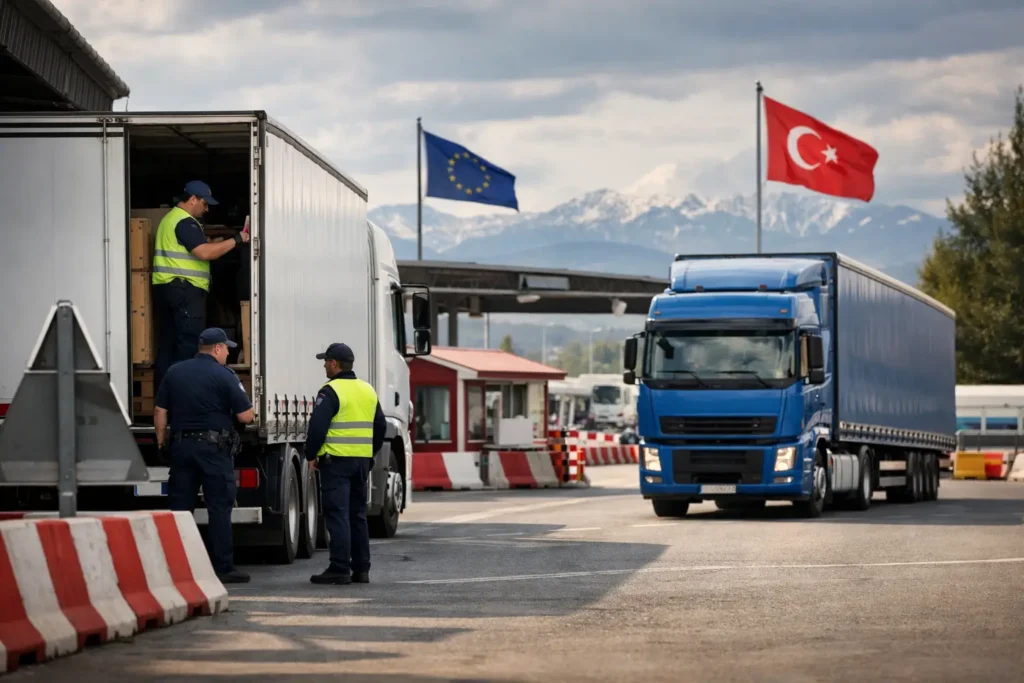
A border can become a bottleneck overnight. One new sanctions package, a sudden customs control, a protest on a strategic corridor, or a regional security incident can turn a routine road movement into a missed delivery slot, a production stoppage, or an urgent premium shipment. For supply chain managers moving goods across Europe, Turkey or the Caucasus, geopolitical risks are no longer a background issue for the boardroom. They affect lead times, routing, carrier capacity, customs clearance and customer commitments in real operational terms. The question is not whether these risks exist, but how quickly your transport set-up can absorb them.
Why geopolitical risks matter on the road
In road freight, disruption rarely stays local. A policy decision in one country can affect transit times across several others, especially on long cross-border routes. This is particularly visible on flows involving the UK, Switzerland and Turkey, where customs formalities already add more moving parts than an intra-EU movement.
Geopolitical risks usually hit road transport through four channels: border friction, regulatory change, security concerns and infrastructure pressure. A stricter inspection regime can lengthen queue times. A sanctions update can stop a shipment at document-check stage. Civil unrest can make a preferred corridor unusable. Driver movement rules, permits or transit requirements can change with little notice.
According to the European Commission, road carries the majority of inland freight in the EU, accounting for around three quarters of inland freight transport by tonne-kilometres. That concentration matters. When disruption hits road corridors, the impact spreads quickly across industrial supply chains, especially for manufacturers running tight replenishment windows. For authoritative transport data, the EU publishes regular updates through the European Commission transport portal.
The routes most exposed to geopolitical risks
Not every lane carries the same level of exposure. A Germany-Belgium movement is not managed in the same way as an export from Spain to Turkey, or a time-critical shipment crossing into the UK with customs formalities on both sides.
UK flows: paperwork errors become delivery failures
On UK routes, political and regulatory change has made customs discipline a transport issue, not just an admin task. A missing commodity code, the wrong Incoterm application, or inconsistent values between commercial documents can delay release and force a vehicle to wait. That quickly becomes costly on urgent freight.
If you are shipping components into a production site with a fixed unloading window, a two-hour document problem at the border can be more damaging than a higher freight rate. The operational insight here is simple: on politically sensitive routes, document quality protects transit time.
For teams managing regular UK movements, MAP’s international road freight services are structured around route complexity and delivery urgency rather than a one-size-fits-all model.
Switzerland and Turkey: customs complexity increases risk exposure
Switzerland and Turkey remain strategically important markets for European industry, but both require disciplined customs handling. In Switzerland, even a standard road movement can be delayed by incomplete declarations or timing issues around border processing. In Turkey, the combination of customs checks, permit requirements and shifting regional conditions can make planning less predictable than on EU corridors.
The same applies further east on routes connected to Azerbaijan or Kazakhstan. The further the route extends, the more geopolitical risks shape practical decisions such as border selection, transit buffers, vehicle assignment and customer communication.
Scandinavia and peripheral corridors: disruption travels fast
Scandinavian flows can also feel the effects of geopolitical pressure, even when the issue starts elsewhere. Congestion on a major continental corridor, industrial action, or rerouted freight from another disrupted region can quickly absorb available capacity and extend lead times. On these lanes, resilience often depends less on distance and more on how early a transport partner identifies the knock-on effects.
How these risks show up in daily operations
For most logistics teams, geopolitical risks do not arrive labelled as such. They appear as practical problems: the lorry is held at the frontier, the customer asks for a revised ETA, the plant requests an emergency upgrade, or a route that worked last week is suddenly no longer viable.
A concrete example: a manufacturer shipping industrial parts from northern Spain to a consignee in western Turkey may plan a standard road movement with a reliable transit pattern. If border controls tighten unexpectedly or a regional security alert affects the preferred crossing, the shipment may need rerouting, revised transit expectations and closer customs coordination. If the goods are production-critical, a standard shipment can become an express operation within hours.
This is where many supply chains lose time. They react too late because they treat disruption as a transport event only after the delay has already started. In reality, the right response begins earlier – when planning the shipment, validating documents, choosing the vehicle type and deciding how much timing risk the delivery can absorb.
The IRU regularly tracks pressure points affecting commercial road transport through its industry updates and policy resources, which can be useful for teams monitoring cross-border exposure.
Reducing geopolitical risks before the shipment moves
You cannot remove geopolitical risks from cross-border freight, but you can reduce the operational damage they cause. The strongest set-ups tend to share the same habits.
First, they segment shipments by business impact, not just by weight or destination. A standard pallet replenishment does not need the same planning intensity as a line-stopping component or a high-value industrial consignment. When urgency is clear from the start, transport planners can build in more suitable routing, better checkpoint visibility and realistic contingency options.
Second, they treat customs readiness as part of transport execution. That means checking whether invoice data, commodity codes, origin information and consignee details are aligned before departure, especially on UK, Swiss and Turkish flows. On paper this sounds obvious. In practice, many delays still come from document mismatches that could have been caught before loading.
Third, they keep route planning flexible. In unstable periods, the cheapest route on Monday may be the riskiest route by Wednesday. A transport partner with active coverage across Europe and beyond can often switch corridor strategy faster, provided the shipment has been planned with realistic alternatives.
Fourth, they build communication into the service. During disruption, silence creates more damage than bad news. Buyers, production teams and customers can usually work around a problem if they get timely information. They cannot plan around uncertainty.
For urgent consignments that cannot wait for standard recovery timelines, a dedicated express option matters. MAP’s transport team supports time-critical flows with rapid response and tailored vehicle selection when a delay threatens production or delivery commitments.
When standard planning is not enough
There are periods when geopolitical risks become too fluid for routine transport rules. That is when logistics managers need a partner that can move from execution to active problem-solving.
If an oversized industrial shipment is heading to a market with permit sensitivity or border volatility, specialist handling becomes essential. The same applies when customs formalities, route restrictions and timing pressure all sit in the same movement. In these cases, transport planning is not just about finding capacity. It is about sequencing documents, route viability, escort or permit requirements where relevant, and constant operational follow-up.
This is also where tailored service design has real value. Some shipments can remain on a classic road freight model with stronger pre-checks and wider timing buffers. Others need a dedicated van or direct vehicle because the cost of delay is greater than the cost of premium transport. The right answer depends on the shipment’s role in your supply chain.
A useful checkpoint is this: if a delivery failure would stop production, trigger contractual penalties, or disrupt a customer launch, it should not be managed like ordinary freight.
Building a more resilient transport set-up
Resilience in road freight is not about eliminating every disruption. It is about shortening the distance between issue detection and decision-making. That depends on three things: route knowledge, customs discipline and responsive coordination.
Supply chain teams reviewing their current exposure should ask practical questions. Which lanes rely on politically sensitive borders? Which customers have no tolerance for delay? Where are we still dependent on reactive rather than planned express transport? Which shipments need more than a standard carrier handover?
These questions are worth asking before the next disruption, not during it. You can also review current border and customs procedures through the EU customs portal to spot process gaps on non-EU flows.
Geopolitical risks are now part of normal freight planning across Europe, especially on customs-heavy and time-sensitive routes. Companies that perform best are usually not the ones with perfect conditions. They are the ones with faster information, better preparation and transport partners able to adapt when the route changes.
For businesses managing complex European road freight, that level of control is often the difference between a delayed shipment and a contained issue. If your flows involve the UK, Switzerland, Turkey or urgent cross-border deliveries, it may be time to review whether your current transport model is built for this level of volatility. You can also read more on MAP Transport’s approach to international logistics if you are assessing support for sensitive routes.
Need support on your transport flows? Contact our team for a tailored solution.
Have a question or need a quote? Contact us at (+34) 943 62 95 77 (ask for Raquel) or by email at lo*******@**********rt.com