
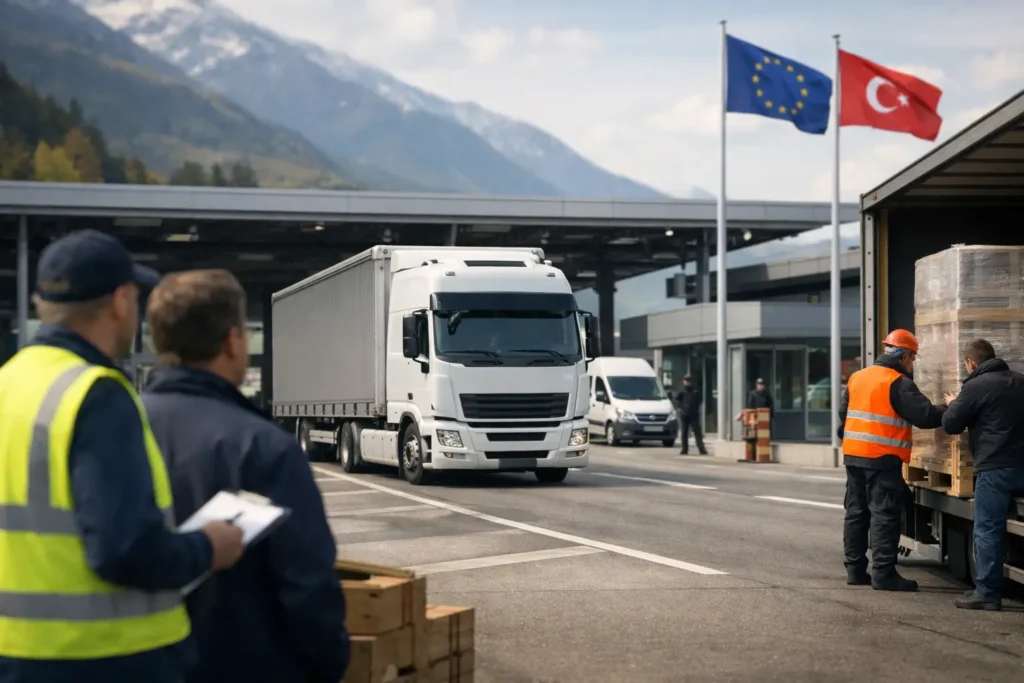
A missed customs reference in Dover, a driver held at the Swiss border because the paperwork does not match the packing list, an urgent pallet for Turkey losing a day because the wrong vehicle was booked – this is what cross border road freight management looks like when control slips. For supply chain managers, the issue is rarely just transport. It is production continuity, customer commitments, margin protection and the daily pressure to keep goods moving across multiple jurisdictions. Good cross border road freight management is less about theory and more about making the right operational decisions early, then following them through without gaps.
Why cross border road freight management breaks down
Most international road movements do not fail because of one dramatic event. They fail because small operational details stack up. A collection slot is booked too tightly. Commodity descriptions are vague. The consignee is not ready for unloading. Transit times are assumed rather than checked against border conditions, local driving restrictions or ferry cut-offs.
That matters even more on routes where customs or documentation sit in the middle of the journey rather than at the start. The UK, Switzerland and Turkey are obvious examples. These are not impossible lanes, but they punish weak planning. According to the European Commission, road freight still carries the largest share of inland freight in the EU, which means border-facing road flows remain critical for manufacturers and distributors handling regular imports and exports.
A common mistake is to treat every shipment as if it were standard. It is not. A two-pallet industrial spare parts shipment from northern Spain to Birmingham has different risks from a full load of metal products into Switzerland, or an urgent van movement to a production site in Germany. The planning logic, document checks and communication rhythm need to reflect that.
The core decisions behind reliable cross border road freight management
Reliable transport performance usually starts with four practical choices: the right service level, the right vehicle, the right document set and the right timing window. If one is wrong, the rest of the movement becomes harder to recover.
Service level is often underestimated. If a shipment is genuinely time-critical, booking it as standard freight to save cost can create a much bigger cost later through downtime, line stoppage or customer penalties. On the other hand, paying for urgent capacity when the consignee cannot receive for 24 hours adds no value. The right answer depends on the consequence of delay, not just the transport budget.
Vehicle choice is just as important. Cross border road freight management should not default to a full-sized articulated lorry if a dedicated van is more appropriate, especially for urgent, high-value or lower-volume freight. Smaller vehicles can reduce handling points and give more direct control on sensitive moves. For oversized or non-standard cargo, specialist planning is needed much earlier because permits, routing and escort requirements can affect both timing and feasibility.
Documentation is where many avoidable delays begin. Commercial invoices, packing lists, customs references, commodity descriptions and consignee details must align exactly. Border teams do not work on assumptions. If weights, values or descriptions conflict between documents, the vehicle may wait while someone on the shipper side tries to correct data that should have been verified before departure.
Timing is the final piece. A route that looks fine on paper can become fragile if departure leaves no buffer for customs clearance, terminal queues or restricted unloading slots. Good planning leaves room for reality.
Customs pressure points on UK, Swiss and Turkish routes
Not all borders create the same workload. Within many European lanes, transit is operationally demanding but administratively lighter. Once customs is involved, the transport plan needs tighter discipline.
UK flows: document accuracy matters more than speed alone
On UK movements, pre-lodgement, customs references and goods data need to be correct before the vehicle reaches the port. A fast vehicle does not solve a missing or invalid declaration. The operational insight here is simple: if customs readiness is uncertain, the real departure time is not when the lorry leaves the shipper. It is when the file is complete.
For manufacturers sending urgent replacement parts into the UK, this distinction can save hours. We have seen shipments where the loading was ready by mid-morning, but dispatch was held until customs data was fully aligned. That pause protected delivery time better than rushing to the port with incomplete paperwork.
Switzerland: small discrepancies create disproportionate delay
Swiss routes often appear straightforward because the geography is familiar and the transit time can look manageable. In practice, invoice detail, origin information and commodity description need close checking. A minor mismatch can lead to border queries that disrupt the whole delivery window.
This is especially relevant for industrial goods where product naming inside ERP systems is too abbreviated for customs use. Internal stock codes make sense to procurement teams, but not at the border.
Turkey and onward routes: time plans must reflect border reality
Turkey movements require a more realistic view of transit time. Border processes, queue times and document handling can vary significantly. If your customer expects a delivery window based only on pure driving hours, the plan is already weak. On these routes, proactive updates are not a courtesy. They are part of managing customer expectations and downstream production planning.
Guidance from HMRC, Swiss customs authorities and IRU all points in the same direction: cross-border compliance is an operational discipline, not a paperwork afterthought.
A practical example of cost and delay control
Consider a machinery supplier shipping a critical replacement component from Belgium to a production plant in western Turkey. The cargo is too urgent for a standard groupage timetable, but not large enough to justify an oversized solution. The first decision is service level: dedicated urgent road transport rather than a consolidated movement. The second is vehicle match: a direct van to reduce cross-docking and handling risk.
The third decision is the one that often decides success or failure – document preparation. The commercial invoice must reflect the emergency nature of the shipment without creating customs ambiguity. The consignee details, goods value and commodity description need confirming before loading. If this is done properly, the movement has a realistic chance of meeting a demanding delivery window. If it is done badly, the extra money spent on urgent transport is wasted at the border.
This is where tailored management earns its keep. Paying more for speed only works when the rest of the chain is built to support that speed.
How to improve cross border road freight management without adding bureaucracy
Most supply chain teams do not need more dashboards. They need fewer surprises. The best improvements are often simple and operational.
Start by separating shipments into decision groups rather than managing all freight in one pool. Standard recurring freight, urgent movements and exceptional loads should not follow the same approval path or planning logic. That alone improves response time and reduces misbooking.
Then tighten shipment data at source. Ask for dimensions, weight, collection and delivery constraints, goods description and customs status before requesting transport. This sounds obvious, but in practice many delays start because transport is booked on partial data and corrected too late.
Communication also needs a clear owner. Cross border freight involves shippers, consignees, customs agents, drivers and transport coordinators. When updates are fragmented, no one has the full picture. One operational contact point with multilingual coordination is often more valuable than a complicated reporting structure.
Finally, review lane performance by cause of delay, not only by total transit time. If UK shipments are slipping because customs files are late, the fix is different from a problem caused by collection readiness. If Swiss deliveries are delayed by consignee access constraints, carrier performance is not the only issue. Better diagnosis leads to better buying decisions.
What experienced shippers should expect from a freight partner
A transport provider should do more than quote a rate and assign a vehicle. In cross border road freight management, real value comes from anticipating where a shipment is likely to fail and adjusting the plan before that happens. That means challenging unrealistic collection times, flagging customs gaps early, recommending urgent capacity when the commercial risk justifies it, and matching equipment to the actual shipment rather than forcing a standard template.
For companies managing flows across Europe, the UK, Switzerland and Turkey, this is where specialist support makes a measurable difference. Since 1985, MAP Transport has focused on exactly this type of road freight coordination, including urgent deliveries, complex customs-facing routes and non-standard loads that need closer planning than a routine lane.
The real goal is not just moving freight across a border. It is protecting lead times, reducing exception management and giving your team the confidence that the next shipment will be handled with the same discipline as the last. Need support on your transport flows? Contact our team for a tailored solution.
Have a question or need a quote? Contact us at (+34) 943 62 95 77 (ask for Raquel) or by email at lo*******@**********rt.com