
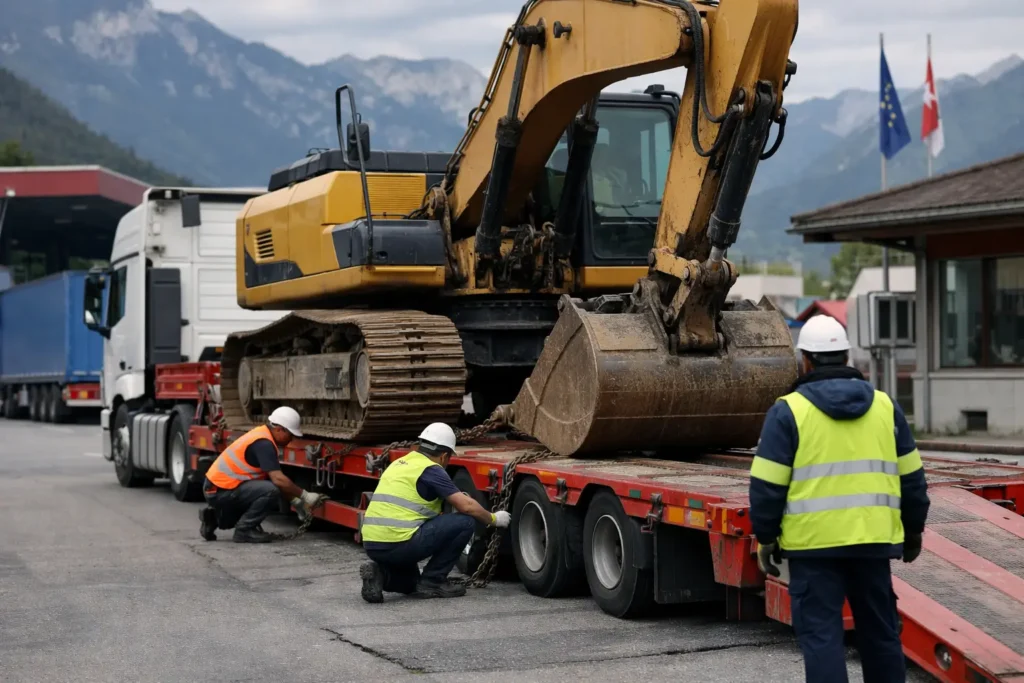
A missed permit slot, the wrong loading plan, or a customs document checked too late can stop a high-value machine long before it reaches site. For supply chain managers, transporting presses, CNC units, transformers or production lines is rarely just a question of booking a vehicle. It is a coordination job with cost, safety and downtime attached to every decision. This guide to transporting heavy industrial equipment looks at the points that matter most in real operations: route feasibility, permits, border handling, loading control and timing. If your shipment is crossing Europe, the UK, Switzerland or Turkey, small errors tend to become expensive ones very quickly.
Start with the shipment profile, not the vehicle
The first mistake in heavy equipment transport is choosing the vehicle too early. The planning should begin with the shipment profile: exact dimensions, verified weight, centre of gravity, lifting points, packing status, and whether any part can be dismantled. A machine that looks manageable on paper can become an exceptional load once crated, or once ancillary parts are added to the consignment.
This is where many delays start. If the declared dimensions are wrong by even a small margin, permits may need to be amended, escort requirements can change, and the planned route may no longer be valid. In practice, transport planners need more than a length-width-height figure. They need loading drawings, photos, site access details and realistic collection and delivery windows.
A concrete example: a metalworking company moving a 4.2-metre-high press from northern Italy to a customer in Germany may assume a standard low-loader is sufficient. But once the skids, protective frame and lifting clearance are included, total height pushes beyond route tolerance for several motorway sections. That changes both permit planning and transit time.
According to the European Commission, road freight remains the dominant inland freight mode in the EU, which makes route pressure, infrastructure constraints and permit coordination highly relevant for oversized industrial loads. See the latest transport data from the European Commission: https://transport.ec.europa.eu/transport-themes/statistics_en
A guide to transporting heavy industrial equipment across borders
When the load crosses a border, transport complexity rises sharply. The operational challenge is not just distance. It is the mix of national rules, permit lead times, driving restrictions and customs procedures. This is especially true on routes involving the UK, Switzerland and Turkey, where border formalities can affect the delivery plan more than the driving time itself.
For intra-EU moves, the main focus is usually road restrictions, escort rules and local movement windows. For non-EU segments, customs becomes part of transport planning from day one. If a machine is moving temporarily for installation, repair or exhibition use, the paperwork may differ from a standard commercial export. If the consignee needs supporting origin or commodity documentation, waiting until the lorry is loaded is already too late.
On a route from Spain to Turkey, for example, an oversized industrial unit may require not only road permits in several transit countries but also close coordination of export paperwork, transit formalities and border timing. A delay at one point can push the movement into a restricted driving period in the next country. That is why experienced operators build border risk into the schedule rather than treating customs as an admin step.
For customs guidance relevant to UK trade, HM Revenue & Customs remains a key reference point: https://www.gov.uk/government/organisations/hm-revenue-customs
Permits, escorts and route surveys are not paperwork extras
In any serious guide to transporting heavy industrial equipment, permits need to be treated as operational controls, not bureaucracy. Oversized and heavy shipments often require movement authorisations that are route-specific, date-specific and sometimes vehicle-specific. Some corridors also require police notification or private escort vehicles, depending on dimensions and local rules.
Lead times vary widely. In one country, a permit may be issued in a day or two. In another, it may take a week or more, especially if bridges, secondary roads or urban access points need review. That makes route surveys valuable, particularly for plant deliveries where the final kilometres involve industrial estates, local roads or site entrances with limited turning space.
There is also a cost trade-off. A faster route is not always the right route if it increases escort needs or requires waiting for a narrow permit window. A slightly longer journey can reduce overall risk if it offers more predictable movement conditions. For supply chain teams measured on delivery certainty, that trade-off often makes sense.
The International Road Transport Union regularly publishes useful material on cross-border road freight and market conditions: https://www.iru.org/
Loading, securing and lifting need one plan
Heavy equipment moves fail as often at the loading point as they do on the road. The issue is usually not a lack of care. It is a lack of one agreed method between shipper, haulier, lifting crew and consignee. If each party works from a different assumption, loading takes longer, handling risk rises and delivery appointments start to slip.
The right plan should confirm who is providing lifting equipment, whether cranes or forklifts have the right capacity, how the machine is secured, and whether weather protection is required. For valuable industrial assets, securing is not only about compliance. It is about avoiding shift, vibration damage and disputes over condition on arrival.
One operational insight that experienced teams apply early is this: if the load has an uneven weight distribution, treat centre of gravity confirmation as essential, not optional. A machine can sit within total weight limits but still create a dangerous or non-compliant axle load if positioned incorrectly. That affects both safety and route legality.
For practical rules on load securing in Europe, the IRU and national road authorities are more useful than generic freight advice because they reflect what happens in enforcement and roadside inspection.
Timing matters more when downtime is expensive
Many industrial equipment movements are linked to shutdowns, line installations or maintenance windows. In those cases, the cost of late delivery is usually far higher than the transport rate. If a production line is waiting for one machine, every missed hour can carry labour, contractor and output costs.
That is why heavy transport planning needs milestones, not just a pickup date and delivery date. Permit approval dates, crane bookings, border cut-offs, escort timings and site readiness should all be confirmed against the production schedule. If any of those remain uncertain, the shipment is not truly planned.
A useful benchmark here is communication frequency. For standard freight, periodic updates may be enough. For exceptional or urgent industrial loads, operations teams often need status at every critical stage: collection completed, permit activated, border crossed, final access confirmed, unloading complete. That level of follow-up allows the consignee to adjust labour and installation resources before delays become expensive.
Reuters has reported repeatedly on how transport disruption and border congestion continue to affect industrial supply chains across Europe, which underlines why schedule control is now a strategic issue rather than a transport detail: https://www.reuters.com/
How to reduce risk before the equipment leaves site
The most effective risk reduction happens before the lorry arrives. That means checking whether dimensions have been physically verified, whether documentation matches the cargo, whether the route has been validated for the exact load profile, and whether delivery site constraints are confirmed in writing.
It also means being realistic about urgency. Some heavy loads genuinely need accelerated handling, but urgency does not remove permit or safety constraints. The better question is where time can be saved without creating exposure. Sometimes that means faster document preparation. Sometimes it means splitting ancillary items from the main load. Sometimes it means using a specialist team that can coordinate permits, customs and road execution in one flow.
For companies shipping across Europe and into more complex corridors such as the UK, Switzerland, Turkey or the Caucasus, a tailored transport setup tends to outperform a generic booking model. Heavy equipment transport works best when vehicle choice, timing and compliance are designed around the shipment rather than forced into a standard process.
MAP Transport has been managing international road freight since 1985, including exceptional shipments that need close operational control across challenging cross-border routes. For logistics teams moving industrial machinery, the value is not only in finding capacity. It is in keeping permits, customs, timing and communication aligned from quote to delivery.
Need support on your transport flows? Contact our team for a tailored solution.
Have a question or need a quote? Contact us at (+34) 943 62 95 77 (ask for Raquel) or by email at lo*******@**********rt.com