
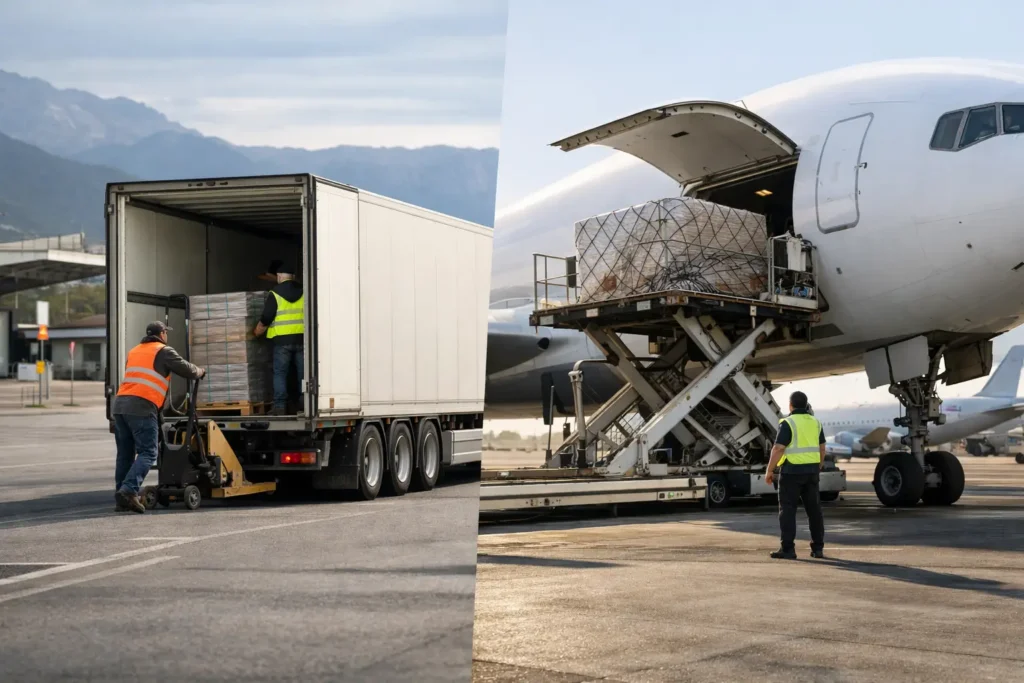
A production line is waiting, a customer deadline is fixed, and the usual lead time has already gone. That is when the real question starts – not simply how fast a shipment can move, but which mode gives you the best chance of arriving on time without creating extra cost, customs issues or handling risk. When comparing road freight vs air freight for urgent goods, speed matters, but so do route design, cut-off times, documentation and what happens once the cargo lands. For supply chain managers moving goods across Europe and into markets such as the UK, Switzerland or Turkey, the fastest option on paper is not always the safest operational choice.
When road freight vs air freight for urgent goods is a real decision
Urgent freight decisions usually happen under pressure. A missed component, a rejected batch that needs replacing, or an unexpected sales spike can all force a transport choice within minutes rather than days. In those moments, air freight looks attractive because flight time is short. But actual door-to-door performance depends on collection timing, airport handling, security screening, airline space and final delivery at destination.
Road freight works differently. A dedicated van or lorry can often collect immediately and run direct to delivery with fewer touchpoints. On many European lanes, that can outperform air in real terms, especially for short and medium distances or where airport processes add delay. This is particularly relevant for urgent industrial freight moving between production sites, suppliers and distribution points.
According to Eurostat, road remains the dominant inland freight mode in Europe by volume, which reflects not only cost efficiency but also its flexibility across dense cross-border networks. For urgent goods, that network can be a major advantage when every hour counts.
Transit time is not the same as delivery time
This is where many urgent shipments go wrong. Air freight may offer a shorter pure transport leg, but urgent deliveries are judged on door-to-door time, not runway-to-runway time.
If your goods are ready near Birmingham at 16:00 and need to reach a plant near Lyon the next morning, a direct road express movement may be more reliable than trying to secure uplift, deliver to the airport, clear acceptance, fly, unload and arrange final delivery. The same applies to many Western and Central European routes where road corridors are dense and collection can begin almost immediately.
Road freight also avoids fixed airline schedules. If the shipment is ready late, a dedicated vehicle can still leave. With air, missing a cut-off by even one hour can push the cargo to the next available flight and turn a same-day solution into a next-day problem.
That does not mean road always wins on time. For long distances or hard deadlines where geography is against you, air may still be the better choice. A shipment from Spain to eastern Turkey, for example, may need air for part of the journey if the delivery window is extremely tight. The point is practical rather than theoretical: compare actual collection-to-delivery timing, not headline transit claims.
Cost pressure changes the calculation
For most logistics buyers, urgency does not remove the need for cost control. It simply changes the threshold of what is acceptable.
Air freight is usually the premium option, and not only because of the flight itself. Charges can include terminal handling, security fees, fuel surcharges and local delivery on both ends. Volumetric weight can also make relatively light but bulky goods surprisingly expensive to move by air.
Road freight tends to be easier to budget for urgent shipments, especially if you are using a dedicated vehicle sized to the actual load. That matters when the cargo is too large for standard air handling, or when a full van avoids unnecessary repacking and rehandling. For many manufacturers and distributors, the real saving is not only the transport spend but the reduction in disruption costs around the shipment.
A concrete example: a supplier in northern Italy needs to send replacement industrial parts to a customer in southern Germany after a quality issue is identified late in the afternoon. The load is small but awkwardly packed and needed before the next morning shift. Air sounds faster, yet airport processing and local delivery would likely erase the advantage. A direct express van can collect the same evening and deliver straight to site with lower handling risk and a clearer cost structure.
Customs and border exposure can outweigh pure speed
Urgent goods moving across the UK border, into Switzerland, or towards Turkey face another issue: customs timing. A fast transport mode is only fast if the paperwork is correct and the border process is ready.
Air freight often introduces additional control points. That can be manageable, but on urgent shipments every extra handover creates another place for delay. In contrast, road freight allows tighter coordination between the transport plan, customs documents and final consignee availability, especially when the movement is direct.
This matters on routes where customs formalities are part of the job, not an exception. UK-Europe traffic after Brexit, Swiss movements outside the EU customs union, and flows into Turkey all require close operational follow-up. The European Commission’s customs guidance makes clear that documentation quality directly affects release timing. If your paperwork is incomplete, the transport mode will not save you.
An operational insight here is simple: when customs is part of the route, choose the option that gives you the most control over timing and communication. For many urgent B2B movements, that favours road, particularly where a specialist team can monitor the shipment from collection through border crossing to delivery.
Handling risk and shipment profile matter more than people admit
Urgency often focuses everyone on speed, but damaged goods are simply another kind of delay. The more handovers a shipment has, the greater the chance of mishandling, especially for sensitive industrial components, high-value parts or non-standard pallets.
Air freight can be excellent for compact, high-value goods that are properly packed for multi-stage handling. But if the load is fragile, oversized, confidential or awkward to move through airport systems, road freight may be the safer urgent option. A dedicated vehicle keeps the cargo together, reduces transhipment points and gives clearer custody from origin to destination.
This is especially relevant for exceptional or irregular freight. If a shipment needs tailored loading, specific securing or direct supervision, forcing it into an air workflow can create more operational friction than benefit. On the road side, the vehicle and route can be matched to the load rather than the other way round.
For urgent goods, reliability is often about reducing variables. Fewer transfers, fewer terminals and fewer parties involved usually mean fewer surprises.
How to choose the right mode under pressure
A useful decision framework is to ask four questions in order.
First, what is the true delivery deadline at consignee level? Not airport arrival, not hub arrival – final signed delivery. Second, what is the shipment profile? Weight, dimensions, packaging and value will quickly narrow the realistic options. Third, does the route involve customs or border complexity? If yes, the best mode is often the one with the strongest operational control. Fourth, what is the cost of failure? If a factory stoppage will cost far more than the transport premium, the decision should reflect that.
In practice, many urgent European shipments are best served by express road freight because it combines fast collection, direct delivery and better flexibility when plans change. Air freight makes more sense when distance is too great for road within the required window, or where the goods are highly time-sensitive and easy to handle through airport processes.
That is why experienced shippers do not ask only, “Which is faster?” They ask, “Which option gives us the highest probability of on-time delivery with the lowest operational risk?” Those are not always the same answer.
For companies managing urgent flows across Europe, the UK, Switzerland or Turkey, this decision benefits from a partner that can assess the route, paperwork, vehicle type and deadline in one go rather than treating transport as a standard booking. That is where specialist road freight planning often proves its value, especially when delivery is needed within hours or inside a 24-hour window.
If you are reviewing urgent transport options regularly, it is worth building a mode-choice playbook based on actual route performance, not assumptions. The shipment that looks expensive at booking stage can still be the cheaper option if it prevents downtime, penalties or customer disruption.
Need support on your transport flows? Contact our team for a tailored solution.
Have a question or need a quote? Contact us at (+34) 943 62 95 77 (ask for Raquel) or by email at lo*******@**********rt.com