
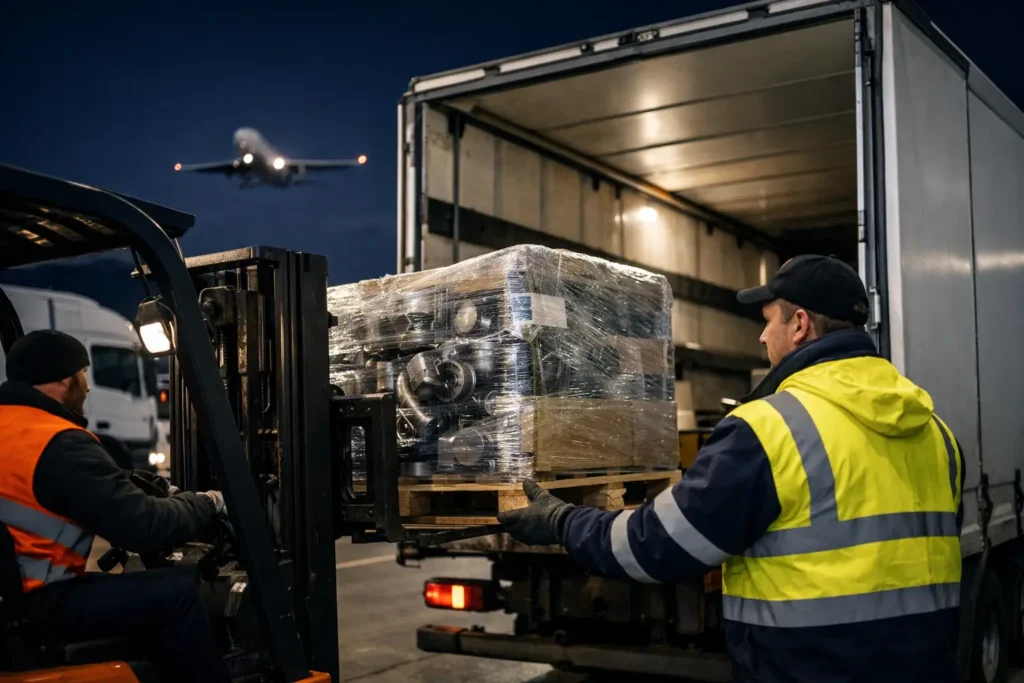
At 16:40, a production line stops and every lost hour starts eating into margin, customer service and tomorrow’s schedule. That is the real context behind this case study urgent spare parts delivered overnight. For most supply chain managers, the question is not whether an urgent shipment is possible. It is whether the right carrier can collect fast, choose the right vehicle, handle border formalities if needed, and keep everyone informed without adding more risk. This is where urgent road freight stops being a transport purchase and becomes an operational decision.
The problem: one missing part, one expensive delay
The shipment in this case involved a critical industrial spare part needed to restart a manufacturing operation in Central Europe. The component was not oversized, but it was time-sensitive, high-value and linked directly to production continuity. If it did not arrive before the morning shift, the customer faced another full day of downtime.
That risk is easy to underestimate. According to European manufacturing benchmarks reported across industry sources, unplanned downtime can cost thousands of euros per hour depending on the sector and process complexity. In practical terms, even a relatively small spare part can carry a business impact far beyond its invoice value.
The collection point was in northern Spain and the delivery point was in southern Germany. The part became available late in the afternoon, after routine groupage cut-off times. Standard road freight was no longer an option. Air freight was considered, but airport handling, security steps and first-mile transfers made it slower than a direct dedicated vehicle in this lane.
This is the first operational insight worth stressing: urgent transport is not always about the theoretically fastest mode. It is about the fastest door-to-door solution with the fewest handovers.
Case study urgent spare parts delivered overnight: what happened
Once the request came in, the priority was not only speed but certainty. The shipper needed confirmation that the load could be collected the same evening, moved directly, and delivered before the plant’s maintenance window closed the next morning.
A dedicated express vehicle was assigned rather than trying to combine the part with other loads. That decision increased the transport cost, but it removed two major risks – terminal delay and route detours. For urgent spare parts, consolidation often saves money while adding uncertainty. When production is already down, that trade-off rarely works in the shipper’s favour.
The workflow was straightforward but tightly controlled. The team validated the dimensions, weight, packaging condition and exact delivery contact. They checked whether unloading equipment was available on site and confirmed the delivery deadline against local receiving restrictions. The collection was arranged within hours, and the vehicle moved directly with two qualified drivers to protect transit time and compliance.
By 06:55 the next morning, the spare part was delivered and signed for. The customer’s maintenance team had enough time to fit the component before the production shift started. The shipment was not dramatic on paper. No exceptional dimensions, no multi-drop route, no special lifting plan. But operationally it was a high-pressure move where a missed detail could have turned a recoverable issue into a full-scale service failure.
Why overnight urgent spare parts deliveries succeed or fail
When readers look at a case study urgent spare parts delivered overnight, it is tempting to focus only on collection time and arrival time. In reality, the success of this kind of move depends on decisions taken in the first 20 to 30 minutes.
The first is vehicle selection. A van may be faster to position for a small part, but not every urgent lane should move in a light vehicle. It depends on distance, driver hours, border requirements and the delivery promise made to the consignee. In some cases, a dedicated lorry is the safer choice because it offers better legal planning over longer routes.
The second is information quality. Urgent shipments fail surprisingly often because the part is described vaguely, the delivery contact is unreachable, or the collection point is not actually ready. Fast transport still depends on precise data. A supply chain team that can provide weight, dimensions, collection readiness and receiving details from the start usually gains hours.
The third is route control. Direct road transport across Europe works well for critical parts because it avoids unnecessary transfers, but route planning still matters. Night driving restrictions, local access rules and border procedures can all affect ETA. This is particularly relevant on routes touching the UK, Switzerland or Turkey, where customs and documentation can quickly cancel out any time saved in collection.
For reference on wider road freight conditions and professional driver operations, the IRU regularly publishes updates that are useful for transport buyers assessing cross-border risk. EU guidance on customs and border procedures is equally relevant when urgent spare parts move outside standard intra-EU flows.
The operational choices behind the delivery
What made this shipment work was not one heroic action. It was a sequence of sensible operational choices made quickly.
The load moved on a dedicated service because the cost of downtime was greater than the premium for express transport. That sounds obvious, but many companies still hesitate too long and lose the time window that would have made overnight delivery possible. Once that happens, the transport budget is no longer the main issue. The real cost becomes missed output, delayed customer orders and internal fire-fighting.
The consignee was also contacted before arrival, not just after departure. That small step matters. Night or early-morning deliveries fail when gates are closed, unloading staff are absent or security procedures were not briefed. In urgent transport, pre-alerting the receiving site is often as important as dispatching the vehicle.
Packaging was another factor. Spare parts often move in a rush, and rushed packaging creates avoidable claims. In this case, the part was secured for direct road transport and clearly labelled, reducing handling risk and helping the driver verify the shipment at collection.
A final point concerns communication. A supply chain manager under pressure does not need vague reassurance. They need milestone updates: collected, in transit, estimated border crossing if relevant, and confirmed delivery. Good urgent freight management is partly about moving the goods and partly about reducing uncertainty for everyone waiting on the result.
What this means for urgent routes with customs complexity
This example stayed within the EU, which simplified execution. But the same logic applies even more strongly on more complex corridors such as the UK, Switzerland or Turkey. On those routes, an overnight promise only works if customs paperwork is checked before departure, not while the vehicle is already moving.
That is where many urgent shipments become expensive for the wrong reasons. Companies pay for express transport but lose time on missing commodity details, incomplete commercial invoices or unclear consignee data. If the spare part is moving to a plant in Switzerland, for instance, customs readiness can be the difference between a true overnight movement and a vehicle waiting at the border.
For cross-border urgent freight, practical preparation should cover:
- accurate goods description and values
- correct shipper and consignee details
- delivery contact available outside office hours
- agreement on who handles import formalities
These are not administrative extras. They are transit-time decisions.
Companies moving urgent industrial goods regularly can also benefit from using an established process rather than improvising each time. That may include a standard escalation contact, approved packaging method and a ready checklist for urgent parts. The faster the internal release, the faster the carrier can turn planning into wheels on the road.
What supply chain managers should take from this case
The lesson from this overnight delivery is simple: speed comes from preparation and judgement, not from urgency alone. A dedicated vehicle, a realistic route plan and accurate shipment data protected the delivery window and avoided a longer production stop.
There is also a broader point here. Not every urgent shipment needs the same solution. Some need a van within the hour. Others need a larger vehicle, two-driver planning or customs coordination across a sensitive route. The right answer depends on the real operational risk, not just the label “urgent”.
For businesses moving critical parts across Europe, the value of a freight partner lies in making those choices quickly and correctly. Since 1985, MAP Transport has built its service around that kind of practical decision-making, from standard road freight to time-critical movements and more complex cross-border lanes. You can also review our express transport service, contact our team, or read more about transport to Switzerland if your urgent flows involve customs-sensitive destinations.
Need support on your transport flows? Contact our team for a tailored solution.
Have a question or need a quote? Contact us at (+34) 943 62 95 77 (ask for Raquel) or by email at lo*******@**********rt.com