
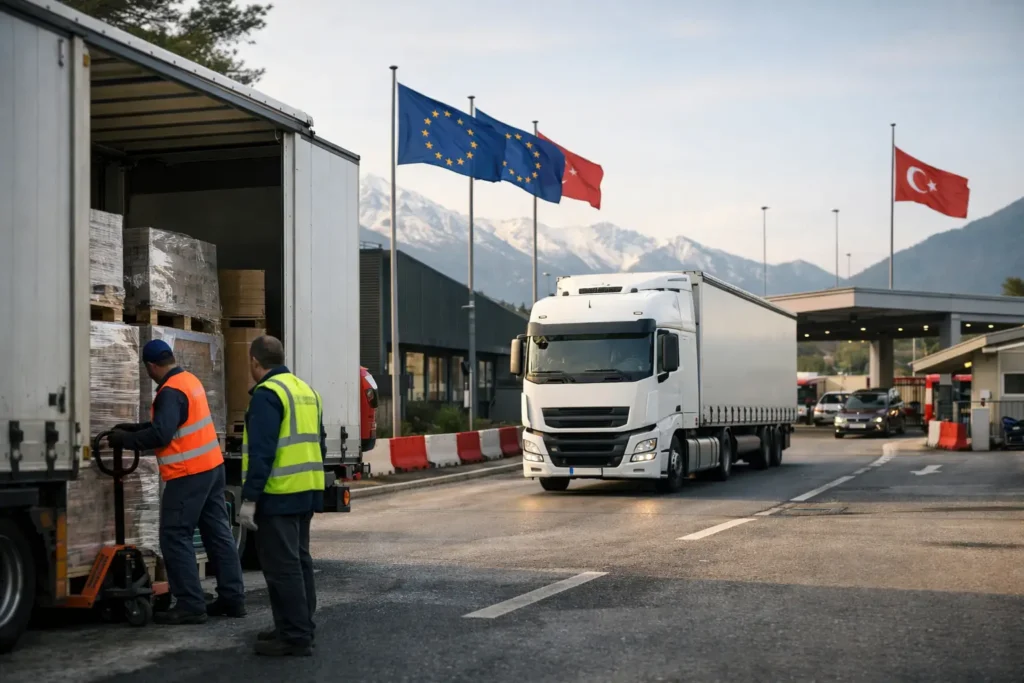
When a production line is waiting on parts or a customer has fixed delivery slots, “how fast can road freight reach Europe” stops being a general question and becomes a commercial one. A missed connection into Germany, a customs hold at the Swiss border, or a late ferry crossing into the UK can turn a simple shipment into lost time, added cost and a difficult internal conversation. The real answer is not a single number. It depends on origin, destination, border formalities, the type of vehicle used, and whether the load is standard, urgent or exceptional.
How fast can road freight reach Europe in practice?
For standard intra-European road freight, transit can range from under 24 hours on short cross-border lanes to several days on longer routes. A van moving urgent freight from northern France into Belgium or western Germany may deliver the same day. A full trailer from Spain to Poland will usually need several days, even with clean loading and no customs issues.
For supply chain managers, the better question is this: what is the fastest realistic transit time for your lane without creating unnecessary cost or risk? The answer depends on distance, driving regulations, border conditions and whether the shipment can move direct or needs routing through hubs, ferries or controlled crossings.
As a broad operational guide, many European lanes fall into three speed bands. Nearby cross-border flows often arrive within 24 hours. Medium-distance lanes usually take 24 to 72 hours. Long-haul European routes, especially those involving border procedures or peripheral regions such as Scandinavia, Turkey or the Caucasus, can extend beyond that.
The route matters more than the map suggests
Two shipments with the same mileage can have very different transit times. A direct movement from northern Italy to southern Germany is not the same as a load heading from Spain to the UK or from Belgium to Turkey. Geography matters, but operational friction matters more.
A road freight movement into mainland EU markets is usually quickest when it stays within Schengen-linked flows and avoids maritime crossings. Once you add a ferry leg, border inspections or customs documents, speed becomes more variable. This is why planning by country pair alone is not enough. You need to account for route design.
Take a concrete example. A pallet of urgent industrial components moving from Barcelona to Lyon can often be collected and delivered within 24 hours with a dedicated van. The same urgent shipment from Barcelona to Birmingham may require collection timing around the Channel crossing, UK border controls and local delivery slot availability. The distance difference is not the only issue. The route has more points where time can slip.
An operational insight many buyers overlook is that peripheral destinations often need earlier cut-off decisions, not just faster vehicles. If your consignee is in Norway, Sweden, Turkey or Switzerland, the shipment may need tailored planning from the first call, especially if paperwork or timed crossings are involved.
Customs can decide whether freight arrives in hours or days
If the route touches the UK, Switzerland, Turkey or markets beyond the EU such as Azerbaijan or Kazakhstan, customs becomes one of the main variables in delivery speed. This is where a realistic transit promise matters more than an optimistic one.
According to the European Commission, customs formalities remain a key control point in cross-border freight flows, particularly where safety, origin or regulatory checks apply. Even when documents are prepared correctly, queues and inspection intensity can vary by border and by day. That is why transit estimates on customs-sensitive routes should always include a margin.
For example, shipping standard goods from France to Switzerland may look straightforward on paper, but invoice detail, commodity codes and accompanying documents still need to be right. If one field is inconsistent, the vehicle may be stopped for clarification. The same applies on UK routes after Brexit, where customs entries and supporting commercial documents directly affect lead time.
On Turkey lanes, transit speed depends heavily on the border situation, document quality and the nature of the goods. Urgent freight can still move quickly, but only if the shipment is prepared operationally, not just commercially. This is one reason experienced shippers often prefer to involve their transport partner before the goods are loaded, rather than after.
Vehicle choice changes the answer
If you ask how fast road freight can reach Europe, the honest answer also depends on what is carrying it. A dedicated van for time-critical freight and a standard full load are not competing solutions. They are different tools for different priorities.
A smaller dedicated vehicle can often shave significant time off an urgent movement because it runs direct, avoids consolidation delays and is easier to position quickly. This is often the right choice for high-value parts, production-critical components or late orders where every hour counts. It costs more per unit than standard freight, but can protect much larger downstream costs.
A standard articulated lorry is usually the right fit for planned shipments where cost efficiency matters more than same-day speed. For oversized or non-standard freight, speed is further shaped by permits, route checks and escort requirements. In these cases, promising unrealistic lead times is a mistake. The priority should be secure, compliant movement with clear milestones.
This is where tailored service design matters. One-size-fits-all transport planning often creates delays because the vehicle is chosen for convenience rather than the shipment’s actual requirement.
What typically speeds delivery up – and what slows it down
Transit time is rarely won or lost on the road alone. In many cases, the biggest delay happens before departure or at handover points.
Delivery usually moves faster when booking is confirmed early, loading times are realistic, documents are complete, and the vehicle is matched to the shipment from the outset. Direct delivery also helps. Every extra stop, transfer or waiting window increases exposure to delay.
What slows it down is equally predictable. Late loading readiness, incomplete customs paperwork, restricted delivery hours, seasonal congestion, weekend driving bans and poor consignee communication all reduce speed. On some European routes, a shipment can leave on time and still lose half a day because the unloading slot was not aligned in advance.
There is also a legal framework behind transit. Professional drivers must comply with EU driving and rest time rules, which means not every “urgent” request can be solved by pushing the same vehicle harder. The International Road Transport Union has repeatedly highlighted that realistic planning and compliance go together. Fast transport only works when the plan is executable.
One useful benchmark: Eurostat data consistently shows road freight remains the dominant inland mode for goods transport in Europe. That makes it the fastest practical option for many cross-border industrial flows, but also means it is exposed to network-wide congestion and regulation. Speed is possible, but not automatic.
How to estimate lead time more accurately
For logistics teams, better forecasting starts with better inputs. Asking for a transit estimate without full shipment details often produces a range that is too broad to guide a decision.
The most reliable way to estimate how fast road freight can reach Europe is to define five basics clearly: origin, destination, cargo type, weight and dimensions, and the required delivery window. Then add the route conditions that often cause problems, such as customs formalities, fixed unloading appointments or special handling.
If the movement is urgent, say so from the start. A same-day collection with a dedicated vehicle may be possible, but only if the transport planner can build around the real urgency rather than a standard booking pattern. If the goods are oversized or difficult to secure, that also needs to be declared early because permits and equipment planning affect transit from day one.
For buyers managing regular flows, it is worth separating standard lead times from emergency lead times in your transport plan. That simple distinction often improves both cost control and service performance. Planned traffic can move on the most efficient model, while urgent freight has a clear escalation path when the business needs delivery in a few hours or under 24 hours.
Speed is valuable when it is credible
Fast road freight is not just about distance covered in a day. It is about whether the shipment arrives when promised, with the right documents, on the right vehicle, and without avoidable border friction. For some European lanes that means next-day delivery. For others, especially the UK, Switzerland, Turkey or more complex eastern corridors, speed depends on planning discipline as much as transport capacity.
That is where an experienced road freight partner makes a practical difference. Since 1985, MAP Transport has supported businesses moving standard, urgent and exceptional shipments across Europe and beyond with route-specific planning and close operational follow-up. Need support on your transport flows? Contact our team for a tailored solution.
Have a question or need a quote? Contact us at (+34) 943 62 95 77 (ask for Raquel) or by email at lo*******@**********rt.com