
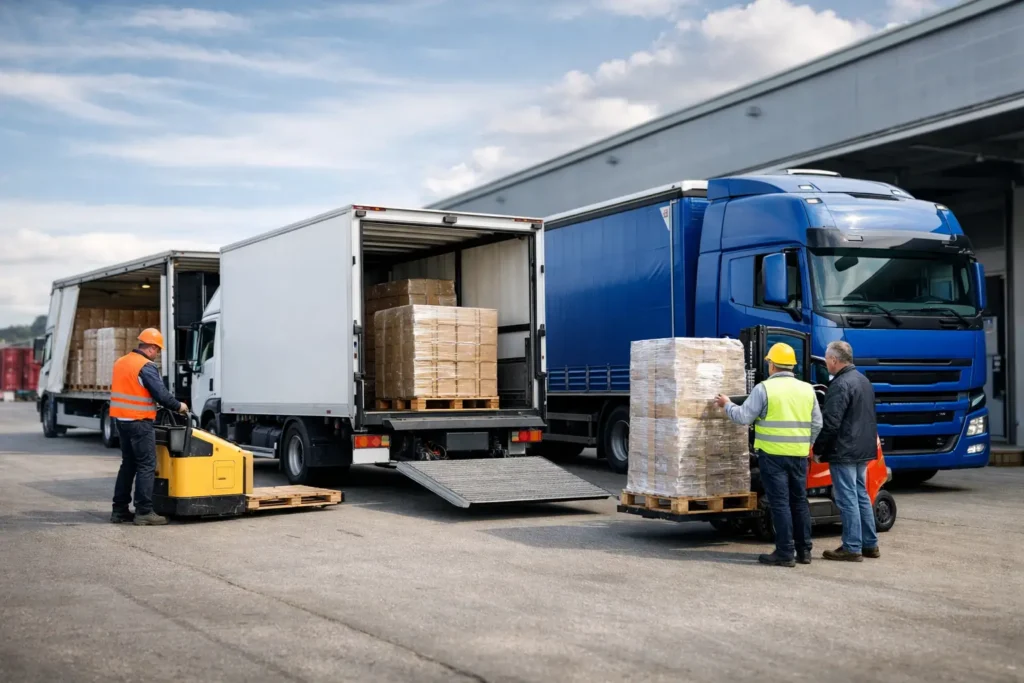
A pallet shipment rarely goes wrong because the goods were ready late. More often, the issue starts earlier – the wrong vehicle is booked, capacity is misjudged, access is tighter than expected, or a border route adds avoidable delay. That is why vehicle selection for pallet transport matters far beyond simple load space. For supply chain managers moving freight across Europe, the right choice affects cost per pallet, transit time, customs handling, damage risk and delivery reliability. If the route includes the UK, Switzerland or Turkey, those decisions become even more sensitive because a poor vehicle match can quickly turn into a missed slot, extra handling or an expensive replan.
Why vehicle selection for pallet transport is a planning decision
Choosing a vehicle for pallets is not an administrative detail. It is part of transport design. A full trailer may look economical on paper, but if the consignment only fills part of the deck, or delivery access is restricted, that choice can add unnecessary cost and complexity. The reverse is also true. Booking a small vehicle for a shipment with strict loading times, long transit distance or high-volume pallet count can create capacity pressure and increase the chance of transhipment.
In road freight, one operational mismatch often triggers another. If pallets are loaded too tightly, unloading takes longer. If the vehicle is too large for the delivery point, a second vehicle may be needed. If the shipment is urgent, every additional handover increases risk. According to the International Road Transport Union, road freight carries the majority of inland freight movements in Europe, which means performance depends heavily on day-to-day execution rather than theory. Vehicle selection sits at the centre of that execution.
The key factors behind the right vehicle choice
The first question is not vehicle type. It is shipment profile. Pallet count matters, but so do stackability, pallet height, total weight, loading method and delivery constraints. Two shipments with the same number of pallets can require different solutions if one is lightweight consumer goods and the other is dense industrial material.
Route profile matters just as much. A standard movement from northern France to Belgium is not planned the same way as a shipment from Spain to the UK or from Germany to Turkey. Cross-border pallet flows often involve ferry timings, customs formalities, waiting times and delivery windows that can shift the most efficient vehicle choice. On more complex routes, selecting for reliability rather than headline rate usually protects the total transport budget.
There is also the issue of urgency. If a production line is waiting, a standard groupage model may not be the right fit even for a modest pallet count. In those cases, a dedicated van or lorry can cost more upfront but reduce the much larger cost of downtime. This is where transport buyers need a clear view of total impact, not just line-haul price.
Matching pallet volumes to vehicle types
For smaller consignments, especially urgent shipments, vans are often the practical option. They work well when the pallet count is low, the goods are time-critical and direct delivery matters more than absolute unit cost. They are also useful for sites with access restrictions or urban delivery points where a larger rigid vehicle would struggle. In an express scenario, a van can remove unnecessary handling and help achieve delivery within hours rather than the next standard network cycle.
For medium pallet volumes, a rigid lorry can offer the right balance. It provides more capacity while remaining easier to position at industrial sites with limited manoeuvring space. This can be a strong option for recurring B2B flows where consignments are too large for vans but do not justify a full articulated trailer.
At the upper end, articulated lorries are typically the most efficient choice for high pallet counts, heavier loads and long-distance transport. They make commercial sense when the shipment can use the capacity properly and when loading and unloading points are equipped to handle them without delay. For full or near-full loads, they support better cost efficiency per pallet and reduce the need to split freight across multiple vehicles.
The trade-off is simple. Larger vehicles improve unit economics when well utilised, but smaller or mid-sized vehicles often improve agility. Vehicle selection for pallet transport is really about balancing those two pressures against the route, urgency and delivery conditions.
Cross-border routes change the equation
This is where many transport decisions become more operational than commercial. A pallet movement into the UK, Switzerland or Turkey is not only about space and weight. It is also about border flow, document readiness and the consequences of delay. HMRC and the European Commission both make it clear that incomplete customs information can stop freight at the border. When that happens, vehicle downtime starts costing money immediately.
A practical example: a manufacturer shipping 10 pallets of industrial components from northern Spain to Birmingham may initially consider a part-load option to save cost. But if those components are needed for a fixed production slot, and customs paperwork must be tightly controlled, a dedicated vehicle can be the safer choice. It simplifies supervision, reduces handovers and makes ETA management easier. The higher transport spend may be justified if it prevents missed unloading or line stoppage.
The same principle applies on routes into Turkey, where long-distance planning and border processes can make recovery from a delay much harder than on an intra-EU movement. Vehicle choice should therefore reflect not only the consignment itself, but how easy or difficult it is to recover if something slips.
Common mistakes that increase pallet transport costs
One frequent mistake is planning only by pallet count. That can overlook gross weight, non-stackable freight or unusual pallet dimensions, all of which directly affect capacity. Another is assuming the cheapest available vehicle will remain the cheapest after access issues, waiting time or redelivery costs are added.
There is also a tendency to separate urgent transport from standard planning, when in reality urgent requirements often emerge from weak initial vehicle matching. If a shipment misses a timed delivery because the wrong lorry was booked, the next move may require a premium service to recover the schedule.
A useful operational insight is to treat vehicle choice as part of risk control. Before confirming a booking, check five things: actual pallet footprint, whether pallets can be stacked, collection and delivery access, border or customs exposure, and the cost of failure if the shipment is late. That review usually reveals whether a standard vehicle is enough or whether a more tailored solution is worth the spend.
How to make better vehicle decisions on recurring pallet flows
The strongest results usually come from looking at transport patterns, not one-off bookings. If you regularly move pallets between the same origins and destinations, review what actually causes disruption. Is it underused trailer space, missed booking slots, difficult final-mile access, customs delay, or the need for last-minute express cover? Once those causes are clear, vehicle planning becomes more accurate.
For example, if a business sends weekly palletised goods from Italy to Switzerland, and delays tend to happen around border formalities and strict delivery windows, the answer may not be a cheaper rate. It may be a more suitable vehicle-service match with tighter document control and direct monitoring in transit. Likewise, if urgent spare parts move from Germany to Scandinavia with little notice, a fast-response dedicated vehicle model may protect service continuity far better than trying to fit those pallets into standard planning.
This is where an experienced road freight partner adds value. The right team does not simply allocate the next available lorry. It reviews dimensions, route sensitivity, urgency and delivery conditions, then matches the shipment to the right service level – standard, express or specialist. That approach is especially useful when transport flows extend across Europe and into more demanding customs corridors.
For companies managing regular imports and exports, the goal is not to find one vehicle that works for everything. It is to build a repeatable selection logic that supports cost control without exposing the business to unnecessary delay or damage risk. With the right planning discipline, vehicle choice becomes a lever for better performance rather than a last-minute booking task.
The better question is not, “What vehicle is available?” It is, “What vehicle gives this pallet movement the best chance of arriving on time, intact and at the right total cost?” That is the level of planning that keeps transport flows stable when the route is straightforward, and even more when it is not. Need support on your transport flows? Contact our team for a tailored solution.
Have a question or need a quote? Contact us at (+34) 943 62 95 77 (ask for Raquel) or by email at lo*******@**********rt.com