
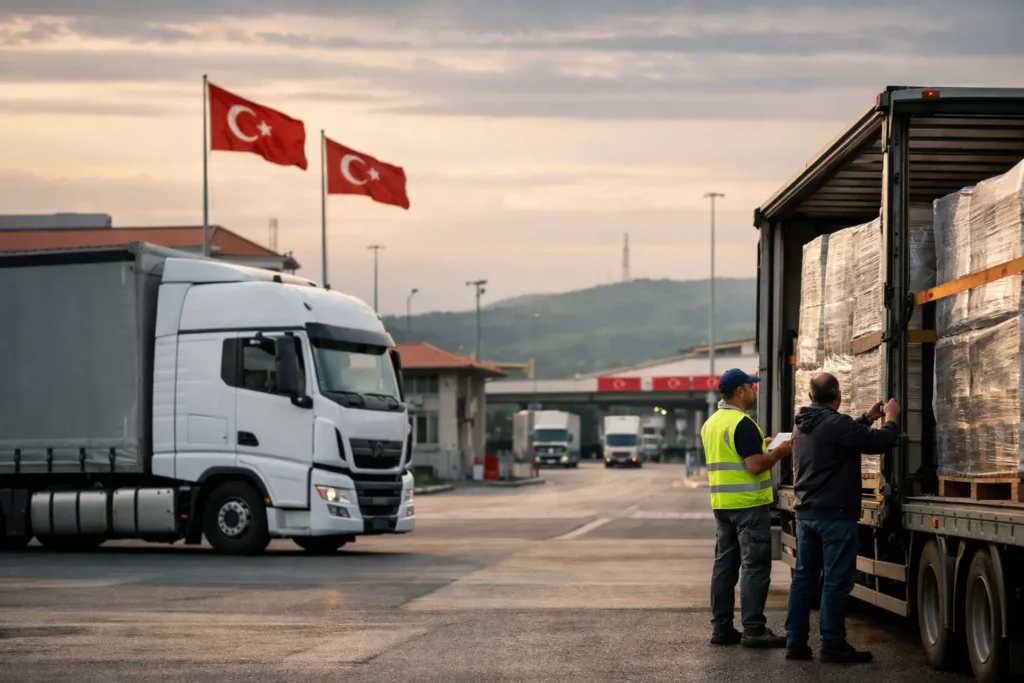
A production line can absorb many problems, but not an empty inbound slot caused by a border delay. For supply chain managers moving goods into or out of Turkey, that is the real issue. Road freight to Turkey is rarely just a mileage calculation. It involves customs formalities, transit-country coordination, equipment choice and timing that has to match factory, project or distribution schedules. When the cargo is urgent, oversized or commercially sensitive, small planning errors become expensive quickly. The good news is that with the right transport setup, this corridor can be managed with far more predictability than many shippers expect.
Why road freight to Turkey needs tighter control than a standard EU lane
Turkey is a key industrial and trading market for European manufacturers, distributors and procurement teams, but the route behaves differently from a purely intra-EU movement. The first reason is customs. Even when the cargo itself is straightforward, document accuracy matters far more because an error at the border does not usually mean a minor delay – it can mean a vehicle waiting, a delivery slot lost, and downstream costs that exceed the freight price.
The second issue is route complexity. Depending on origin, destination and transit conditions, operators may need to balance driving time, border performance and customer deadlines rather than simply selecting the shortest route. A lane from Spain or France to Istanbul does not carry the same operational profile as a shipment from Central Europe into western Turkey. Distance, border crossing patterns and consignee requirements all shape the plan.
There is also a cost-risk trade-off. The cheapest option on paper may not be the lowest landed cost once delay risk, missed unloading windows and plant disruption are factored in. That matters particularly for industrial inputs, metal products, machinery components and time-bound deliveries where a one-day delay can affect production or contractual performance.
According to the International Road Transport Union, road remains a critical mode for regional trade because of its flexibility and door-to-door capability, especially where manufacturers need direct delivery rather than terminal-based handling. On Turkey lanes, that flexibility only pays off when the transport partner actively manages the route rather than treating it as a standard groupage move.
Customs and documentation are often the real critical path
On many Turkey shipments, the lorry is not the bottleneck – the paperwork is. Commercial invoices, packing lists, commodity codes, origin details and consignee information all need to align. If they do not, the border process slows down fast. For supply chain teams, this means transport planning should begin with document readiness, not only collection dates.
A practical example: a manufacturer shipping industrial components from northern Italy to Bursa may have the goods ready on Thursday, but if invoice descriptions are too vague or package counts do not match the transport instruction, the issue will not appear at loading. It will appear at customs, where fixing it takes longer and costs more. That is why experienced operators ask detailed questions early – dimensions, gross weight, loading method, delivery constraints and exact product description are not administrative extras. They are part of transit control.
The European Commission’s customs guidance makes clear that cross-border trade efficiency depends heavily on accurate pre-declared information and compliance with documentary requirements. For shippers, the operational lesson is simple: the earlier discrepancies are identified, the lower the chance of border downtime.
There is also an urgency angle here. When a shipment has to move within hours, not days, documentation discipline becomes even more important. Express transport can save time on the road, but it cannot compensate for missing or incorrect customs data. On this route, speed and compliance have to work together.
Choosing the right vehicle for road freight to Turkey
Vehicle selection should follow cargo reality, not habit. That sounds obvious, but many avoidable issues start with using the wrong equipment for the goods, the lead time or the unloading conditions. A standard full-load movement may suit regular industrial freight, while an urgent consignment may be better served by a dedicated van or direct-run vehicle. Exceptional cargo, meanwhile, requires specialist planning from the start.
For road freight to Turkey, the choice usually comes down to three practical questions. First, how sensitive is the delivery deadline? Second, what are the dimensions and handling requirements? Third, what happens if the load is delayed by even a few hours? A procurement team moving routine stock replenishment can often optimise for cost. A plant sending a line-stop component cannot.
This is where tailored service design makes a measurable difference. A one-size-fits-all transport model tends to create either unnecessary spend or unnecessary risk. Matching the shipment to the right service level is usually the better commercial decision.
In practice, that may mean using a classic road freight setup for planned industrial deliveries, an express solution for emergency parts needed in less than 24 hours across parts of Europe before onward movement, or a specialist configuration for heavy and non-standard cargo. The key operational insight is that mode within road transport matters. Not every road shipment should be planned the same way simply because it travels by lorry.
Transit time, urgency and what “on time” really means
When shippers ask for transit time to Turkey, the useful answer is rarely a single number. It depends on origin, cargo profile, border performance, consignee location and whether the movement is standard or urgent. A realistic plan includes not only driving time but also collection coordination, customs readiness and delivery booking constraints.
That is especially relevant for companies with production-linked flows. If a consignee in Turkey accepts unloading only within a fixed slot, arriving early is not necessarily helpful, and arriving late may trigger storage, waiting time or rebooking. Reliable transport, then, is not just about moving fast. It is about matching the transport plan to the receiving operation.
A good operator will therefore set expectations based on the actual lane, not a generic average. They will also flag where flexibility exists and where it does not. For example, a shipment from Germany to western Turkey may be relatively predictable if documents are clean and loading is punctual. A multi-pick industrial load from different European origins is a different case altogether and needs tighter coordination.
For urgent movements, the conversation changes again. The priority becomes direct routing, fast response, immediate vehicle allocation and active status follow-up. If your team is dealing with a plant stop, a delayed tool, or a customer commitment that cannot move, responsiveness matters as much as the physical transport.
How to reduce delay risk before the vehicle even loads
Most Turkey-lane problems can be reduced before departure. The practical question for supply chain managers is not whether risk exists, but where control is strongest. In most cases, control is highest at quotation and booking stage.
The most effective shipment briefs include full loading and delivery addresses, available dates and times, gross weight, dimensions, stackability, commodity details and any customs-specific notes. If the goods are non-standard, oversized or particularly valuable, that should be identified immediately. Leaving those details until after the quote often results in replanning, cost changes or avoidable delays.
It also helps to align internal teams. Sales may promise a date, purchasing may issue the order, and logistics may only later receive the actual packing data. On Turkey flows, that gap creates risk. A more disciplined handover between departments usually improves transport performance more than trying to renegotiate the route after loading.
Another useful control point is communication during transit. For buyers and logistics managers, silence is rarely a sign that everything is fine. Proactive updates are more valuable than reactive explanations, especially on long international routes where customer teams need to prepare unloading, labour or onward distribution.
Companies that move regularly on this corridor tend to get better results when they work with a transport partner that can quote quickly, challenge incomplete shipment data and monitor the load from collection to delivery. That is one reason businesses with recurring Turkey flows often prefer a specialist road freight partner over ad hoc spot buying.
Road freight to Turkey works best when the service fits the shipment
The strongest Turkey transport plans are not always the most complicated. They are the ones built around the real shipment requirement – standard, urgent or exceptional – with customs, routing and communication handled as one operational process. That is where experience pays off. Since 1985, MAP Transport has supported European companies with tailored road freight planning across complex lanes, including Turkey, with close follow-up from quote to delivery.
If your flows involve recurring imports, export deadlines, emergency shipments or difficult cargo profiles, it makes sense to review the route before the next delay does it for you. Better transport decisions usually start with clearer shipment data, more realistic transit planning and a partner that treats accountability as part of the service. Need support on your transport flows? Contact our team for a tailored solution.
Have a question or need a quote? Contact us at (+34) 943 62 95 77 (ask for Raquel) or by email at lo*******@**********rt.com