
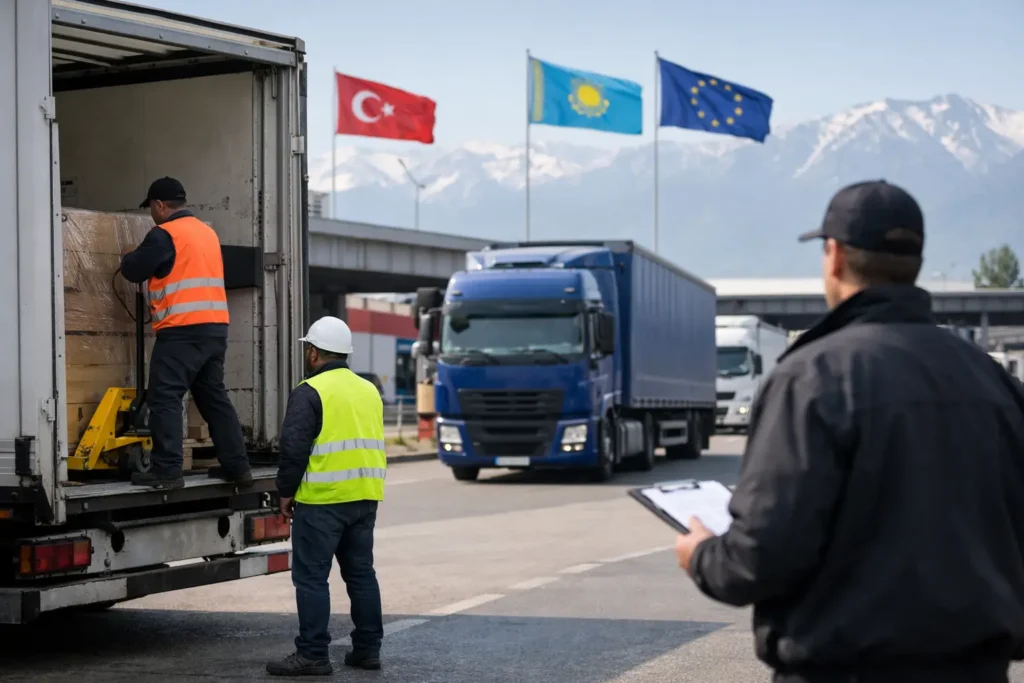
When a shipment to Kazakhstan slips by two or three days, the problem rarely starts at the delivery point. It usually starts much earlier – with the wrong route assumption, incomplete customs paperwork, poor timing at border crossings, or a vehicle choice that does not match the cargo. For supply chain managers, road freight to Kazakhstan is not just a long-haul move. It is a transport flow where delay risk, visibility and document accuracy directly affect customer commitments, production schedules and cost control.
Why road freight to Kazakhstan needs tighter planning
Kazakhstan is a strategic destination for European exporters, especially in industrial supply, machinery, metal products, automotive parts and project cargo. The country sits at the intersection of Europe and Central Asia, which creates opportunity, but also adds operational complexity. A road movement is not simply a longer version of an intra-European delivery.
The first issue is distance. Depending on origin, a shipment can involve several thousand kilometres, multiple transit countries and different border procedures. The second issue is predictability. Transit times can be affected by customs inspections, national holidays, weather conditions and queue times at key crossings. According to the International Road Transport Union, border waiting times on some Eurasian corridors can extend significantly when procedures are not harmonised or documentation is inconsistent. That matters if your consignee is planning around a fixed unloading slot or a production restart.
There is also a commercial point many teams underestimate. On these lanes, the cheapest rate can quickly become the most expensive option if it results in idle labour, line stoppages or penalty costs. For road freight to Kazakhstan, planning discipline usually saves more money than aggressive price cutting.
Route choice changes the risk profile
Not every Kazakhstan movement should follow the same corridor. The right routing depends on cargo type, urgency, customs setup, origin point and the consignee’s receiving constraints. In practice, route design is one of the biggest levers for controlling transit reliability.
A standard industrial shipment from Spain, France or Benelux may transit through Central or Eastern Europe before continuing towards Kazakhstan via established overland corridors. But route choice is not only about geography. It is also about border performance and operational resilience on a given week.
For example, if a manufacturer is sending palletised spare parts with a firm delivery window, a route with slightly higher linehaul cost but more stable border performance may be the better decision. If the cargo is oversized or heavy, the route also needs to account for permit requirements, escort rules and road restrictions. In those cases, planning cannot be left until loading day.
An operational insight that often makes a difference is matching the service level to the actual business risk. Standard transport can be entirely appropriate for planned replenishment, while urgent parts for a shutdown scenario may need a dedicated vehicle and close milestone monitoring from departure. Treating every shipment the same tends to create unnecessary spend at one end and avoidable delay at the other.
Customs is where many avoidable delays begin
For European shippers, customs preparation is one of the decisive factors in successful road freight to Kazakhstan. The physical movement may be straightforward, but if the invoice data, product descriptions or supporting documents are weak, the load can lose valuable time.
The most common mistakes are familiar: vague goods descriptions, mismatched weights, incorrect Incoterms application, and missing data needed for export and import clearance. On a long-distance route, even a minor discrepancy can trigger inspection, clarification requests or a border hold.
A concrete example: a supplier of industrial components sends a mixed load with several part references under a broad commercial description such as « metal goods ». The shipment reaches the border, but customs requests clearer classification support and item detail. The lorry is stationary, the consignee has no revised ETA, and what should have been a routine movement turns into a service failure. The transport itself was not the problem. The document quality was.
This is why experienced operators build checks upstream. Before departure, it helps to verify commercial invoice wording, packing list consistency, consignee details, customs data alignment and any destination-specific requirements tied to the cargo. If the goods are non-standard, oversized or especially time-sensitive, that pre-check becomes even more valuable.
Urgent and exceptional shipments need a different playbook
Some Kazakhstan flows cannot tolerate normal planning buffers. If the load supports a production line, a plant repair or a contractual delivery deadline, speed matters – but so does control. Expediting a long-distance road shipment without the right operating model simply moves the pressure downstream.
Urgent transport works best when there is one clear escalation path, one agreed communication rhythm and a vehicle assigned to the shipment profile. A dedicated van or lorry can reduce handling points and improve ETA stability, especially for high-priority cargo moving from a European manufacturing site to a consignee that needs a precise arrival window.
Exceptional cargo adds another layer. Oversized equipment, heavy industrial components or awkward freight shapes often require route surveys, permit coordination and timing around border and road restrictions. In those cases, the transport plan has to be built around the load, not the other way round. This is where tailored service becomes commercially useful rather than simply operationally nice to have.
One useful benchmark: for long and complex overland routes, proactive updates are not a luxury. They are part of risk management. If your internal team learns about a delay after the planned unloading slot has passed, the information has little value. Good transport management means being informed early enough to adjust labour, production or customer communication.
What supply chain teams should confirm before booking
A strong Kazakhstan movement usually starts with better booking information. The more precise the brief, the easier it is to select the right vehicle, route and customs approach from the outset. This is especially relevant for companies trying to control spend without increasing delivery risk.
At quotation stage, four details tend to shape the plan more than anything else: exact loading and delivery points, cargo dimensions and weight, whether the goods are stackable or non-standard, and the true delivery priority. A shipment that is described as standard can quickly become an operational problem if it later turns out to include overlength pieces, urgent delivery conditions or site-specific unloading constraints.
It also helps to be honest about flexibility. If your consignee can receive within a two-day window, that opens different routing options than a fixed appointment with penalties attached. If customs support is already arranged at destination, the transport plan can be built accordingly. If not, that should be identified before wheels are on the road.
From a procurement perspective, this is where tailored road freight management creates value. A one-size-fits-all quote may look efficient, but on Kazakhstan lanes it often hides assumptions that later become delays, extra costs or internal firefighting.
Choosing a freight partner for Kazakhstan lanes
The right partner for road freight to Kazakhstan is not just a carrier with geographic coverage. You need a team that can manage cross-border coordination, handle exceptions calmly and communicate clearly when conditions change. That matters more on complex routes than polished sales language ever will.
Look for evidence of operational fit. Can they manage both routine and urgent shipments? Do they adapt vehicle choice to the load, or force cargo into a standard setup? Can they support oversized or unusual freight if your profile changes? And, just as important, will they keep your team informed at the moments that actually matter?
For many European shippers, the practical requirement is simple: fewer surprises. That means realistic transit planning, disciplined document checks, fast escalation when an issue appears, and communication that helps operations teams make decisions rather than chase updates.
With 40 years of experience and regular management of complex European road flows, MAP Transport approaches Kazakhstan movements with that same logic – route discipline, tailored service and close follow-up from quotation to delivery. On this lane, reliability is rarely accidental. It is built into the plan from the start.
Road freight to Kazakhstan rewards preparation more than optimism. If your flows are growing, becoming more urgent or involving non-standard cargo, it is worth tightening the process before the next shipment puts pressure on your team.
Need support on your transport flows? Contact our team for a tailored solution.
Have a question or need a quote? Contact us at (+34) 943 62 95 77 (ask for Raquel) or by email at lo*******@**********rt.com