
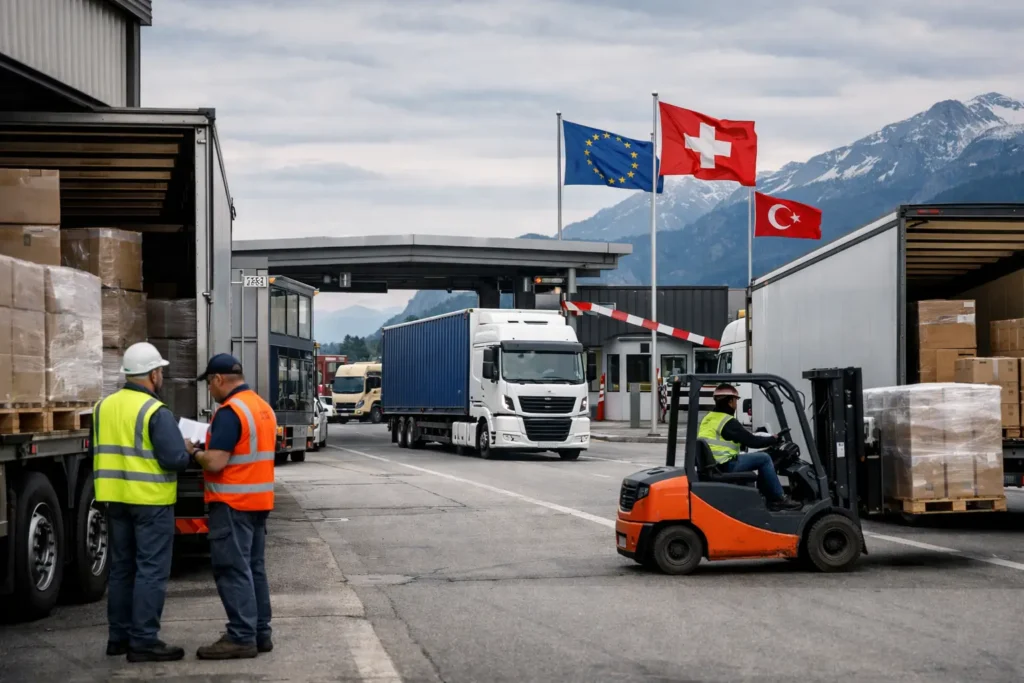
A late customs release at Dover, a missed unloading slot in Switzerland, or a last-minute line stoppage in northern Italy can turn a normal road shipment into an expensive problem within hours. That is why cross-border logistics trends matter to supply chain managers far beyond market commentary. They affect lead times, transport cost, customer service and risk exposure on every lane. For companies moving goods across Europe, the real question is not which trend sounds interesting. It is which changes are already affecting planning, documentation, carrier choice and the speed at which you can recover when a shipment goes off plan.
1. Customs complexity is no longer limited to exceptional cases
One of the clearest cross-border logistics trends is the return of customs as a daily operational factor. Movements involving the UK, Switzerland and Turkey now demand tighter document control, better sequencing and faster issue resolution than many shippers needed a few years ago.
The impact is practical rather than theoretical. A shipment can be physically ready, the vehicle can be on site, and the delivery window can still be missed because a commodity code is wrong, the invoice wording is incomplete, or clearance timing does not match the transport plan. According to European Commission customs data, the EU handles millions of customs declarations every day, which shows the scale of administrative pressure on cross-border freight flows. See the European Commission customs overview: https://taxation-customs.ec.europa.eu/customs-4_en
For supply chain teams, this means transport planning and document planning have to work together. If you ship industrial components from Spain to the UK, for example, the road leg itself may be straightforward. The real risk sits in export declarations, transit procedures, import clearance and the timing of release at the border. On paper, a two-day movement can still be a two-day movement. In practice, it depends on whether every party is aligned before departure.
An operational insight here is simple: the best carrier is often the one that spots document gaps before loading, not the one that only offers the lowest rate.
2. Urgent transport is moving from exception to planning requirement
Many manufacturers used to separate routine freight from emergency freight quite clearly. That line is getting thinner. Shorter production buffers, tighter delivery commitments and more volatile inbound flows mean urgent transport is becoming part of standard transport strategy.
This is especially visible on cross-border lanes where one disruption multiplies quickly. A delayed component from France to Germany may trigger premium handling at the plant, rebooking at the receiver and expedited outbound transport later in the week. In sectors such as automotive, metal processing and industrial supply, the cost of a stopped line can exceed the transport cost by a large margin.
That is why one of the most relevant cross-border logistics trends is the rise of dedicated express movements. Not every shipment needs a van direct service or delivery within hours, but more shippers need that option available without rebuilding the whole transport plan from scratch.
The International Road Transport Union has repeatedly highlighted how road freight remains the dominant mode for inland freight distribution in Europe because of its flexibility and responsiveness under time pressure. See IRU market intelligence: https://www.iru.org/resources
A concrete example: a Turkish supplier shipping a replacement industrial part to a customer in Belgium may face customs formalities, ferry timing, driver hour constraints and strict plant delivery slots. In that case, speed alone is not enough. The job requires the right vehicle, proactive customs coordination and live follow-up from pickup to final delivery.
3. Visibility is becoming a service expectation, not a premium extra
Buyers are less patient with vague updates, especially when the shipment is moving across several jurisdictions. “In transit” is no longer useful when a consignee is asking whether unloading will happen at 09:00 or 15:00.
This is one of the cross-border logistics trends with the most direct effect on customer relationships. Better visibility helps logistics managers make decisions early. If a border queue, weather issue or customs hold is likely to push delivery back, production, labour and receiving teams can adjust before the disruption spreads.
The trade-off is that visibility only has value when the data is accurate and someone acts on it. Automated tracking tools can show where a vehicle is, but they do not solve a customs discrepancy or renegotiate a missed delivery slot. For complex routes, human follow-up still matters.
That is why experienced shippers increasingly ask not just for tracking, but for accountable communication. They want to be informed at any time of the progress, and they want someone to take ownership if the movement starts slipping.
4. Route resilience matters more than pure transit time
Fast on paper does not always mean dependable in operation. Another major trend is the shift from shortest-route thinking to resilience-based route planning.
Across Europe, road freight is dealing with recurring pressure points: border checks, ferry dependency, seasonal weather in Scandinavia, driver availability, weekend restrictions and congestion around key industrial corridors. Reuters has regularly reported on how disruption at European borders and major transport arteries can quickly ripple through supply chains. See Reuters transport coverage: https://www.reuters.com
For a logistics manager, the question becomes more nuanced. Is the cheapest lane still the best choice if it repeatedly creates uncertainty at border crossings? Is a slightly higher transport cost acceptable if it reduces missed delivery windows and emergency spend later?
This is particularly relevant for Switzerland, the UK and Turkey, where customs and regulatory timing can outweigh pure mileage. A route that looks efficient in a TMS may be less reliable in real conditions than an alternative with better clearance timing or fewer operational handovers.
The practical recommendation is to review lane performance by exception rate, not just by average transit time. A route that arrives in 48 hours most of the time but fails badly on critical loads can be more expensive than a steadier 60-hour solution.
5. Vehicle choice is becoming more tailored by shipment profile
A broad market trend in road freight is the move away from one-size-fits-all transport buying. More companies now recognise that shipment urgency, dimensions, risk profile and unloading conditions should shape vehicle selection from the start.
That matters in cross-border operations because the wrong vehicle choice creates avoidable friction. A standard groupage approach may work for regular pallets, but it is often the wrong answer for a high-value urgent consignment, a sensitive industrial part, or an oversized load moving through multiple countries.
In practice, supply chain teams are looking for three things:
- standard road freight that stays cost-efficient for planned flows
- direct express options for time-critical movements
- specialist handling for heavy, oversized or non-standard shipments
The operational gain is not only speed. It is fit. If a shipment to Kazakhstan via European road corridors requires unusual dimensions, permit coordination and close transit monitoring, treating it like ordinary freight creates unnecessary risk from day one.
6. Compliance pressure is raising the value of specialist coordination
Transport buyers are under pressure to reduce delays, but also to reduce exposure. That includes customs errors, confidentiality concerns, handling mistakes and weak communication across languages and jurisdictions.
This is why specialist coordination is becoming more valuable as freight flows grow more complex. A multilingual operations team can often solve issues faster simply because it can speak directly with consignors, drivers, agents and consignees without creating another layer of interpretation.
There is also a growing compliance angle. Whether the load involves industrial materials, regulated residues or non-standard documentation requirements, transport execution now demands more operational discipline than a basic collection-and-delivery model.
For experienced shippers, this changes procurement criteria. Rate still matters, but so do response time, escalation speed and confidence that the carrier can manage the full movement from quote to delivery. A quote within 48 hours is useful. A partner who can also identify likely border or documentation risks before the lorry departs is more valuable.
Turning cross-border logistics trends into better decisions
The main lesson is not that every trend requires a new transport strategy. It is that cross-border road freight is getting less forgiving. Customs accuracy, route resilience, urgent capacity and communication quality now have a direct effect on cost and delivery performance.
For logistics managers, the strongest response is usually practical rather than dramatic. Review the lanes where delays create the highest commercial impact. Separate shipments that truly need express handling from those that need stable planning. Check whether your current transport setup is built around the shipment, or whether the shipment is being forced into the wrong service model.
Companies that move goods across Europe, the UK, Switzerland or Turkey do not need more theory. They need a partner that can adapt vehicle type, manage complexity and keep control when the movement becomes time-critical or document-sensitive. That is where an experienced road freight specialist can make the difference between a manageable exception and a costly failure.
Need support on your transport flows? Contact our team for a tailored solution.
Have a question or need a quote? Contact us at (+34) 943 62 95 77 (ask for Raquel) or by email at lo*******@**********rt.com